Investment Strategies

OFF MARKET MULTIFAMILY DEALS CREATE PROFITS

MV

Off Market deals solve a lot of problems for Portland, OR multifamily investors. Many Rose City Commercial Real Estate (RCCRE) customers have confided that they would love to sell their current assets. Fear of not being able to find a second leg property for their 1031 Exchange keeps them from making a move.  RCCRE has a group that focuses resources solely on multifamily assets that are not publicly marketed.

JUNE OFF MARKET SUCCESS

Our June success story success was finding an off market 57 unit property in great condition. And plenty of upside. Our client was  an institutional investor in a tight spot. They had closed on the first leg of their 1031 Exchange and their 45-Day ID Period was dwindling down. They weren’t finding a good property invest their equity in. We found them an off market opportunity that had been well managed, but the Seller had directed the management company to focus on stability rather than aggressively pushing rents.  Normally you don’t see high levels of upside in a two-year-old property.  With our help the client closed on a winner with great potential…and didn’t have to settle for “whatever’s left”.

JULY OFF MARKET SUCCESS

We were asked to help a California-based institutional investor with the second leg of their 1031 Exchange.  Sure they had multiple options. But they made an offer on our off market property because the asset because of its profit potential.  They are currently under contract finishing up their Due Diligence activities on the 30+ unit property.  Its located in Vancouver, WA.

AUGUST OFF MARKET SUCCESS

In August we found another off market but available asset.  It’s a 75-unit apartment property in Washington with significant profit potential.  We’re still working on the contract, but it looks promising.  Again, we have an institutional Buyer with a 1031 exchange.  Fingers crossed but it looks good!

FUTURE OFF MARKET SUCCESSES?

  1. We have located a 28 unit property and a 31 unit property that we are researching.   The owner has indicated that they are ready to sell, but we have not established a price.  They don’t fit in with the acquisition profile for our remaining 1031 Exchange Investors. They look like they have great profit potential for someone.
  2. We located an off-market-but-available Portland area apartment complex with 45+ units. The price is $7,150,000.  It’s almost new…so it’s in great shape. I’m still looking for a Buyer!

DO YOU WANT OFF MARKET APARTMENTS?

Could having access to our multifamily deals before other investors become aware of them be an advantage for you?  Contact our team at PH: (503)577-1034, or EM: rick@rosecitycre.com.

--- END POST ---

Residential Multifamily Basics

I am currently looking for 50 unit and up properties for a 1031 investor…but I’m also researching plexes and small apartments for a California investor that wants to move his equity to an environment that is more favorable.  There are huge REIT funds now that focus on single family residences and plexes…and they are doing quite well.  The fact that they are active in Portland says volumes.  With PDX being the #1 city in the US for year over year appreciation three months in a row we can expect that to continue.

Residential Multifamily (RM) Definition:  Typically Residential Multifamily is regarded as 2-4 units, or “doors”, with 5 units and up being considered Commercial Multifamily.  Lending requirements differ greatly…so the differences are important.  Many multifamily investors start by purchasing a duplex, triplex or quad; living in one unit and renting out the balance.  I know of one very successful investor that started out with a tri-plex and now has 5,000 multifamily units to his portfolio.  Perhaps even more amazing…he sold the triplex years ago…but has yet to pay taxes on the profit due to judicious use of the Section 1031 IRS Rules.

Residential Multifamily Pluses and Minuses: One advantage of a plex investment strategy is that lower down-payments are permitted by banks…sometimes as low as 3%.  RM loans close much more quickly with fewer requirements than CM loans.  RM loans focus exclusively on the lender’s evaluation of the owner’s credit worthiness…with CR weight is also given to the quality of the investment.  It’s easier to keep a watch on your renters when they’re next door, too.  Prices per door tend to be lower than single family homes.

Their pluses are also a source of their weakness:  living next to your renters means they always know when you’re home.  From the renter’s perspective you are always available to discuss their maintenance problems and “wish list” of improvements they would like you to make (without compensation.) You are more likely to become “friends” rather than business associates.  It’s harder for most to enforce rent timeliness on friends.  Paying a Property Manager 8-10% of your gross rental income makes it very hard to have positive cash flow on small investments.

Plexes tend to produce low Cash Flow, a reason they were previously eschewed by some investors.  Cash Flow is simply the monthly amount remaining from:  (All Income) – (All Expenses, including taxes, insurance and debt service).  With fewer units to amortize expenses over, plexes had a hard time competing with the functional efficiency of commercial complexes.  As a result, the plex investor focuses primarily on returns gained over time from appreciation.  Those gains are that are reaped at resale or refinancing of the property.  Contrast this with the investor of larger investments that expects to make a higher downpayment (20 to 40%) and receive monthly distributions from profitable operations.  (In addition to appreciation.)

Valuing Residential Multifamily Assets: The local submarket  for single family residences (SFR) is the strongest fundamental in determining values of plexes.  Without adding in other factors, most potential renters will not pay more for the inconvenience of living close to neighbors than they would pay for of a SFR which would likely have more privacy. RM purchasers use the Gross Rent Multiplier (GRM) to compare properties.    GRM = Purchase Price ÷ Annualized Gross Rent. GIM, or Gross Income Multiplier is also used interchangeably.  It’s intended to reflect that rent is not the sole source of income; late payment fees, NSF charges, garage rent and other revenue sources need to be considered.  A triplex that rents for $600 per door and produces $400/year in other income that is for sale for $279,000 is available at a 12.7 GRM.  Proof:  $279,000 ÷ $22,000 = 12.7.

GRM Limitations: As it is based solely on the Gross Income, there is no accounting for vacancies, concessions or expenses.  What if their property has occupancy problems due to poor maintenance?  What if the landlord is giving a lease concession of two months free rent, thereby reducing revenues by 10/12’s or 16.7%?  What if expenses are managed poorly?  In each of these examples the value of the asset is lessened, yet the GRM would remain the same.  Use GRM only as a rule of thumb when investing in plexes to see if a more thorough investigation is warranted.  All competent investment advisors will offer a proforma including expected profits based on actual income and expense.

1% Rule: This archaic valuation factor was derived from the notion a property’s value would  equal 100 times a month’s rent.  Rent rates have not increased at the same rate as home values.  A $250,000 house would rent for $2,500/month under this scenario.  If someone cites the 1% rule they are telling you: “I don’t know what in the heck I’m talking about.”


--- END POST ---

Investors: Portland Multifamily-Even Hotter Than You Thought!

Portland-Real-Estate-Hot-Multifamily-Market
Real estate investors know that I have been touting Portland’s meteoric recovery from The Great Recession for some time.  But it may be even better than you thought in regarding investment real estate…particularly in the Multifamily Segment.  Industrial, Office, and even Retail properties are doing very well in Portland, but Multifamily is still the “Belle of the Ball”. Not only is PDX a hot multifamily market…but the fundamentals seem to support long term success as well.

#1 Spot as a Top Moving Destination

United Van Lines issued their 2015 Movers Study last week.  It showed Oregon as the Number 1 Destination State with 70% Inbound vs. 30% Outbound moves.  This was Oregon’s third straight year being Number 1…and Oregon actually increased it’s percentage lead over other states in 2015.  Bear in mind that while Oregon is cited…its the Greater Portland Area that is the primary cause.

I call it “youngification”.  Millennials are moving to Oregon in droves.  They may be the leading segment, but their not the only ones.  Oregon’s livability is a key…but there has also been significant job growth too.  Nike and Intel seem to be racing to see who can expand the fastest.  Its just about impossible to find office space of 25,000 plus in the Sunset Corridor, and downtown is even tighter.  Start-ups see Oregon as a great place to start operations…we’re one of the 3 fastest growing tech centers in the nation.  All those folks need somewhere to live.

Portland #1 for Home Price Increases

Portland has been booming.  The most recent S&P/Case-Shiller Home Price Indices show Portland, Dallas, and San Francisco with a 10.9% year-over-year increase in October, 2015 …the highest in the nation.  Portland has been near the top for awhile.  To give Portland’s numbers some contrast, our 10.9% increase is more than double the rest of the nations 5.2% increase. With so many moving to Portland there is upward pressure on housing prices that show no signs of abating.  One of the impacts of rapidly rising home prices is that the affordability level for purchasing moves up…meaning that many would be owners are forced to be renters.  This in turn pushes up rents.

New Figures Show Oregon’s Vacancy Rate Lowest in U.S.

The Associated Press reported two weeks ago that data from The U.S. Census Bureau shows that Oregon’s rental vacancy rate was the lowest in the country in at 3.6%…down from 4.4% the previous year.  Second was California at 3.9%; Massachusetts, Vermont, and Washington State were also low.

While those vacancy rates seem low…Portland’s extremely low vacancy rate, even lower than most of the state, is skewing the numbers downward.

What it Means to Investors

As recently as 3 weeks ago I was quoted 3.125% on multifamily debt.  That means even buying at a 5.0 Cap Rate you have a 175 points of favorable leverage when comparing Acquisition Cap Rate vs. Debt Cost.  While you can make pretty good returns on that basis in a flat market…a market like PDX that holds long-term promise for continued upward results explains why so many institutional players lover Portland.

I spent much of The Great Recession telling potential Buyers that unless they were buying for all cash from a highly distressed Seller they should stay out of the market.  I could have used those commissions, to tell you the truth.  For the last couple of years I have been a big proponent of multifamily, particularly in Portland.

Outlook

While it won’t go on like this forever…growth will slow down before it stops.  I continue to see signs of of the local market in Expansion Phase.  I see the influx of population and jobs continuing for some time.  Higher single family home prices will create a condo friendly environment as well as higher rent rates.  My advice: continue buying if you already have a portfolio…and start buying if you don’t.

--- END POST ---

Commercial Real Estate Trends Roundup From Rose City CRE

Rick's Picks Recommended Reading

Rent forecasting for Portland multifamily investments shows promising returns for investors. Multifamily apartment rent growth has placed Portland Oregon in the third highest position in the US. We also are taking a look at value of number crunching with an article focused on rent rolls and another with a focus on books and records.

HFO’s News Blog for Multifamily Apartment Investors (MPF: Portland’s May Rent Growth Third Highest in US at 12.6%)

More good news comes from MPF research who found Portland’s rent growth at 3rd position in the US. A sign of good investment opportunity comes from a total rent growth standing at 12.6%. When comparing the numbers with other markets, look to Portland multifamily investments to add to your portfolio.

MPF reports that in Portland rents for new residents are up 17.6 percent and renewals are up 7.4 percent, the third highest in the country, putting total rent growth at 12.6 percent. – Greg Frick, HOF News Blog

HFO’s News Blog for Multifamily Apartment Investors | Apartment Building Owners

Rent Roll Analytics: Purpose of the Rent Roll

While growth is an important sign for any multifamily investor, crunching numbers will tell you an investments worth. This article from multifamily insight discusses the rent roll analytics and its purpose in determining fair rental rates. It’s also an important tool to be used when deciding on investments in multifamily units.

As they say in baseball, catch the ball, hit the ball and throw the ball. A great hitter hits the ball 30% to 40% of the time. When making decisions on placing millions of dollars of equity into millions of dollars of hard assets you must have a perfect record when validating income. Anything less is a financial disaster. – John Wilhoit, Multifamily Insight

Rent Roll Analytics: Purpose of the Rent Roll

The Importance of Due Diligence in Multifamily Profits – Phase II: Books and Records

Estimating the value of a multifamily property will help you decide on your next investment, but once that investment has been made, you’ll want to ensure it stays profitable. Keeping accurate books and records is talked about here, with examples explaining how Rick has lowered his client’s investment costs from others keeping bad records.

Books & Records evaluations tends to be low or no cost. As such I always complete them to the point at which I know it makes sense to proceed further before I do the Physical Inspection. Physical Inspections almost always cost more money. – Rick Bean, Rose City Commercial Real Estate

The Importance of Due Diligence in Multifamily Profits – Phase II: Books and Records
Portland multifamily investments show a steady increase in rent. It’s never been a better time to get in. Get a professional investment real estate broker that works out the best deal for you. Call us today at 503-577-1034.

--- END POST ---

Investors – Why Commercial Real Estate?

A friend recently asked me if I thought they should get into the stock market. I told them that the lowest point for the stock market in the last 10 years was 7,062.93 in Feb. 2009…a month after the new administration took office. Since then it has run, scrambled and raced as high as 18,312.39 set on May 19, 2015.

Tired Runner

STOCKS: Getting into the market now is a little like asking someone who has just finished a successful marathon run if this is a good time for them to enter a race. Not only do I have concerns about future yields…the stock market has lost a trillion bucks valuation in a single day. I’m just not that kind of gambler!

BONDS: The only guaranteed investment is bonds. I guarantee you will lose buying power. Hard to offset 2.8% inflation with 2.12% yields. I call them “bondies”. Bonds are a great addition to an investment portfolio…but they can’t be your whole portfolio.

RESIDENTIAL REAL ESTATE: I have a friend that has close to a dozen single family homes. He “bought well”…but not “near”. He spends a terrible amount of time running between them for management and maintenance duties.

Why I Endorse Commercial Real Estate

COMMERCIAL REAL ESTATE: Money is pouring into commercial real estate as investors perceive it to have great long term potential, having good yields as well.

--- END POST ---

Portland Multifamily Investment News Roundup From Rose City CRE

From one of the nation’s lowest vacancy rate to spiraling rents, the Portland multifamily real estate scene is in a frenzy. We’ll help keep you up-to-date on all the trends and latest information: here our multifamily experts have put together a quick read of four articles.

With the Portland multifamily market as hot as it is, the rising prices and scarce availability has given rise to more than a few “urban legends” about the reasons. This fact-filled, but still humorous, article debunks 5 of them.

“Few trends boil the blood of Portlanders like developers ripping down old homes and replacing them with monster houses. But there’s one problem with the idea that teardowns are a force in making the city more costly. The numbers show it can’t be true. In the past five years, developers tore down 929 single-family homes, according to the Portland Bureau of Planning and Sustainability. Developers then built 2,002 new housing units on those cleared lots.” – WWeek

The 5 Myths About Portland Apartments
Long used to a steady supply of residential properties discounted due to foreclosure or other distress, investors are moving to multifamily investments as the supply of inexpensive residential properties dries up. In just two years, the number of investors with MF in their portfolio has increased 50%.

“Investors’ search for discount-priced, distressed houses—like vacant foreclosures priced for quick sale—has become more difficult over the past two years as inventory tightens…” – Construction Dive

Investors pivot to multifamily as distressed house inventory dries up
Portland multifamily property owners and managers cannot afford to be ignorant of the laws governing their relationship with their tenants. And, these laws can change periodically, so an update is always a good idea—and much less expensive than a lawsuit.

“…managing an investment property is about much more than finding the perfect tenant for the perfect unit. It’s even more important to understand the legalities associated with running a rental business.” – BiggerPockets Blog

The Top 7 Laws Every Landlord Needs to Study

When you’re considering multifamily investments, you can’t afford to have anything less than a commercial real estate expert advocating on your behalf. Our article carefully explains why you need a broker looking after only your best interests.

“You want a Buyer’s Broker that is willing to be a strong (perhaps even aggressive), creative, superbly informed, and resourceful ADVOCATE for your side” – The Investment Insider Report  Rose City CRE

The Case For Using A Buyer Broker Specialist To Acquire Investment Real Estate: The Advocate

Not much is as hot as the Portland multifamily investment real estate market right now. Make sure a professional investment real estate broker is working on your behalf as your advocate. Call us today at 503-577-1034!

--- END POST ---

Portland is One of The Nation’s Hottest Real Estate Markets

Hottest Real Estate Martkets Portland Oregon
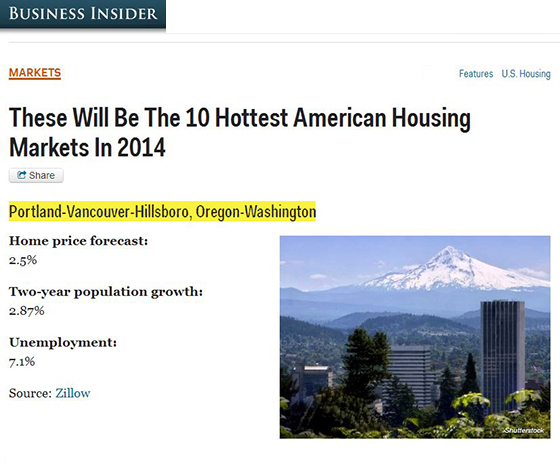
Business Insider recently compiled a list of America’s 10 hottest housing markets for 2014. Portland is one of the nation’s hottest real estate markets because of:

  • Anticipated population growth.
  • Projected strong year over year housing price increases.
  • Low unemployment rate.

We belong on the list based on the fundamentals of our local market.  By way of clarification: I believe we are in very for some very solid gains not only in 2014 but for the next few years ahead.  But I don’t think that we are going to have explosive gains expected in Seattle, San Diego, Salt Lake City, or Miami. Those cities are expected to post bigger gains…and those markets are characterized by some larger valuation swings (good and bad) than good ol’ PDX.

A Rising Tide lifts all boats

My assessment:  Currently the Single Family Residence (SFR) market is doing very well, and our Multifamily Investments in Portland are the talk of the nation.  Retail has made solid gains. The Office market is gaining momentum, particularly the Medical Office Building Sub-segment.  Industrial shows signs of rebounding in some sub-markets but I don’t think we’re seeing that across the entire PDX Metro area yet.

Some investors have asked me if I’m concerned with Portland’s current multifamily building boom.  I’ve witnessed over building before…and guess that we’ll do it again someday…but I’m not seeing it yet.  The numbers I have seen thus far don’t worry me…particularly when I consider the 43,500 new Portlanders projected to arrive in the next 2 years.  That’s around 60 new folks a day, every day.

If you want to be a Genius in 5-years…talk to me about investment real estate today! Rick M. Bean

These are good days to enhance your real estate investment portfolio! Contact Rick Bean of Rose City Commercial Real Estate for more information at 503.577.1034, or rick@rosecitycre.com.

--- END POST ---

Real Estate the Superior Investment Opportunity

thumbs-up-greenI’ll return to my series “The Case for using a Buyers Agent” shortly, but the attached article was just to good to pass up.  Hats off to author Ken Holman for his succinct statement regarding the benefits of investing in real estate that supports my mantra: real estate is the superior investment opportunity. Ken is the President of  The National Association of Real Estate Investment Advisors:

Seven Reason Real Estate is a Superior Investment | By Ken Holman

As with any investment, real estate has its advantages and disadvantages. Some naysayers would claim that real estate investing requires a substantial amount of capital. Others would argue that it is management intensive and lacks liquidity. Still, others maintain that it is too complicated. While there is some merit to these so-called disadvantages, some distinct advantages are unique to investing in real estate. Listed below are some of the advantages that make real estate a superior investment to other forms of asset accumulation.

Cash Flow

1. Real estate offers a predictable cash flow. Cash flow is the net spendable income derived from the investment after all operating expenses and mortgage payments have been made. A good real estate investment, whether it’s a residential or a commercial property should achieve a 6 to 10 percent positive cash flow. On the other hand, the average dividend for the typical stock investment averages just more than 2 percent.

Appreciation

2. Real estate consistently appreciates in value. Appreciation is the increase in value over the lifetime of a property due to inflation, supply and demand, capital improvements and other factors, such as change in use. Since 1968, appreciation levels for real estate have been 6 percent per year, including the downturn in the economy beginning in 2007, according to the National Association of Realtors (NAR). Unlike real estate, the Dow Jones Industrial Average has fluctuated wildly over certain decades, showing little progress in the overall.

Leverage

3. Real estate can be leveraged. Leverage is the use of borrowed capital to increase the potential return of an investment. In real estate transactions, leverage occurs when a mortgage is used to reduce the amount of investor capital required to purchase a property. The annual return on a $200,000 property with a $20,000 net cash flow purchased with cash is 10 percent. If 75 percent of the money required to purchase the property is borrowed, even factoring in the cost of making the mortgage payment, the annual return more than doubles to 22 percent (assuming a loan of $150,000 is amortized over 30 years at 5 percent interest). Because of its volatility, leverage an investment in stocks is difficult.

Equity Buildup

4. Real estate provides equity buildup. Most real estate is purchased with a small down payment with the balance of the money being provided through debt financing from a lender. Over time, the principal amount on the mortgage is paid down, slowly at first, and then more rapidly toward the end of the amortization period. This principal reduction builds equity.

Tax Sheltering/Avoidance

5. Real estate offers numerous tax advantages. The three most prominent tax advantages are depreciation, capital gains, and a tax-deferred exchange. Depreciation is a non-cash expense permitted by the Internal Revenue Service that reduces the amount of net income upon which taxes must be paid. For tax purposes, the IRS assumes a property depreciates in value over time. However, from an economic standpoint, the value of the property actually appreciates. The depreciation deduction allows a real estate investor to generate a positive cash flow while reporting a lower income for tax purposes. This creates a higher cash-on-cash return for the investor. When the asset is sold, after holding it for a year, the government permits the gain on the sale to be taxed at a significantly lower rate than the individual income tax rates, generally the rate is 15 or 20 percent, depending on one’s personal income tax bracket, compared to a rate as high as 39.6 percent. A 1031 Tax-Deferred allows the payment of taxes to be deferred on the sale of a property. The IRS permits the gain on the sale of the real estate to be transferred from the property being sold to a new property being purchased, hence deferring the payment of any tax on the sale of the property.

Intangible Benefits

6. Real estate offers other intangible benefits. The person owning the real estate has control over the asset. If inflation occurs, rents can be adjusted accordingly. If the market takes a downturn, rates can be adjusted to coincide with the economic conditions for the area. Real estate can be improved, which enables the asset to increase in value. Unlike the stock market, which occasionally has a company take out bankruptcy and eliminating the owner’s equity, real estate has intrinsic value. Its value never goes to zero.

Retirement Vehicle

7. Real estate coincides with retirement. When real estate is purchased, the cash flow is lower and the principal reduction on the mortgage is less. Over time, the mortgage is paid down or in some cases, completely paid off, and the cash flow increases. The income from real estate kicks in about the time a person is ready to retire. In some ways, it’s a forced savings program. Just as an investor is ready to retire, the passive income from real estate begins to supplant their earned income. As they age, their real estate holdings continue to appreciate in value and produce passive income to offset the effects of inflation. Real estate seldom diminishes in value, so it can be passed on to the next generation. Stocks, on the other hand, must be liquidated during retirement to provide sufficient income on which to live. In the end, one hopes their stock portfolio outlasts their life; otherwise they’re left with nothing. With a stock portfolio, little is left at the end of one’s life to pass on to the next generation.

Summary

As Ken McElroy, author of The Advanced Guide to Real Estate Investing, stated, “Real estate is the ultimate investment. Nothing else provides the same kind of dollar-for-dollar returns and has the same kinds of advantages. If I had a choice to invest $1 million in real estate or $1 million in … stock, I would choose real estate hands down. The reason is simple; even if the real estate investment appreciated at half the rate as the stock, I would still come out way ahead when taking into account leverage, tax advantages, and cash flow.” As an avid real estate investor for more than 30 years, I have learned ways to mitigate any disadvantages to investing in real estate. I have never found a better investment with more advantages. Real estate, and only real estate, provides a unique set of advantages that make it a superior investment over any other investment I’ve found.

About The Author

Kenneth T. Holman is president of Overland Group, RE/MAX Overland, and the National Association of Real Estate Investment Advisors. For more than 30 years, Mr. Holman has had extensive experience in the real estate industry, primarily in the areas of single family and multifamily residential, lodging, industrial, office, and free-standing retail. He is a licensed real estate broker, general contractor, mortgage loan originator, and teacher. Find our more about Mr. Holman at www.NAREIAGroup.org. He can be reached at KHolman@NAREIAGroup.org or 801.931.5571

--- END POST ---

Commercial Real Estate Investment Trends: Our Must Read Picks

Rick's Picks Recommended ReadingIf you’re interested in the latest commercial real estate investment trends, you’ve come to the right place. From the latest commercial market report to investments in “micro” apartments, it’s all here.

PSU Releases Quarterly Commercial Real Estate Report

One of the rosiest commercial real estate investment trends is the popularity of rentals and the outlook for that to continue.

“The report [says] that high demand for rentals is expected to persist over the next several years.”

HFO Investment Real Estate- PSU Releases Quarterly Commercial Real Estate Report

Title Billions Of Commercial Loans Are Ballooning In 2013

Sounds ominous but this is actually a great opportunity for savvy commercial real estate investors.

“In 2013, apartment buildings are probably the most popular type of property to fund in many regions due to decreasing vacancy rates, increasing rents, and incredibly low mortgage rates for apartments which may significantly increase the owner’s net monthly cash flow.”

REIClub.com – Title Billions Of Commercial Loans Are Ballooning In 2013

Portland Multifamily Profits To Lead The Nation

High on the list of the latest commercial real estate investment trends is the emergence of ‘tier 2’ markets like Portland, Raleigh, NC, and Austin

“Basic math is the reason for Portland’s high multifamily profits.”

The Investment Insider Report | Rose City Commercial Real Estate – Portland Multifamily Profits To Lead The Nation

Investors Bet Tiny Micro Apts. Can Yield Outsized Returns

Despite their small size, micro apartments stand out as one of biggest commercial real estate investment trends.

“…studio micro apartment units are getting a long look from developers and investors hoping to maximize returns in several of the nation’s most heated multifamily markets.””

CoStar Group – Investors Bet Tiny Micro Apts. Can Yield Outsized Returns

High Construction Costs Bring New Opportunity for Developers

More good news for followers of commercial investment real estate trends: high rise multifamily housing has the attention of lots of developers.

“The lack of new supply during the recession, coupled with a tremendous amount of pent-up demand, has led to an environment where developers are trying to play catch-up, to make up for lost time”

Multifamily Executive | Construction Trends – High Construction Costs Bring New Opportunity for Developers

Smart investors stay on top of commercial real estate investment trends. Smarter investors count on the experts at Rose City Commercial Real Estate for the professional advice they need. Call 503.577.1035 today to get started.

--- END POST ---

National Trends: The Case for Sustained Multifamily Investment Profits

Good Real Estate Investment News

Kent Hoover, The Business Journal‘s Washington Bureau Chief recently made the case for a sustained improvement in multifamily investment profitability.  Maybe that wasn’t his intent, but that’s what the trends he cites will create.  In his most recent article Hoover quotes data from The National Home Builder’s Association Economist David Crow and Wells Fargo’s Housing Opportunity Index.

In a nutshell, the uninterrupted string of successive increases in year over year (YOY) median sales prices for Single Family Detached homes (SFDs) is pricing some potential homeowners out of the market.  Combined with rising interest rates, fewer and fewer families can afford their own home.  In the past this has spurred rental rates skyward as their is less competition from home ownership to keep them in check.  The wave that follows rapidly rising rents?  Condos (and condo conversions of existing apartments) will come back in style.  Deja Vu!

I spend a lot of time researching business trends and find The Business Journals to be valuable sources of information. Below are key excerpts from Mr. Hoover’s article:

There’s a down side to the housing market’s recovery: More people now can’t afford to buy a house.

Only 69.3 percent of new and existing homes sold in the second quarter of 2013 were affordable to households with the U.S. median income of $64,400, according to the National Association of Home Builders/Wells Fargo Housing Opportunity Index.

That’s down from 73.7 percent in the first quarter, and it’s the first time this housing affordability measure has fallen below 70 percent since late 2008.

The median price of homes sold in the second quarter was $202,000, compared with $185,000 for the same period a year ago, according to NAHB.

“Home values are strengthening at the same time that the cost of building homes is rising due to tightened supplies of building materials, developable lots and labor,” said NAHB Chairman Rick Judson, a home builder from Charlotte, N.C.

“Together with rising mortgage rates, this contributed to affordability slipping to the lowest level in more than four years,” said NAHB Chief Economist David Crowe.

This problem could get worse, Crowe hinted, if Congress limits the mortgage interest deduction as part of tax reform and ends federal support for the secondary mortgage market, “both of which play enormous roles in keeping home ownership affordable.”

While multifamily investment may be the belle of the ball lately, a number of investors are switching their equities into an ever broadening group of real estate asset types. Whether you are entering the market for the first time or desire to add to an expansive portfolio, let Rose City Commercial Real Estate assist you. For more information, contact Rick Bean at: 503.577.1034 or rick@rosecitycre.com.

--- END POST ---

Scroll to Top