Investment Strategies

Portland Multifamily Update from Rose City Commercial Real Estate

In order to put our local multifamily market in perspective I performed my own analysis of the data.  The headlines about big REIT players and  Class A assets?  Absolutely true.  But under reported is the way that all segments of the multifamily market have picked up.  The average age of multifamily investment closed in the last 12 months?  36+ years!  That suggests that repositioning opportunities and value add plays are as important as the flagship pride of ownership assets.

Apartment investments continue to be the preferred commercial real estate niche both locally and nationally.  CoStar reports  multi family volume jumped 80% in the second quarter over

For additional information on my study, contact me at 503.577.1034 or email me: rick@rosecitycre.com.

the same period last year.  Nationally almost $15 billion in  sales closed in the second quarter this year along with $9.5 billion in the first quarter for a $24.5 billion start to the year.  While that is less than the peak market, (mid 2007) it is still quite robust.  REITs are a major factor in this story…but acquisistions are also being made by individual portfolio owners large and small.  Nationally the average cost per unit is up to $88,500.  There’s been lots of press about all the deals in Phoenix ($1.3 B first half  2011) but during that same time period San Francisco ($2.1 B); Los Angeles ($2.3 B) and Washington DC ($2.6B) have actually had higher sales. It should be noted that the price per door in Phoenix is much lower.

So how is Portland doing?  Well…sales have been robust here…REITs have actually been net sellers…although all that I have talked to are still in buy mode.  I ran a list of all activity of $1 million and up  multifamily sales in a 25 mile diameter area roughly equal to the Greater Portland Metropolitan for the last calendar year.  Here are some of the highs and lows:

  • Total number of multifamily sales in excess of $1 million: 94. Greater than $5 million: 20;  Greater than $10 million: 12; Greater than $20 million: 7; Greater than $30 million: 3.
  • Highest sale price:  $36,875,000 for Kearney Plaza in NW Portland.
  • Busiest area: East side of town.  Only two of the 7 largest assets sold were on the West side of town (Kearney Plaza and Park 19). The remaining 5 were on the East side (Russellville Commons, Orchard Pointe, 2121 Belmont, and Kemton Downs).
  • Lowest Cap Rate (Actual): 2121 Belmont at 4.4% (Kearney Plaza was second lowest at 4.75%
  • Highest Cap Rate (Actual):  Heather Glenn 10% .  Honorable mentions: Burnside Station 9.32% and Pioneer Plaza Manor: 9.99%
  • Average Cap Rate:  6.91
  • Average per unit: $82,650
  • Newest 1 year old
  • Oldest: 108 yrs old
  • Average age of property sold: 36 years

Other articles you may like:


The Importance of Due Diligence in Multifamily Profits – Phase II – Books and Records | Rose City Commercial Real Estate

Demystifying multifamily cap rates, NOI, and investing basics | Rose City Commercial Real Estate

Multifamily real estate investment basics – part 1 of a series | Rose City Commercial Real Estate

Attractive cap rates attract investors to multifamily properties in Portland | Rose City Commercial Real Estate

Prospects for multifamily sector improve greatly | Rose City Commercial Real Estate


--- END POST ---

A Conservative Strategy For Investment Opportunities, part 2


To be a genius in 5 years make smart multifamily real estate investments today. To minimize risk, consider only conservative investment opportunities:

  • Buying a multifamily investment with no debt, or very low Loan to Value debt.
  • If any debt is part of the deal make sure it is positive leverage! (Finance rate percentage is lower that Cap Rate.)
  • Buy in a city who’s in “Recovery Mode”.

Use Portland as an example of a Recovery Mode city:

  • Apartment prices per unit will be low
  • Absorption is high…no worries that rapid building will drop revenues
  • High barriers to entry (That’s PDX alright!)
  • Rents starting to rise (PDX!)
  • High occupancy rates (Portland is above 95%.)

When a conservative investor buys in the Recovery cycle they are buying in at the bottom of the market.  Buying in with little or no debt assures them that they can make much higher

I have chosen a boutique approach because I believe each investor deserves to have a strategy custom tailored for their needs.  If you would prefer individual attention rather than “shoehorning”…contact me at Rose City Commercial Real Estate: rick@rosecitycre.com or 503.577.1034.

returns than the bond market…and have their profits paid monthly from cash flow.  Because they have taken a very conservative acquisition strategy and used good timing, they are substantially sheltered from the pain of a further downturn. Even the combination of a reduction in occupancy and reduction revenues is not likely to impact them because of their superior Debt Service Coverage Ratio. Since they are buying in a Recovery market the inertia is for increased revenues and profits.

At the end of the year they will shelter their taxes with depreciation.  When they go to sell…their gains can be rolled over using a 1031 Exchange.  I know of an investor with several thousand multifamily units  that started out with a triplex in Eugene.  He made a nice return on the plex…but 36 years later the taxes still are deferred.  Now that’s a good deal…but I digress.

The Ultraconservative Approach: How to Invest

A truly conservative approach to multifamily investing would be an all cash purchase.  Let’s say you bought a 15 unit property that the listing agent said was a steal at a 7.5 Cap and $1,000,000.  For the right seller we might be able to offer $850,00 cash, conditioned only on books and records and physical inspection contingencies.  A 30 day close  has great value…particularly if the Seller is motivated.

Remember…this isn’t a sexy deal…as a conservative investor you’re more focused on:

  • Avoidance of equity loss.
  • Stability
  • Cash flow.
  • Preferential tax treatment on profits.

To achieve these you’re willing to give up some long term appreciation. (After all: you had your money in a bond that guaranteed a loss of buying power.)

The Cap rate is the ratio of the first year operational revenues- operational expenses compared to the sale price.  This allows us to see what kind of revenue generating machine we’re looking at without clouding the picture with capital expenses and financing costs.  In our example, after paying all of the operational expenses $75,000 (7.50% of the offering price, or 8.82% of the price paid) is left for profit, capital expenses and loan payments. We call this NOI or Net Operating Income.

Since we paid cash there is no loan to deal with.  The listing agent didn’t mention a capital reserve in his proforma…or he might have put in $150/unit per year in.  We don’t believe him.  As conservative investors we will set aside $350 per unit for a replacement reserve.  We will also pre-fund at closing an operating reserve to the tune of $10,000 and a replacement reserve at $15,000.  This will increase the original equity requirement to almost $900,000 due to closing costs, etc.

YIELD:   Our increased reserve fund payments took care of our capital expenses, but reduced NOI by to $5,025.  That left us a $69,750 year 1 return on a $900,000 investment or 7.75%. Please note that we can take depreciation based on a 27.5 year basis…so we have tax sheltered a significant portion of our profits.   Because we bought in at the lower end of the market we can expect an increase in cash flow over the next few years.    

Are you a conservative investor? Call Rose City Commercial Real Estate today at: 503.577.1034 oe e-mail me at: rick@rosecitycre.com.


--- END POST ---

Commercial Properties for Sale: Taxes and Other Considerations

Guest columnist Robert Poe-MBA, CCIM leads Kernors, a long time established real estate investment firm, and discussed considerations when you have commercial properties for sale.

Robert Poe:  First and foremost, always seek competent tax counsel when deciding to sell your commercial real estate. In addition to capital gains taxes, commercial real estate sales also involve taxes on income, the property itself, and non-cash expenses. These need to be carefully analyzed in order to determine your tax liability upon sale. Having an appraisal done on the commercial property can help in evaluating your potential taxes.

Rose city Commercial Real Estate can assist you with dispositions.  We offer a free 90-minute property assessment consultation to prepare your property, books and records for inspection.  Contact us for details: rick@rosecitycre.com or 503.577.1034.

A 1031 exchange can help you defer many tax liabilities. It’s wise to determine what you want in a replacement property before you list your property for sale. There is a specific timeframe for 1031 exchanges-you don’t want to lose the opportunity to do a 1031 exchange due to lack of planning.

You should also know your motivation for selling. Is it to gain liquidity? To free up funds for another commercial investment? And how quickly do you want to sell? In other words, is your need to sell immediate, or are you more motivated by price than by time?

Finally, you should seek the advice of a competent commercial real estate broker who knows the market and can price your property accordingly. The broker should have experience with the type of commercial property you wish to sell and should be able to provide you with details about comparable properties that are currently on the market and%

via Selling Your Commercial Property: Taxes and Other Considerations – KerNors.

--- END POST ---

Multifamily Real Estate Investment Fundamentals Improve Nationwide


By Ilaina Jonas

NEW YORK, July 7 (Reuters) – U.S. apartment rents rose and the vacancy rate fell to its lowest level in more than three years in the second quarter as economic trends and limited apartment construction kept the rental market tight, according to preliminary data from real estate research firm Reis.

In a report issued on Thursday, Reis said the April-June vacancy rate fell 0.20

Nationally the fundamentals for multifamily investments are improving…but Portland is actually better than reported here.  80 of 82 major markets showing improved effective rents…and PDX was in the top five.  Call Rick Bean of Rose City Commercial Real Estate at 503.577.1034 to begin or add to your multifamily portfolio.  Or you can e-mail me at rick@rosecitycre.com.

percentage points to 6 percent from the first quarter while asking rent rose 0.5 percent to $1,052 a month.

For more than a year, the U.S. apartment sector has been the darling of commercial real estate, with rent, occupancy rates and building prices rising.

Reis does not expect that to change, given a constrained supply after almost no capital was available for construction in recent years due to the financial crisis.

“We still expect to see limited supply growth until at least the later stages of 2012,” Reis senior economist Ryan Severino said.

Only 8,675 units came online in the second quarter, the second-lowest quarterly number for new completions since the record low first quarter. Reis began tracking quarterly apartment fundamentals beginning in 1999.

Factoring in months of free rent and other perks landlords use to attract tenants, effective rent rose 0.6 percent to $997 per month in the second quarter.

Effective rent is up 2.4 percent over the past 12 months, a sign that landlords are trimming concessions and enjoying greater bargaining power.

Eighty of the 82 markets that Reis tracks for the report posted higher effective rents in the second quarter. (For a graphic of apartment rents and vacancy rates please click: link.reuters.com/fym52s )

The second-quarter vacancy decline was less dramatic than the 0.4 percentage point drop in the first quarter, indicating the apartment market was not immune from the slowing economy.

But demand for rental apartments is seen continuing to grow given demographics and because of tougher lending standards for would-be home buyers.

“You still have really good demographics that are backing this,” Severino said. “You do have household growth, population growth.

“You do have a bunch of 20- to 34-year-olds who want to move out of mom and dad’s basement and don’t want to share an apartment with Chuck and Zed who never clean the bathroom and don’t wash the dishes,” he said.

Green Street Advisors, a real estate investment research firm that follows publicly traded real estate investment trusts said it expects the improved rent and occupancy to last through the year. REITs are often in the strongest markets or locations and have access to different types of loans and capital to finance acquisitions and construction.

Many REITs, such as AvalonBay Communities Inc (AVB.N) and Equity Residential (EQR.N), have increased their construction pipelines.

By market, New Haven in Connecticut displaced New York City as the tightest rental market with a 2.5 percent vacancy rate.

The vacancy rate in New York City — which excludes Staten Island — rose 0.10 percentage points to 2.8 percent. But landlords were able to push rents up 1 percent to $2,826 per month.

Jacksonville, Florida posted a second-quarter rental decline, to $759 a month, but that came off a very strong first quarter, Reis said. The hard hit market of Las Vegas, which had not posted any rent increases since the third quarter of 2008, edged up 0.3 percent in the second quarter to $769 a month. (Reporting by Ilaina Jonas; Editing by Tim Dobbyn)

--- END POST ---

Does How I Take Title to Commercial Real Estate Really Matter?

Guest columnist:  Craig Johnson, an expert on commercial real estate, has written a great article that deserves wide circulation.  He and business partner, Bill Younce are the founders of Northwest Equities Investment Real Estate Services, Inc.

You have just found the perfect commercial real estate asset to invest in, whether it is an apartment complex, a strip mall, or a building to house your expanding business. As you get ready to write the offer, your broker asks, “How are you going to take title?”

The answer to that question is very important for three reasons:

  • Liability Protection: If something unexpected happens, do you really want
    your personal assets at risk?
  • Taxation: How you hold title will affect the way you will be taxed both
    during the holding period and of course when you sell the asset.
  • Exit Strategies: How you hold title can affect what exit strategies will
    be available to you when it comes time to sell.

The overriding consideration and primary reason to create different “ownership baskets” is to build a liability shield for both personal and other assets. So long as the owner of an entity

When you get ready to acquire investment real estate, contact Rick Bean of Rose City Commercial Real Estate at rick@rosecitycre.com or 503.577.1034.

observes the entity formalities, a creditor should not be able to reach the owners assets to satisfy the liability of the entity.

Of course, once you start using entities for liability protection, then the next considerations that come into play are taxation and exit strategies.

The big consideration in taxation is using an entity that avoids creating extra levels of taxation as well as avoiding employment tax where possible. When these considerations are taken into account, the two top entity choices that emerge are Subchapter S Corporations (S Corps) and Limited Liability Companies, or (LLC).

S Corporation or an LLC?

The two predominant issues that will help you answer that question are the issues of self employment tax and the distribution of appreciated assets.

In S Corps there are no self employment taxes on the distribution of profits to owners. So if you own a profitable operating business and you take a reasonable salary, then you can take the remaining profits of the S corporation as distributions and avoid paying self employment taxes on those distributions. With an LLC you will generally be required to pay self employment taxes on distributions from the company. Therefore as a general rule if you are structuring for a profitable operating business you should use a S Corp.

Alternatively, if you are creating an entity that will hold appreciating assets, like real estate, then a primary consideration is whether you can distribute the appreciated assets to the owners of the entity without creating a deemed sale. Deemed sale means that for tax purposes the IRS will treat the conveyance as a sale of the property for fair market value, and tax the transferror as if a sale had taken place. Therefore there is a tax event without a cash event, thus creating undesirable phantom income.

In an S Corp, the transfer of an appreciated asset to the shareholders is deemed sale. In an LLC it is not. So, as a general rule if you are holding real property in an entity for the always important limitation of liability, then the proper entity is an LLC.

As an example: Joe Developer owns in his own name four apartment buildings in four different cities. If there is a liability-creating event in excess of Joe’s insurance limits, the creditor can take all four buildings and also Joe’s house.

A better ownership structure is for Joe to create four separate LLCs and convey each apartment building as a capital contribution to each separate LLC in exchange for the ownership interest in the LLC. That way, when the same liability event occurs, the creditor can take only the one apartment building where the event occurred and not the other buildings or Joe’s personal residence.

Another example: If Jane Manufacturer as a sole proprietor owns land and a building in which she operates a profitable manufacturing business, and if she suffers a large product liability judgment, the creditor can take Jane’s business, her land and building, and her house.

With proper structuring, by conveying the operating business assets in an S Corp, and the land and building in an LLC, each owned by Jane, and then creating an arms length lease between the two entities, the same judgment creditor could only take Jane’s manufacturing business, and not her land or her house.

As you can see from the examples above, how you take title to assets matters. With proper structuring of entities it is possible to minimize both tax consequences and liability exposure. As there are exceptions to every rule, both legal and tax wise, it is critical to involve competent legal and tax counsel in planning and creating these entities and this article is not meant in any way to be a substitute for tax or legal advice.

This article is based in large part on a presentation regularly delivered by Coni Rathbone, a partner in the law firm of Zupancic Rathbone Law Group PC, Lake Oswego, OR. Coni practices in the area of real estate transactions leasing and development, real estate securities, business transactions, and tenant-in-common syndications and workouts you can reach her at (503) 968-8200 X19 or Coni@ZupGroup.com


--- END POST ---

CoStar Says: Upside to the CRE Market Has Begun!

This article is from CoStar…one of the top names for real estate data research.  Yet another example of why the Portland multifamily market is expected to do well!
June 22, 2011
What better time than the summer solstice to shine a light on current market conditions. CRE firms and organizations released a broad array of mid-year market overviews and viewpoints this past week – all of which cast conditions with a fairly sunny outlook.
The Portland multifamily market continues to improve…leading the way for all Oregon commercial real estate investments.  Whether you want to make your first acquisition or expand your portfolio, contact Rick Bean at Rose City Commercial Real Estate: 503.577.1034 or rick@rosecitycre.com.
We report on the views presented by four respected analysts, including Credit Suisse, which is telling global investors to follow other world currencies flowing to the United States. Also, Maximus Advisors and Fannie Mae both say the U.S. multifamily market is poised for a four-year upswing. And RREEF Global Real Estate Investment says U.S. investors would do well to look closely at the industrial and retail property sectors.

We’ve summarized their reports below.

Credit Suisse: Follow the Money

After suffering through the credit crisis, commercial real estate macro indicators are beginning to show signs of improvement, according a paper from the Customized Funds Investment Group (CFIG) of Credit Suisse’s Asset Management division.

Entitled, “Commercial Real Estate: Has the Tide Turned?”authors Kelly Williams, head of CFIG, Nadim Barakat, CIO of CFIG, and Peter Braffman, a partner on the CFIG Real Estate team, discuss the sector’s uneven global recovery, and how the U.S. commercial real estate market may well provide the most compelling opportunities in the first phase of the recovery.

“We believe that the U.S. commercial real estate market will likely provide the most compelling opportunities in the first phase of the recovery,” the authors write.

This is a result of:

  • Stabilizing debt markets and the re-emergence of commercial mortgage-backed securities (CMBS) issuance;
  • Property demand improvements, as shown in vacancy and absorption trends;
  • Favorable commercial property valuations;
  • Macro-economic tailwinds; and
  • Significant level of capital ready to be deployed for U.S. real estate.

“Many of the world’s largest investment firms, institutional investors and pension plans have been increasing allocations to this asset class. Starting in 2009 and throughout 2010, institutional capital poured into core and stabilized real estate in primary U.S. market regions in search of reliable, long-term yield,” the authors write. “Public pension plans, such as California Public Employees’ Retirement System (CalPERS), have been restructuring their real estate initiatives to include a greater allocation to core commercial property.”

“This investment activity has led to a meaningful recovery for these properties as yields re-approached pre-financial crisis levels,” the authors write. “The growing liquidity has also made possible the re-opening of the initial public offering market for real estate ventures.”

Of note, the authors point out that Archstone, one of the largest real estate firms focused on the development and management of multifamily (apartment) properties, has been exploring the possibility of a $5 billion IPO, which would be the largest real estate IPO in history.

Low interest rates in the U.S. have also been instrumental in containing the cost of capital for real estate investors and making property returns attractive in comparison to other asset classes, such as fixed-income instruments.

The authors say that investors may be able to take advantage of the changing real estate conditions in the U.S. by considering a number of specific strategies, including income-generating value-added commercial property, opportunistic distressed commercial property and certain other niche income-generating real estate such as senior housing, student housing, medical offices and self-storage.

Despite compelling opportunities, the paper also addresses the risks associated with the commercial real estate market and how investors should consider developing real estate investments in the context of their aggregate portfolio.

Maximus Advisors: 4 Years of Improving Multifamily Conditions Coming

As the U.S. economic recovery gathers sustained momentum and spending returns to pre-recession levels, fundamental shifts in consumer behavior are expected to have lasting effects on numerous real estate sectors, according to the latest national economic and property ratings report by real estate research and consulting firm Maximus Advisors.

“As we have previously predicted, the U.S. apartment market has been recovering at an astounding pace,” said Dr. Peter Muoio, senior principal of Maximus Advisors. “The sector will continue to benefit from the growing preference for renting over homeownership as well as rapid growth of the young adult population. We predict that vacancies will continue to decline while effective rents grow robustly during the next two years due to limited development of new multifamily properties during the recession.”

Key findings from the report include:

  • The apartment market will continue to improve over the next four years as renting remains more attractive than homeownership and there is little in the pipeline in terms of new construction.
  • The office/commercial market recovery has begun as supply and demand have crossed over. Office absorption has been positive for the past two quarters, driven by gains in office employment. However, further labor market weakness could inhibit recovery in the office segment in the short-term. According to Muoio, the market has bottomed and will see vacancies decline more rapidly in 2013 and 2014.
  • Retail real estate stands to benefit from consumer spending stabilization, though higher gasoline prices this summer will inhibit this trend. Additionally, the rise of online retailing will apply downward pressure on in-store demand, further threatening the retail segment.
  • The industrial segment is bottoming but demand appears to be picking up as industrial output continues to rise and exports are at all-time highs.Maximus Advisors is an affiliated research provider of CW Financial Services, a vertically integrated commercial real estate debt platform.

    Fannie Mae: Multifamily Demand/Supply Imbalance

    Overall housing starts are at historic lows and multifamily new construction is no exception. However, Kim Betancourt, director, multifamily economics and market research for Fannie Mae, says that portends well for the multifamily segment.

    Looking at the construction data, there are less than 230,000 multifamily and condo units under way. As a result, year to date completions through May 2011 totaled just 31,312 units — well below historic averages.

    “Despite the oversupply of single-family housing, demand for multifamily rentals is outpacing supply quickly in many metros,” Betancourt wrote in a commentary this week. “Even at the national level, apartment rental demand has been quite robust, resulting in rising rents and declining concession rates.”

    There are an estimated 77,600 apartment and condo units expected to complete in 2012, but beyond that timeframe the number of completions plummet, Betancourt writes that those numbers do not represent enough supply to meet demand.

    With overall multifamily completions abating, developers have taken notice, she writes, noting that in metros such as Washington, DC, there are nearly 11,000 apartment units under way and 16,000 units under way in New York.

    RREEF: U.S. Property Selection Should Be Overweighted to Industrial, Retail

    Real estate fundamentals are improving globally and, with only a few exceptions, all property types and regions are in recovery, according to RREEF Global Real Estate Investment’s latest outlook.

    The United States will continue to produce appealing risk-adjusted opportunities in the near term and benefit from having a deeper investable universe, RREEF said. In addition to office and shopping center properties, institutional investors can invest in the industrial warehouse, R&D space and multifamily sectors in the United States.

    The United States real estate market is among the most transparent and liquid in the world. This is especially true for tier one markets, where international investors are most likely to place capital, RREEF said. Within the U.S., property type selection should have an overweight to industrial and retail properties and underweight to the apartment and office sectors relative to the NCREIF Property Index and a moderate overweight to the East and West regions with corresponding underweight to the Midwest and South.

    Coastal, supply constrained, markets tend to have higher volatility than those in the interior, but will also tend to outperform during the next five years, RREEF said. It will be longer before meaningful amounts of construction commence in the supply-constrained markets and so vacancy will be able to compress further in these markets.

    Seattle and Miami-Ft Lauderdale retail will outperform, with lower volatility. Office space in San Francisco, New York and Boston will also likely outperform, as will industrial space in Los Angeles, New York and Seattle.

--- END POST ---

CoStar: Multifamily Investment, Leasing Off to Solid Start in 2011

From CoStar: Investor interest in U.S. multifamily properties continued at a healthy clip at the beginning of 2011, as investment sales dollar volume jumped 40% in the first quarter over the same period last year. More deals closed than in any quarter since mid-2005, according to CoStar Group data.

Just under 4,000 multifamily sales transactions were recorded in the quarter at a total volume of $9.4 billion, according to preliminary CoStar sales data, compared with $6.7 billion in first-quarter 2010 and just $3.76 billion in first-quarter 2009. Despite the heightened activity, sales were just 22% of their mid-2007

Please note that his article has a national scope in mind…Portland Multifamily properties are experiencing a vacancy rate half of the national average as we have a market that is surging.  To learn more about investing in Portland multifamily properties contact Rick Bean at Rose City Commercial Real Estate: rick@rosecitycre.com, or 503.577.1034.  This market promises to be hot for some time…but why not get in early?

market peak of $43 billion in the most recent quarter. Sales volumes declined about $6 billion from fourth-quarter 2010.

While leasing fundamentals are no longer improving at last year’s torrid pace, investor interest by all accounts remained sharp for quality apartment product. Renter demand for apartment units remained solid in the first quarter, as the supply of new units continued to dwindle and the national apartment vacancy rate fell to 7.4%, a decline of 100 basis points since late 2009.

Despite an uneven economic expansion, “fundamentally, the outlook for the economy remains one of recovery and growth, and CoStar remains optimistic about its prospects. That is good news for commercial real estate and good news for apartment demand,” said CoStar Real Estate Strategist Kevin White during the Washington, D.C.-based company’s recent First Quarter 2011 Multifamily Review & Outlook.

Investor appetite for newer institutional-grade product in high-barrier coastal markets is driving sales volume in recent quarters, unlike 2008 and 2009, when larger transactions were difficult to finance and the limited pool of mostly local investors opted for smaller properties in suburban locations, explained CoStar Senior Real Estate Strategist Michael Cohen, who co-presented the outlook with White.

REITs and private equity firms were the dominant net buyers of multifamily property in the first quarter. REITs purchased a total of $515 million in the quarter, with $130 million in net purchases after subtracting dispositions. Private equity player netted $117 million in sales, an amount expected rise into 2012. Institutions were the largest apartment sellers, disposing of a net $354 million in assets.

Washington, D.C. and Los Angeles logged the highest year-to-date sales volume at $900 million, followed by the San Francisco Bay Area ($600 million), Phoenix ($500 million) and Long Island ($400 million). The top five multifamily markets accounted for $3.3 billion, about 35% of the $9.4 billion in total sales volume. Collectively, those top markets saw a 15% year-over-year increase in the first quarter.

“Core investors are still very interested in paying up for stability and low volatility,” Cohen said. “Pricing has been strong in D.C., but it still took the top spot for multifamily investment dollars.”

Distressed transactions, including REO sales, deeds in lieu of foreclosure and properties with high vacancy and/or deferred maintenance costs, accounted for about 21% of all multifamily sales volume in the first quarter. While still quite high, the percentage of distressed deals declined 5% from the previous quarter, however, and CoStar expects distress levels to slowly drift down as fundamentals continue to improve.

In housing-exposed markets like Tucson, AZ, Fresno, CA, Jacksonville, Las Vegas and Atlanta, distressed trades exceeded 60% of all transactions. Supply constrained markets like Boston, Marin/Sonoma counties, CA; San Diego, Northern New Jersey, Portland, Washington, D.C. and San Jose, CA showed distressed levels of 20% or less.

OCCUPANCY, RENTS RISE EVEN AS ABSORPTION SLOWS

While the drop in the homeownership rate has led to higher absorption of apartments over the last five quarters, the pace has slowed from last year’s 167,000 units absorbed, which was the strongest level of demand since 2005. The last two quarters have seen demand of 19,000 and 23,000 units, respectively.

CoStar forecasts total supply additions of just 27,000 units in the 54 largest markets in 2011, just one-third of the pre-recession average between 2003 and 2008. However, CoStar expects to see occupancy gains in 49 out of the 54 metros over the next three quarters, led by San Antonio, Houston, Raleigh, Salt Lake City, Orlando and Portland. Markets such as Richmond, VA, Norfolk, VA, Seattle, Cincinnati and St. Louis will see modest increases in vacancy.

The limited supply of Class A and B properties continues to generate the most demand, resulting in fewer rent concessions a strong effective rent growth in 2011.

Three of the five top markets for rent growth in 2011 are in the supply constrained San Francisco Bay Area, led San Francisco (7.3%) and San Jose (7%). The East Bay, Honolulu and Boston round out the top five, followed closely by Phoenix, Raleigh, Washington, Baltimore and Denver.

--- END POST ---

Demystifying the Four Engines of Real Estate Wealth Building

Swimming pool and Apartment housess

This is an article I wrote at the request of a small investor who asked that I lay out a simple framework of the four engines of real estate wealth building and how residential and commercial investment strategies vary.  

When investors buy any commercial real estate they are acquiring a revenue stream.  Admittedly there are a few signature buildings that are so iconic that they are a ”pride of ownership” acquisition, but most properties are valued solely for their future economic potential.  I tell investors that its better to admire the revenue generated more than the asset itself.

There are four primary ways in which wealth building occurs

1. Cash Flow

is the sum of:  Cash In – Cash Out.  The primary source of inflow cash is rent.  Pet rent, late fees, laundry and owner contributions are also part of the cash in stream.  Cash Outflows include taxes, expenses and distributions to owners.

Rose City Commercial Real Estate is a resource for investors ready to move into this hot market…or those that just want to learn more about real estate investing.  Contact us at 503.577.1034 or rick@rosecitycre.com.

Owner types vary widely on the importance they place on distributions:

  • Residential Multifamily properties (2 to 4 units) and smaller Commercial Multifamily properties cast off little cash.  Their owners tend to focus more on equity gained at the time of disposition.
  • Investors of larger properties often use cash flows (distributions) as a primary source of spendable income.  They certainly expect gains at sale, but they often will use that gain to step up in basis to acquire a larger asset in the hope of increasing the monthly cash-flow.
  • The bane of all investors is the much dreaded Cash Call.  When cash out ‹ cash in to the extent that operations are impacted, the property owner(s) are forced to add cash to keep expenses current.  Because of their focus on maintaining regular, dependable distributions, the owners of larger properties tend to have lower LTV loans.  Instead of holding assets with 20% as equity and 80% debt…they put down 30% or even more. This doesn’t eliminate cash calls, but it does make operations inherently more stable, reducing the likelihood of requiring additional cash.

2. Appreciation

is Future Disposition Price – Original Acquisition Price.   A 53 unit complex that is purchased for $3.2 million is 2007 appreciates $700,000 if it is sold for $3.9 million several years down the road.

  • Appreciation gains can occur from (external) market forces such as a downward trend in Cap rates, or from increases in rent relative to expenses due to high demand.
  • Gains can also be “forced” by internal forces.  This occurs when we reposition a property.  Renters will pay more for upscale amenities and newer looking accommodations.  Success requires having the amortized costs of improvements be exceeded by the increased rents.  In some cases we merely seek to raise the rents on the existing renters; other times we are using the upgrades to attract a new tenant profile.  The strategy of turning a C+ asset into a B or B- is pone of the most lucrative plays in real estate.

3. Loan Paydown

is determined by subtracting the initial loan amount from the remaining loan balance at any given time.  Suppose a $3,200,000 property is acquired with a roughly 65% LTV loan at 6% with a 30-year amortization.  Day one the beginning loan balance would be $2,000,000.  42 months later (3-1/2 years) the loan balance would be $1,909,649.  The loan paydown amounts to $90,351 for that period.

4. Tax Shelters and Tax Avoidance Benefits

The final benefit to investors is the tax sheltering of income.  Cost Recovery (Depreciation) is the primary example.  Industrial and retail properties are depreciated on a 40-year basis; housing is depreciated using 27.5-years.   Note: Land is not depreciable.  Using our previous example of a $3,200,000 community, let’s assume that land was 25% of the value, leaving a deprecable amount of $2,400,000 to be depreciated over 27.5 years, or $87,27.73 per year.  That will act as a tax deduction to reduce profits by that amount for tax basis purposes.

A more rapid depreciation methodology is provided by Cost Segmentation, or familiarly, Cost Seg.  This is performed based on findings of a cost engineer during their on-site inspection and review of the property. There is great acceptance of this approach by the IRS, but it is not fully understood by investors and many Tax Accountants.  Cost Seg. on Assets under $1 Million is not always cost effective due to the fixed costs of the on-site inspection.  Savings on multimillion dollar properties are substantial, and can change a 1.1 DSCR property into a 1.25. That means that Cost Seg utilization can be the difference in some loans being approved!

Duties of Professional Investment Brokers

It is incumbent on the Real Estate Professional assisting a client with a multifamilty acquisition to have an understanding of that client’s risk profile, investment horizon plus target cash flow and appreciation rates.  It is also beneficial to have an awareness of how important their client deems tax shelter options.

--- END POST ---

Billionaire Carl Icahn returns $1.76B to investors – Yahoo! News


NEW YORK – On the eve of the bull market’s second anniversary, billionaire investor Carl Icahn had an unsettling message for his investors: Take your money back. Icahn told investors in his hedge funds that he didn’t want to be responsible to them for “another possible market crisis,” especially given the rapid increases over the past two years. Stocks have nearly doubled since hitting 12-year lows on March 9, 2009.

While Carl Icahn is worried about the legs of the current bull stock market tiring, Rose City CRE is forecasting the start of a multifamily bull market.  We are not sending capital back to investors…our mesage is clear: “Bring it on!” 

 The overall commercial real estate market is unhealthy, but Portland multifamily, Beaverton apartment investing…they make real sense.  (The best time to buy is when prices are down, there’s a limited supply and prices are getting ready to go up.  What’s not to like?!) Express your inner bull by calling 503.577.1034 or emailing me at rick@rosecitycre.com.

Icahn, who has built a fortune from taking stakes in well-known companies and then pressing for changes, also said he was concerned about the economic outlook and political tensions in the Middle East. Icahn’s targets over the years have included Yahoo Inc., RJR Nabisco and Revlon.

“While we are not forecasting renewed market dislocation, this possibility cannot be dismissed,” Icahn said in a letter to his limited partners. The letter was dated Monday and disclosed in a regulatory filing Tuesday.

Outside investors make up just 25 percent, or $1.76 billion, of the $7 billion in assets Icahn oversees. Despite losses in 2008, the funds have had returns of 106.9 percent since their inception in 2004. In the first two months of the year the funds have returned 8.7 percent.

Not everyone believes Icahn is returning his investors’ money because he’s bearish about the markets.

Jack Ablin, chief investment officer at Harris Private

via Billionaire Carl Icahn returns $1.76B to investors – Yahoo! News.

--- END POST ---

Time to invest again!


It seems as though we are continually getting asked whether we are at the bottom of the Real Estate market and our reply is “we may not be at the bottom but we must be close”.

What we can tell you though is what we see happening with the deals that are being done and reasons to consider doing deals sooner rather than later.

THE BOTTOM

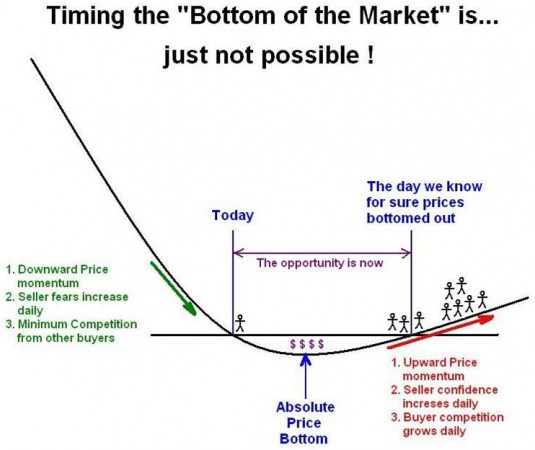
Unlike the stock market, the actual cost of real estate is a combination of price paid and the interest rate of any loan. The lowest price paid often is not actually the “bottom” and it is with this thought in mind and current interest rate trends that many believe the actual bottom may have already passed…

TIMING

The diagram above clearly exhibits another reason to work your deal sooner rather than later. The exchanges we are completing today are the tightest we have seen in twenty years. What I mean by tight is we have very little time in the exchange, sales and purchases often happening within days of one another. One’s ability to time a deal is better today than we have ever seen, and as you know time is the #1 headache in any exchange.

CONCESSIONS

Whether discussing one’s ability to time the deal, get terms on a deal, or working to get something built we are seeing people work to make things happen. Even municipalities are encouraging development in hope of fees enabling projects that in the past were not possible.

Stop trying to time the market…the time is now to move into multifamily investing.  We ask for the opportunity to respresent you:  Rick M.  Bean at 503.577.1034 or rick@rosecitycre.com

CAPITAL GAINS TAX RATES

Although we have been granted an extension of the Bush Era capital gains tax rates it is temporary with proposals that could increase those rates dramatically in the near future. Additionally, individual States with income taxes continue to increase their State rates. For those intending to exit real estate realizing a gain it is critical to understand what lies on the horizon.

JUST WRITE THE OFFER

Our advice is to write the offer that makes sense to you. The offer might get accepted or you may get the call 6 months from now asking whether you are still interested. We have had several deals recently where initial offers were promptly discarded yet the deal ultimately got done!

via Post 1031 800.735.1031 capital gains self directed IRAs 1031 investment sec 1031 exchange.

--- END POST ---

Scroll to Top