Investment Strategies

REIT Multifamily Investment Takes Off
Sam Zell Does it again
REIT Investing Skyrockets

Sam Zell’s Equity Residential has invested over half a billion dollars recently in portfolio additions…but they are also upgrading a number of their units and repositioning others.  These are irrefutable signs that they see enhanced rents around the corner.  For those of you who don’t know who Sam Zell is…he’s so rich that when Trump stands next to him…the Donald looks like just another guy having a bad hair day life.

My suggestion:  Read the article, then contact us to start acquiring additional multifamily assets for your portfolio! 503.577.1034

Apartment REITs Go On The Offensive

By Brad Berton, 03.16.10, 11:24 AM EDT

Equity Residential signals recovery with pace-setting deals.

How do some of the smartest real estate outfits begin buying and building again after a major economic collapse? Suddenly.

Adding to its recent $475 million purchase of apartment high-rise properties from the troubled Macklowe family, Equity Residential ( EQRnews people ) has paid $45 million for an apartment complex rental community a mile from the beach in tony Del Mar, Calif., Forbes has learned. San Diego County real estate records of the deal, which closed Jan. 12, indicate the seller was DMG Associates, a company headed by developer Stuart R. Posnock. The complex, called Del Mar Ridge, includes 181 apartments built in the 1990s.

The Chicago-based apartment giant, headed by billionaire Samuel Zell, hasn’t disclosed the purchase price of this deal in SEC filings. For a company with an $11 billion stock market value, that’s not surprising. But at nearly $250,000 per apartment, Equity Residential’s deal in Del Mar is a significant outlay.

Equity Residential plans to invest more, too, on improvements to the property’s 181 apartments as tenants turn over–also part of a pattern of things to come. After a couple years marked by mostly defensive maneuverings, Equity Residential and other apartment REITs are returning to more offensive-minded investments. They aim to boost property values and rents by sprucing up properties like Del Mar Ridge, finishing up partially completed projects, redeveloping older communities or even launching entirely new developments.

Equity Residential Chief Executive David Neithercut cited the Del Mar deal while explaining the REIT’s renewed offensive strategy in a Feb. 4 conference call to discuss the company’s fourth-quarter earnings. Equity Residential plans to renovate and seek higher rents as tenants turn over.

“We’re going to do a repositioning on this asset, and we projected a year-two yield of 6.7%,” said Neithercut.

--- END POST ---

Multifamily Investment Basics

As there is a mix of investment sophistication  levels on this site I have opted to interject a review of the basics.  For you institutional investors…hang on we’ll have some information that we think you’ll find valuable in…later posts.

Below is a brief overview of basic investment evaluation techniques including: NOI, CAP Rate, and NOI, CAP, and NOI Multiplier.

What is NOI?: Net Operating income

What does it measure?: Measures the revenue generating capacity from operations.

When is it important?: Two times: When you is sellin’…and when you aint. On a more serious note, NOI is the source of payment for debt service, and cash flow distributions to the owners.

Why it’s important:  It provides a way to measure the revenue producing capabilities of an asset excluding debt service considerations.

What’s the formula?: Current Revenue – Current Expenses (Exclude debt service, capital expenses.)

Example: Current Revenue, June 2009: $100,000.
Current Expenses, June 2009: $ 35,000.
NOI, June 2009 $65,000.

What is a Cap Rate?

The capitalization rate is what the yield as a percentage of the initial investment would be in year one if you acquired the property all cash.

Why it is important: First “sniff test” investors use to check out an available commercial property.

What is the formula? NOI/Sale Price = Cap Rate
Example: $65,000/$812,500= 8%.

What is NOI Multiplier?

How much each dollar of NOI would contribute to value if property was for sale.

Why we care: Knowing how much each dollar on NOI is worth helps us evaluate the impact of incremental increases in revenue and expense. (Great for rehab/repositioning!)

What’s the formula? Sale Price/NOI = NOI Multiplier
Example: $812,500/$65,000= 12.50 (Each dollar of NOI creates $12.50 of value.)

NOI, CAP, and NOI Multiplier Problems

A Portland Multifamily investment Property X had the following revenues in 2008:
• Rent $122,500.
• Extraordinary gain: harvest lumber on property $25,000.
• Pet rent $300.

Property X had the paid the following in 2008:
• Utilities, taxes, management fees, etc. $48,000.
• Cap Ex: Completely rebuild lower parking lot $19,000.
• Re-stripe upper parking lot $125.

QUESTIONS 1 & 2 are based on the information above.

1. What was NOI?    ANSWER:  $74,675  Note: The lumber revenue and parking lot expense were not operating related and were thus excluded from NOI.

2. What is the asset worth if we assume a 6.9 Cap% ?   ANSWER: $74,675 / .069 =  $1,082,246

QUESTIONS 3 – 4 are based on repositioning an 18 unit property we are buying for $1,200,000 at an 8 cap with a 5.9 % loan. Current Annual NOI is $96,000:

3. How much is each dollar of NOI worth? ANSWER: $1,200,000/$96,000 = $12.50.

4. How much more would the property be worth if we could raise the rents in 10 of the units $10/month? (Assume that a year has 12 months, all the units are increased at the same time for the full year…and that we could do this without increasing expenses…without any change in turnover.)  Answer: 10 units X $10 X 12 months equals a $1,200 increase in Annual NOI. Multiply by $12.50 = $15,000 increase in value!

Whether you’re a seasoned pro or a newbie…feel free to contact us:  503.577.1034 or rick@rosecitycre.com.

These equations apply whether your looking at Portland OR investments…or anywhere else too!

--- END POST ---

Simplifying The 4 Ways Investors Benefit From Multifamily Investments

What investors look for
Profits from multiple sources

When investors buy  commercial real estate they are acquiring a revenue stream. Admittedly there are a few signature buildings that are so iconic that they are a “pride of ownership” acquisition, but most properties are valued solely for their future economic potential. There are four primary ways in which investors benefit from their acquisitions:

1. Cash Flow

is the sum of: Cash In – Cash Out. The primary source of inflow cash is rent. Pet rent, late fees, laundry and owner contributions are also part of the cash in stream. Cash Outflows include taxes, expenses and distributions to owners.

Owner types vary widely on the importance they place on distributions:

  • Residential Multifamily properties (2 to 4 units) and smaller Commercial Multifamily properties cast off little cash. Their owners tend to focus more on equity gained at the time of disposition.
  • Investors of larger properties often use cash flows (distributions) as a primary source of spendable income. They certainly expect gains at sale, but they often will use that gain to step up in basis to acquire a larger asset in the hope of increasing the monthly cash-flow.
  • The bane of all investors is the much dreaded Cash Call. When cash out ‹ cash in to the extent that operations are impacted, the property owner(s) are forced to add new equity to keep expenses current. Be aware that cash call inputs wreak havoc on IRR Calcs.
    Because of their focus on maintaining regular, dependable distributions, the owners of larger properties tend to have lower LTV loans. This doesn’t eliminate cash calls, but it does make operations inherently more stable, reducing the likelihood of requiring additional cash.

2. Appreciation

is Future Disposition Price – Original Acquisition Price. A 53 unit complex that is purchased for $3.2 million is 2007 appreciates $700,000 if it is sold for $3.9 million several years down the road.

  • Appreciation gains can occur from (external) market forces such as a downward trend in Cap rates, or from increases in rent relative to expenses due to high demand.
  • Gains can also be “forced” by internal forces. This occurs when we reposition a property. Renters will pay more for upscale amenities and newer looking accommodations. Success requires having the amortized costs of improvements be exceeded by the increased rents. In some cases we merely seek to raise the rents on the existing renters; other times we are using the upgrades to attract a new tenant profile.

3. Loan Paydown

is determined by subtracting the initial loan amount from the remaining loan balance at any given time. Suppose a $3,200,000 property is acquired with a roughly 65% LTV loan at 6% with a 30-year amortization. Day one the beginning loan balance would be $2,000,000. 42 months later (3-1/2 years) the loan balance would be $1,909,649. The loan paydown amounts to $90,351 for that period.  Using interest only loans eliminates loan paydown…but does increase cashflow.

4. Tax Shelters and Tax Avoidance Benefits

The final benefit to investors is the tax sheltering of income. Cost Recovery (Depreciation) is the primary example. Industrial and retail properties are depreciated on a 40-year basis; housing is depreciated using 27.5-years. Note: Land is not depreciable. Using our previous example of a $3,200,000 community, let’s assume that land was 25% of the value, leaving a depreciable amount of $2,400,000 to be depreciated over 27.5 years, or $87,27.73 per year. That will act as a tax deduction to reduce profits by that amount for tax basis purposes.

A more rapid depreciation methodology is provided by Cost Segmentation, or familiarly, Cost Seg. This is performed based on findings of a cost engineer during their on-site inspection and review of the property. There is great acceptance of this approach by the IRS, but it is not fully understood by investors and many Tax Accountants. Cost Seg. on Assets under $1 Million is not always cost effective due to the fixed costs of the on-site inspection. Savings on multimillion dollar properties are substantial, and can change a 1.1 DSCR property into a 1.25. That means that Cost Seg utilization can impact approval outcomes.

Duties of Professional Investment Brokers

It is incumbent on the Real Estate Professional assisting a client with a multifamilty acquisition to have an understanding of that client’s risk profile, investment horizon plus target cash flow and appreciation rates. It is also beneficial to have an awareness of how important their client deems tax shelter options.  Given that 1 in 5 1031 Exchanges fail for one reason or another…it makes sense for a broker to offer information regarding Structured Sales before closing on the inital leg of the exchange.  This preserves reinvestment options.

Whether you’re looking at Beaverton multifamily investments, Salem apartments…or assets anywnere in Oregon, contact Rose City Commercial Real Estate today at 503.577.1034, or rick@rosecitycre.com.

--- END POST ---

REIT Multifamily Equity Index Surges

REIT Equity Growth
Good News For Investors

National Real Estate Investor

Despite poor commercial real estate fundamentals, retail and apartment real estate investment trusts (REITs) are enjoying a powerful resurgence.

For the 12-month period ending February 28, a key equity REIT index soared 95.19%, outdoing both the Nasdaq and Standard & Poor’s 500 index of stocks, according to a new report.
For the month of February, U.S. REITs gained more than 5%, according to the report by the National Association of Real Estate Investment Trusts (NAREIT), a trade group based in Washington, D.C. The gains were driven by investment in the retail and apartment sectors, according to the report.
“This has been a period of tremendous growth for REIT shares,” says Ron Kuykendall, vice president at NAREIT. “What it means, I believe, is that investors are betting on a recovery.”
The performance represents a remarkable contrast to the period from the market peak in early 2007 to the trough in March 2009, the lowest point for REITs. Share prices fell a devastating 75% during that period, says Kuykendall.
If investors indeed are betting on recovery, that could provide a shot in the arm to the commercial real estate industry across the U.S. Although REITs comprise just 10% to 15% of the total U.S. commercial real estate marketplace, they represent many of the largest companies and property owners across all property types — retail, multifamily, office, industrial and hotel.

Dealmakers get busy…contact Rose City Commercial Real Estate at 503.577.1034 or Rick@rosecitycre.com.

Continued…

A developing trend that factors into the recent investment in shares is that acquisitions are once again beginning to take place after the nation’s deep recession and credit shortage, particularly in the retail and apartment sectors.
“We have seen apartment companies like Avalon Bay and Equity Residential doing some strategic acquisitions. It has also begun to happen in the retail sector, where you have of course the General Growth situation,” says Kuykendall. Several rival REITs have expressed interest in buying mall REIT General Growth as it attempts to emerge from Chapter 11 bankruptcy.
“Equity One has been talking to Liberty about acquiring some of their retail shopping centers,” as well, says Kuykendall.
Over the past year, many REITs strengthened their balance sheets as they recapitalized, raising fresh equity through secondary equity offerings and paying down debt, says Kuykendall. The steps made them more attractive to investors.
“There were about $22 billion in secondary equity offerings in the REIT marketplace last year,” says Kuykendall. “That represented more shares coming onto the market.” The offerings followed a trend developing over the past year of share growth rather than a reduction in the number of shares outstanding.
Regional malls recorded an 11.9% return on the FTSE NAREIT Equity REIT Index in February, while shopping centers registered 8.9%. During the month, apartments also showed strong gains of 8.4%, a dramatic improvement from a year earlier. In February 2009, shopping center index returns declined 25.8% while regional mall returns dropped 21.1%. In the same period, apartment returns declined 24.7%.
This year, REITs are generating more optimism. “Investors have been looking forward to the returns that REITs are going to be able to generate by acquiring high-quality property at good prices,” says NAREIT economist Brad Case. “What we’ve seen in the last month is that those opportunities have arrived.”
The investors are driving the prices of REIT stocks up in anticipation of better REIT performance going forward, says Case. He notes that in addition to the improved returns for retail and apartments, lodging REITs recorded a 6% gain in February.
Tough year for fundamentals
The gains have taken place against the backdrop of a brutal climate for commercial real estate fundamentals. The vacancy rate for community and neighborhood shopping centers is projected to rise to 11.5% this year, according to New York-based data research firm Reis. That would represent the highest vacancy rate for the centers since at least 1999.
The shopping center vacancy rate is projected to rise to 12.2% next year. For apartments, Reis projects a vacancy rate of 8.3% in 2010, shattering records for the last 11 years.
Because REITs have been able to raise fresh capital through equity offerings, unlike private companies, they have not been hamstrung by banks’ unwillingness to lend money for acquisitions, says Kuykendall. That has made a crucial difference in their ability to grow as the nation attempts to shake off the effects of the economic slowdown.
Another problem for private commercial real estate companies is that many are weighed down by maturing debts, while banks practice a policy of “extend and pretend” rather than foreclosing on assets.
That’s why the investment marketplace has looked more favorably on REITs, says Kuykendall. Debt maturities still hang over the private companies, while REITs are positioned for opportunistic buys. “These are going to be the winners as banks come to a point where they are no longer willing or able to do the pretend and extend.”

--- END POST ---

Looking for tax savings?

Study building costs to up cash flowBaltimore Business Journal – by Gary Anderson

Cost Seg Saves Money!
Optimizing your investment

Cost segregation, though known by many real estate owners, is sometimes overlooked.

It is a methodology used to reallocate certain building costs into separate identifiable components that can be depreciated over shorter lives. The primary purpose of a cost-segregation study is to reallocate as much building costs between land improvements and tangible property. The more costs allocated to tangible property, the greater the desired tax benefit. Tangible property creates tax benefits because it is depreciated over five or seven years while normal building costs are depreciated over 27.5 or 39 years.

A cost-segregation study may be performed for real estate already in service, for new construction and acquisitions. Generally, it is easier to analyze a building’s cost structure during initial construction or expansion since building plans are readily available and can be utilized to identify various components that may qualify as tangible property.

Costs that may be reallocated to land improvements consist of, but are not limited to, certain landscaping, sidewalks and fencing which are depreciated over a 15 year recovery period.

Costs that may be reallocated to tangible property include movable partitions, furniture, removable carpeting and wallpaper, certain fixtures and window treatments. Support systems that are needed to run certain equipment or machinery could be considered tangible property under certain circumstances.

There are several internal levels of cost-segregation studies ranging from a detailed engineering approach through a less formal rule-of-thumb appraisal. The Internal Revenue Service prefers the engineering approach since it will produce the most accurate results.

All businesses that acquire, construct or renovate real property would benefit from a cost-segregation study.

The real benefit of a properly documented cost-segregation study is the enhanced depreciation deductions it yields. A major advantage of the study is not necessarily that it produces more depreciation deductions, but that expenses accelerate more rapidly, producing a greater benefit due to the time value of money.

The ability to write off specific components identified as they are replaced is yet another advantage. For example, when a study is performed, the cost of the roof would be specifically identified. As the roof will eventually be replaced, the remaining cost could be written off.

One disadvantage of a cost-segregation study is the potential triggering of depreciation recapture and possible understatement penalties a taxpayer could incur for studies that are too aggressive in classifying costs. To avoid penalties and pass IRS scrutiny, the study must be objective and supported by contemporaneous records. Studies supported by an engineering study add credibility and produce the most accurate cost allocations.

Overall, cost-segregation studies can produce tremendous tax savings for those who build, acquire any business that builds, acquires or renovates property. The increased tax savings increase cash flow, which in turn, businesses can reinvest.

Gary Anderson, a certified public accountant and senior manager at Reznick Group P.C. in Baltimore, can be reached at gary.anderson@reznickgroup.com.

--- END POST ---

Distressed Commercial Real Estate Assets Jump 15%

FEATURED AUTHOR:   Mark Heschmeyer

The amount of distressed commercial real estate assets on the books of the nation’s banks and thrifts approached $60 billion as of year-end 2009. That is up from $52 billion just three months earlier, a 15% increase.

The $59.9 billion includes loans on multifamily and nonresidential income producing-properties that were 90 or more days past due, or in nonaccrual or foreclosure status.

The year-end numbers are contained in the Federal Insurance Deposit Corporation’s latest Quarterly Banking Profile, released this week. And they confirm that commercial real estate troubles are eroding the balance sheets of the nation’s banks.

As the CRE distress numbers went up, so did the number of troubled institutions on the FDIC’s “Problem List.” At the end of December, there were 702 insured institutions on the Problem List, up from 552 on Sept. 30. In addition, the total assets of “problem” institutions increased during the quarter from $345.9 billion to $402.8 billion. Forty-five institutions failed during the fourth quarter, bringing the total number of failures for the year to 140, the highest annual total since 1992.

The FDIC does not release the identity of the banks on its Problem List.

Loans on nonresidential income-producing properties that had been foreclosed on increased from $5.84 billion to $7.05 billion – a 21% increase.

Loans on multifamily properties that had been foreclosed on increased from $1.44 billion to $1.75 billion – a 22% increase.

Loans on nonresidential income-producing properties that were 90 days or more past due or were in nonaccrual status increased from $37.05 billion to $41.74 billion – a 13% increase.

Loans on multifamily properties that were 90 days or more past due or were in nonaccrual status increased from $7.75 billion to $9.39 billion – a 21% increase.

Reserves for loan and lease losses increased by only $7 billion (3.2%) in the fourth quarter, as institutions added $8.1 billion more in loss provisions to their reserves than they took out in net charge-offs.

Total net charge-offs totaled $53 billion, an increase of $14.4 billion (37.2%) over the same period in 2008. The annualized net charge-off rate rose to 2.89%, up from 1.95% a year earlier and 2.72% in the third quarter of 2009. This is the highest quarterly net charge-off rate reported by the industry in the 26 years for which quarterly data is available. Banks charged off 0.77% of their loans on nonresidential income-producing properties, up from 0.62% in the previous quarter. Banks charged off 1.11% of their multifamily loans, up from 0.92% in the previous quarter. This was the sixth increase in as many quarters in both categories.

For related CoStar coverage, see “http://www.costar.com/News/Article.aspx?id=6A579770FF5EC1CFD05D7036BE366D25

The average coverage ratio of reserves to noncurrent loans and leases fell from 60.1% to 58.1%, ending the year at the lowest level since midyear 1991. In contrast, the industry’s ratio of reserves to total loans and leases rose from 2.97% to 3.12% during the quarter, and is now at its highest level since the creation of the FDIC.

Not surprisingly, the total amount of commercial real estate loans on bank books was flat. Banks posted only $2 billion more in CRE loans at $1.092 trillion. The total amount of multifamily loans decreased slightly from $216 million to $211 million.

Despite the troubles in their CRE portfolios, commercial banks and savings institutions reported an aggregate profit of $914 million in the fourth quarter compared to $37.8 billion net loss a year earlier. More than half of all institutions (50.3%) reported year-over-year improvements in their quarterly net income.

Almost one-third of all institutions (32.7%) reported net losses for the quarter, compared to 34.6% a year earlier. For the full year, banks reported net income totaling $12.5 billion – up from $4.5 billion in 2008.

Do you want to increase your investment stake?  Whether your Want Vancouver, WA multifamily, or Lake Oswego Apartments, call Rose City Commercial Real Estate at 503.577.1034

--- END POST ---

Private Equity Investors To Boost Real Estate Allocations in 2010

Good news for real estate investors!


By Ben Johnson, NREI contributor


What did private equity investors, including huge institutional players such as pension funds, learn most from the recent collapse in commercial real estate values? They want more of the asset class.
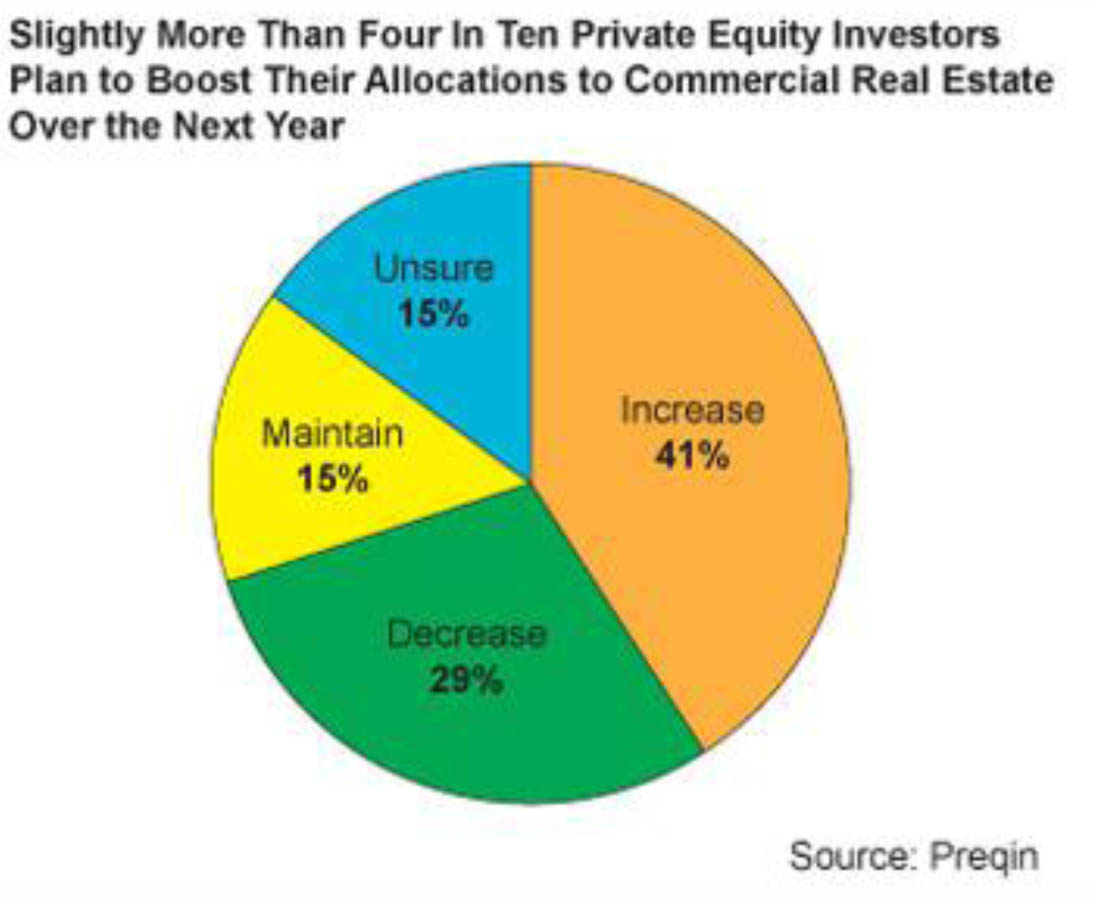
A new study of 90 global private equity real estate investors by London-based researcher Preqin confirms that instead of fleeing to the hills, institutional investors intend to commit more capital to private equity real estate funds in 2010 than they did in 2009. And surprisingly, none of the participants in the survey conducted in the fourth quarter of 2009 has abandoned commercial real estate.
In fact, 41% of investors plan to increase their investment in the sector, while 29% expect to invest less than last year. Another 15% say that they will maintain their allocations, and the remaining 15% are unsure as they await the bottom of the market and recalibrate their strategies accordingly.   

Overall, the survey results suggest that “confidence is returning and investors are feeling more optimistic about the asset class,” says Forena Akthar, co-author of the Preqin study.

Hesitation lingers

Despite the apparent optimism, investors have not completely thrown caution to the wind when it comes to investing in real estate, whether making direct investments or committing capital to private equity funds. According to the survey, 55% of private equity real estate investors made no new fund commitments in 2009.
That helps explain the huge decline in private equity real estate fundraising activity. According to Preqin, the total capital raised in 2009 equaled just 31% of the levels reached in 2008. In all, 103 funds closed in 2009 with total commitments of $42 billion.   

Of those investors who plan to invest in commercial real estate in 2010, only 29% could estimate the number of funds they would invest in, and only 24% had an approximate figure in mind for the amount of capital they would commit.
These figures are much lower than in previous years, when most investors could more clearly predict both the number of funds and the amount of capital they would invest over the next 12 months.
When it comes to the long-term view, however, 75% of investors surveyed remain bullish on the real estate sector. “Despite the gloom, many investors did not lose confidence in the long-term benefits of investing in private equity real estate. They simply were not investing in 2009,” says Akthar, the survey’s co-author.
According to Preqin, returns from private equity real estate funds topped the S&P 500 Index by 35.8% over the past five years.
One long-time institutional advisor, Ted Leary, head of Los Angeles-based Crosswater Realty Advisors, thinks investors will cautiously re-enter the real estate game. He also notes that investors will be in a stronger position to dictate terms, including a reduction in fees, with their fund managers.
“The real estate investment manager community needs to regain the trust of their investor clients,” says Leary. “Some managers will, some managers won’t.”
When and where?
Nearly six in 10 investors (58%) plan to make their real estate investments in the first half of 2010. The remaining 42% are uncertain about when they will make a move in 2010.
And when they do pull the trigger, U.S. investors will likely stick close to home. That means potentially less capital for emerging property markets like China and India.
Not surprisingly, the vast majority of investors (73%) also are shifting their focus to target the two pillars of the commercial real estate industry — debt and distress.
“While investors are still attracted to value-added and opportunistic funds, a growing number of investors are looking to capitalize on opportunities presented by the dislocated real estate market,” says Stuart Taylor, a senior real estate analyst at Preqin.
The largest of these commercial real estate investors — targeting both mortgage notes and properties — include the Abu Dhabi Investment Authority with $62.5 billion in funding. Also in the mix is U.S.-based Allstate Investment Management with $20.7 billion, the California Public Employees’ Retirement System with $13.6 billion and TIAA-CREF with $13 billion.   

If you’re an investor wishing to re-enter the market, contact Rick Bean or Robert Poe at: 503.577.1034.  Whether you are looking for Portland distressed real estate or Hillsboro multifamily, we are ready to give you full service!

--- END POST ---

Get information on off market deals here!

The Deal Room

Why should you sign up for the Deal Room?

Simple:

  1. Bid on off market deals.  You know…the ones where you hear that someone closed on a great deal and you say:  “Heck…I’d have bought that if I knew it was available at that price!”
  2. The lowest proforma deal IRR currently is 20%.  Others are over 50%!
  3. Current opportunities:
    • Portland, OR deals
    • Phoenix, AZ deals
    • Dallas, TX deals

More cities and more deals are coming soon!

To be notified in advance of off market distressed properties becoming available, contact us to get your free pass to the Deal Room!

Rick M. Bean and Robert H. Poe

Rick@rosecitycre.com

503.577.1034

As with any investment there is an element of risk.  Purchaser should perform a complete Due Diligence Inspection before closing any deal.  Best of luck to you!

--- END POST ---

Buyer Alert! Act now to close before New Years!

Multifamily, equity advantage, apartment, investmentRose City Commercial Real Estate has a buyer who is looking to purchase a multifamily investment in Vancouver, WA. The ideal size would be from 30 to 60 units. While he will not be using 1031 Exchange funds…he’s happy to cooperate with a seller who does. A to C- quality rating of improvements in A to C locations.

We are fully prepared to assist you in identifying a property to exchange into.

Financing is already handled…we can support a quick close before the end of the year. Stop reading and start dialing 503.336.6382 now!

--- END POST ---

Investing With Accredited Investors

Accredited investor, multifamily, Rick Bean, Rose City Commercial Real Estate
What are Accredited Investors?

I’ve fielded several inquiries lately about just what an Accredited Investor is.  In most cases this has been in conjunction with Tenancy In Common sponsorship.   Below I’ve summarized the criteria for determining whether or not someone qualifies as an Accredited Investor.  It’s important to remember that working with AI’s may facilitate the formation of a TIC that is exempt from registering as a security.  This should only be done with the assistance of an attorney.  The attorney chosen should be a real estate specialist

Accredited Investor Criteria:

Under the Securities Act of 1933, a company that offers or sells its securities must register the securities with the SEC or find an exemption from the registration requirements.  The Act provides companies with a number of exemptions. For some of the exemptions, such as rules 505 and 506 of Regulation D, a company may sell its securities to what are known as “accredited investors.”
The federal securities laws define the term accredited investor in Rule 501 of Regulation D as:
1. a bank, insurance company, registered investment company, business development company, or small business investment company;
2. an employee benefit plan, within the meaning of the Employee Retirement Income Security Act, if a bank, insurance company, or registered investment adviser makes the investment decisions, or if the plan has total assets in excess of $5 million;
3. a charitable organization, corporation, or partnership with assets exceeding $5 million;
4. a director, executive officer, or general partner of the company selling the securities;
5. a business in which all the equity owners are accredited investors;
6. a natural person who has individual net worth, or joint net worth with the person’s spouse, that exceeds $1 million at the time of the purchase;
7. a natural person with income exceeding $200,000 in each of the two most recent years or joint income with a spouse exceeding $300,000 for those years and a reasonable expectation of the same income level in the current year; or
8. a trust with assets in excess of $5 million, not formed to acquire the securities offered, whose purchases a sophisticated person makes.

Some hold members of an investment group such as the Northwest Real Estate Investors Association(NWREIA) to be tantamount to AI’s…confirm this with your attorney.  You don’t want to violate SEC Rules.  Think of them as being like the IRS…without as good of sense of humor.  Contact me if you would like additional information at: 503.577.1034 or rick@rosecitycre.com.

--- END POST ---

Scroll to Top