Multifamily

The Portland Multifamily Update from Rose City Commercial Real Estate

This installment of the Portland Multifamily Update starts with an excellent quote from Bloomberg:

Rent increases replaced landlord giveaways as U.S. apartment vacancies dropped in the second quarter to the lowest in more than three years, bolstered by rising demand on the West Coast, according to Reis Inc. (REIS)

The apartment vacancy rate fell to 6 percent in the three months ended June 30 from 6.2 percent in the first quarter and 7.8 percent a year earlier, the New York-based property research firm said in a report today. The second-quarter rate matched the first three months of 2008 and was the lowest since 5.7 percent at the end of 2007, the year multifamily real estate prices peaked. Rents rose in all but two of the cities Reis tracks.

Please check back to the Multifamily Insider Report on Friday, July 15th for my analysis on the benefits of replacing incentives with rent increases.   Remember, you don’t have to wait until Friday if you want to get started investing in Portland Multifamily Real Estate.  Call Rick Bean at Rose City Commercial Real Estate:  503.577.1034, or e-mail me at: rick@rosecitycre.com.

“The ongoing recovery and tightening vacancies continue to generate greater pricing power on the part of landlords,” Ryan Severino, an economist at Reis, said in the report. “Vacancies should continue to decline while rents rise at an even faster pace than we observed in the first half.”

Demand for rental apartments in the U.S. has soared as foreclosures forced people out of their homes and prospective homebuyers found it harder to get mortgages. The home ownership rate in the U.S. fell to 66.4 percent in the first quarter, the lowest since 1998, according to the U.S. Census Bureau.

“There’s still a stigma to buying houses,” said Stan Harrelson, chief executive officer of Pinnacle, a Seattle-based company that manages more than $17 billion of apartments and other commercial properties. “Even with job growth, people aren’t ready to take that step.”

Landlords had a net increase in occupied space of about 33,000 units in the second quarter, down from 45,000 units in the first quarter, Reis said.

$997 a Month

Effective rents, or what tenants actually pay after perks such as a free month, climbed in 80 of the 82 metropolitan areas surveyed, to an average $997 a month from $974 a year earlier and $991 in the first quarter.

San Jose, California, led rent growth last quarter, followed by New York’s Westchester County and San Francisco, according to Reis.

Las Vegas, one of the cities hardest hit by the housing collapse, had an increase in effective rents for the first time since 2008, Reis said. Rents in the city were still down from a year earlier.

The national rent increases mark a reversal from early last year, when many landlords were offering gifts to attract tenants. Aspira, a 325-unit luxury apartment building in Seattle, gave away dozens of iPads and 40-inch televisions, preloaded credit cards worth $1,000 each and up to three months of free rent when it opened in January 2010. With occupancy surpassing 80 percent, such enticements are no longer needed.

Incentives ‘Gone’

“They’re gone,” said John Schwartz, director of the Northwest regional office for Keller CMS Inc., the Los Angeles- based project manager that oversaw the development of the 37- story Aspira.

San Jose, the largest city in Silicon Valley, led rent growth for both the second quarter and the 12 months through June 30, Reis said.

“San Jose is everyone’s darling and rents are through the roof, but that will plane off” as new supply comes to market in the next 12 to 18 months, said Harrelson of Pinnacle.

Seattle is still one of the best markets for potential rent growth, he said, citing increased hiring by technology companies and airplane manufacturer Boeing Co.

Shane Lynch, a software developer in Microsoft Corp. (MSFT)’s Xbox gaming division, said he plans to renew his lease, at the Neptune apartments in Seattle’s high-tech South Lake Union district, even though the rent for his one-bedroom unit is going up 11 percent to $1,300 a month.

‘Everyone’s Increasing’

“I’ve been looking around and it seems like everyone’s increasing that amount,” said Lynch, who moved to Seattle about a year ago from the Baltimore area to take the job with Microsoft. “I’m not seeing anything cheaper, and there’s also the cost of moving.”

Lynch, 26, said he plans to consider buying a house after he gets to know the city better.

“Because I’m so new to Seattle, I don’t want to be tied down to a certain neighborhood, but if rents continue to increase and get closer to mortgage prices, it will be kind of silly not to buy,” he said.

Rising rents have in turn attracted investors to multifamily properties, encouraging new developments and purchases.

“We don’t anticipate a recovery in for-sale housing until at least 2013,”Michael Schall, president and chief executive officer of Essex Property Trust Inc. (ESS), said on a May 5 conference call to discuss first-quarter earnings. The company, based in Palo Alto, California, owns and operates multifamily complexes in California and Washington state.

Supply and Demand

“Each month from December has shown significant improvement, and we are now confident that the apartment supply- and-demand equation is tipping towards housing shortage,” Schall said.

Market rents at Essex properties have increased 9.2 percent since the first quarter of 2010 and the rate of growth is accelerating, Senior Vice President Erik Alexander said on the conference call. Occupancy for the company’s apartments reached 97.1 percent by the end of April.

“We should see lower occupancies during the summer months as market rents continue to grow, more leases expire and we push rents on renewals,” Alexander said.

Other articles you may like:


The Importance of Due Diligence in Multifamily Profits – Phase II – Books and Records | Rose City Commercial Real Estate

Demystifying multifamily cap rates, NOI, and investing basics | Rose City Commercial Real Estate

Multifamily real estate investment basics – part 1 of a series | Rose City Commercial Real Estate

Attractive cap rates attract investors to multifamily properties in Portland | Rose City Commercial Real Estate

Prospects for multifamily sector improve greatly | Rose City Commercial Real Estate


--- END POST ---

Lowest Home Ownership Rate Since Great Depression Spurs Multifamily

What investors look forHome ownership rates continue their plunge. The vast majority of the millions of households that are no longer home owners have become renters.  Many of these new renters have reported  that they do not intend to buy into a home once the economy picks up.  This is creating a new type of “Rent By Choice”.   In the past RBC’s were pretty much the folks that could easily afford a home, but chose to rent an upscale apartment instead.  The new group of renters has lower

Rose City Commercial Real Estate sees profits ahead for Oregon multifamily investments.  To discuss specific opportunities, contact Rick Bean at 503.577.1034 or rick@rosecitycre.com.

resources and could buy a starter home if they marshaled their resources…but buying a home is not a priority because they don’t look at their home as an investment the way the bulk of previous buyers did, thus home ownership is just not as important.  They don’t see the opportunities and rewards being there like they once were.

As the economy improves the increase in occupancy rates will continue.  Profit killing concessions will be eliminated.  Households that had two or more families will return to being single homes…and rents will start increasing.  Investing in Oregon multifamily assets before they become over inflated makes great sense.  I’ve attached an article by David Streitfield of the New York Times

By DAVID STREITFELD

Published: May 30, 2011

SAN FRANCISCO — The desire to own your own home, long a bedrock of the American Dream, is fast becoming a casualty of the worst housing downturn since the Great Depression.

Even as the economy began to fitfully recover in the last year, the percentage of homeowners dropped sharply, to 66.4 percent, from a peak of 69.2 percent in 2004. The ownership rate is now back to the level of 1998, and some housing experts say it could decline to the level of the 1980s or even earlier.

Disenchantment with real estate is bound to swell further on Tuesday when the most widely watched housing index is all but guaranteed to show that prices of existing homes sank in March below the lows reached two years ago — until now the bottom of the housing crash. In February, the Standard & Poor’s/Case-Shiller index of 20 large cities slumped for the seventh month in a row.

Housing is locked in a downward spiral, industry analysts say, not only because so many people are blocked from the market — being unemployed, in foreclosure or trapped in homes that are worth less than the mortgage — but because even those who are solvent are opting out.

“The emotional scars left by the collapse are changing the American psyche,” said Pete Flint, chief executive of the housing Web site Trulia. “There was a time when owning a home was a symbol you had made it. Now it’s O.K. not to own.”

Trulia, a real estate search engine for buyers and renters that is based here, is a hive of renters, including Mr. Flint. “I’m in no rush at all to buy,” he said. He expects home ownership to decline further to about 63 percent, a level the country first achieved in the mid-1960s.

Tim Hebb, a Los Angeles systems engineer, expertly called the real estate bubble. He sold his bungalow in August 2006, then leased it back for a year. Since then, the 61-year-old single father has rented a succession of apartments.

“I have flirted with buying again many times over the past few years,” said Mr. Hebb. “Let’s face it, people are not rational creatures.”

But he always resists, figuring housing is still overpriced and even when it stops declining it will stumble along the bottom for years and years. He says there is plenty of time to get back in if he should ever want to.

The market signaled further trouble on Friday when the April index of pending deals was released by the National Association of Realtors. Analysts had predicted the index, which anticipates sales that will be completed in the next two months, would be down 1 percent from March. Instead, it plunged 11.6 percent.

Many of those in the business of building and selling houses believe the current disaffection with real estate will pass. After every giddy boom comes the hangover, they acknowledge, but that deep-rooted desire for a castle of one’s own quickly reasserts itself.

“There’s no question that people are reticent to own,” said Douglas C. Yearley Jr., chief executive of Toll Brothers, the builder of high-end homes. “They’re renting and they’re happy renting because they’re scared.”

Yet those fears will fade, he predicted.

“Most people still want the big house with the big lot in the desirable school district in the suburbs. No one ever renovated the kitchen or redid a room for the kids in a rental,” Mr. Yearley said. “I think — I hope — we’ll be O.K.”

The market’s persistent weakness, however, runs the risk of feeding on itself. Buyers are staying away despite the lowest interest rates and the highest affordability levels in many years, which in turn prompts others to hesitate.

Trulia and another real estate site, RealtyTrac, commissioned Harris Interactive to take a poll last November about when people thought the market would recover. A third of the respondents chose 2014 or later. But in a new poll, released this month, the percentage giving that answer rose to 54 percent.

The sharp decline in prices since 2006 has meant a lost decade for many owners. But what may prove even more discouraging to potential buyers is academic research showing that the financial rewards of ownership were uncertain even before the crash.

In a recent paper, a senior economist at the Federal Reserve Bank of Kansas City found that the notion that homeownership builds more wealth than investing was true only about half the time.

“For many households in many years, renting and investing the saved cash flow has built more wealth than homeownership,” the economist, Jordan Rappaport, concluded.

Economics affects potential owners in other ways. A house is a long-term commitment that many are loath to make in uncertain times like these.

“What I’m hearing from people is that they don’t want to be tied to a particular geography, which inclines them to renting,” said Mr. Flint of Trulia.

San Francisco is one of the country’s most expensive cities, so renting has a natural appeal here. But the Associated Estates Realty Corporation, which owns 13,000 apartments in Georgia, Indiana, Michigan and other Midwest and Southeast states, also is seeing more people deciding to rent.

“We have more of what we call ‘renters by choice’ than I’ve seen in the 40 years I’ve been in the apartment business,” said Jeffrey I. Friedman, chief executive of Associated Estates.

For decades, the company has asked former tenants why they were moving out. During the housing boom, as many as a quarter of those moving on said they were buying a house. In 2009, the percentage of new owners fell in the first quarter to 13.7 percent, the lowest ever.

Last year, as the economy improved, the number rebounded. This year, it fell back again, to 14 percent.

Builders clearly believe that the future includes many more renters. So far this year, construction of multiunit buildings is up 21 percent compared with 2010, while single family-homes are down 22 percent. Sales of new single-family homes are lower than at any time since the data was first kept in 1963.

Susan Lindsey, a San Diego software programmer, was once eagerly waiting for the housing market to crash. She said she would have no guilt about swooping in on some foreclosed owner who had bought a place he could not afford.

With prices now down by a third, however, she is content to stay in her $2,500-a-month rented house. She prefers to invest in gold, which she has been buying since 2003.

“I could afford a median-priced house, no problem,” said Ms. Lindsey, 48, as she headed off for a holiday weekend in Las Vegas. “But I would be paying more to live in a place I like less.”

--- END POST ---

Portland: Lowest Multifamily Vacancy Rate in the Nation

By Erika Schnitzer, Managing Editor

Portland, Ore.—Portland-Vancouver-Beaverton has the lowest apartment vacancy rate, 4 percent, among the top 75 U.S. MSAs, according to the U.S. Census Bureau’s latest report.

While the unemployment rate has declined, it’s still relatively high at 9.6 percent, according to the U.S. Bureau of Labor Statistics. But, as Greg Frick, partner at HFO Investment Real Estate, points out, “even when we had high unemployment, our vacancy was about 10 percent, so we didn’t fall that far. We’re not typically a boom-or-bust market; we’re really slow and steady.”

Some good news includes Intel’s commitment to invest in an existing plant in Hillsboro,

A perfect storm for profits: Last week we learned that Portland multifamily was the nation’s 3rd leading market for rent escalations; This week our fair city is celebrated for having the lowest vacancy rate in the nation.   Contact Rose City Commercial Real Estate immediately: rick@rosecitycre.com or 503.577.1034.

says Frick. And the market’s continued in-migration and urban growth are expected to help the market’s recovery.

In the multifamily arena, construction remains extremely limited. The market typically averages between 4,000 and 5,000 units per year, Frick tells MHN; in the last two years, about 750 units were permitted each year.

Meanwhile, concessions are burning off, and the market is experiencing between 5 percent and 10 percent rental growth. But, Frick adds, “we’re typically the lowest on the West Coast for rent numbers, so 5 percent in our market does not equate to the same dollar amount as some of the other markets.”

On the investment side of the market, Frick reports, “there’s been a lot of money chasing deals … [for the] Class A institutional stuff.” In-core Class A assets are trading at sub-5 cap rates, while suburban Class A deals have traded between 5 percent and 5.75 percent. Meanwhile, B and C asset values have held steady.

“We are seeing some B/C stuff trade, but it’s not at the fevered pitch you’re seeing in the Class A,” Frick tells MHN. “There’s institutional money chasing deals now, trying to get into this market because of the demographics and low vacancy.”

As far as the recovery, Frick points to the bond measures that are trying to get passed, and the resulting increase in taxes and utility charges, that could have a negative impact on the apartment market. “Those are a couple of expense items you don’t really have control over,” he notes. “Will we get enough rent growth to keep pace? How much will that be eroded from these added operational costs?”

While Portland’s livability factor poises it for a strong recovery, Frick notes, “we just need …[to] get some jobs in here and wage inflation so apartment owners can really capitalize on that increased demand.”

Other articles you may like:


The Importance of Due Diligence in Multifamily Profits – Phase II – Books and Records | Rose City Commercial Real Estate

Demystifying multifamily cap rates, NOI, and investing basics | Rose City Commercial Real Estate

Multifamily real estate investment basics – part 1 of a series | Rose City Commercial Real Estate

Attractive cap rates attract investors to multifamily properties in Portland | Rose City Commercial Real Estate

Prospects for multifamily sector improve greatly | Rose City Commercial Real Estate


--- END POST ---

Double Digit Rent Increases Ahead

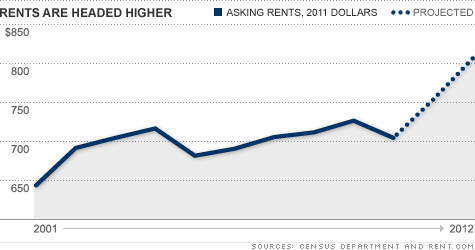
 (CNNMoney) — Renters beware: Double-digit rent hikes may be coming soon.

“The demand for rental housing has already started to increase,” said Peggy Alford, president of Rent.com. “Young people are starting to get rid of their roommates and move out of their parent’s basements.”

By 2012, she predicts the vacancy rate will hover at a mere 5%. And with fewer units on the market, prices will explode.

The conditions that Alford cites as spurring rent increases are more pronounced in the Portland multifamily market:  4% vacancy rates, high barriers to entry, and years of under building apartments in Oregon are setting the table for large rent increases for several years.  Add to that scenario the availability of ultra cheap financing and you have an investment niche that is set up to wildly outperform other segments.  For additional information contact Rose City Commercial Real Estate at: 503.577.1034 or rick@rosecitycre.com.

Rent hikes have averaged less than 1% a year over the past decade, according to Commerce Department statistics, adjusted for inflation. Now, Alford expects rents to spike 7% or so in each of the next two years — to a national average that will top $800 per month.

In the hottest rental markets, the increases will likely top the 10% mark annually for the next couple of years. In San Diego, Alford anticipates rents will rise more than 31% by 2015. In Seattle rents will climb 29% over that period; and in Boston, they may jump between 25% and 30%.

This is a sharp change from the recession, when many Americans couldn’t afford to live on their own. More than 1.2 million young adults moved back in with their parentsfrom 2005 to 2010, said Lesley Deutch of John Burns Real Estate Consulting. Many others doubled up together.

As a result, landlords had to reduce prices and offer big incentives to snag renters.

Now that the recession is easing, many of these young people are ready to find new digs, mostly as renters, not owners. Plus, the foreclosure crisis continues unabated, and the millions losing their homes are looking for new places to live.

Apartment developers many not be able to keep up with this heightened demand, which will force prices upwards, according to Chris Macke, a real estate analyst with CoStar, which tracks multi-family housing trends.

“There will be an envelope of two or three years,” said Macke, “when the rise in demand for rentals will exceed the industry’s ability to meet it.”

Plus, Alford added, “there’s been a shift in the American Dream. We’re learning from our surveys that a huge proportion of people are choosing to rent.”

They’ve experienced the downsides of homeownership — or seen friends and family suffer — and don’t want to take the risks or pay the higher costs of homeownership.

Where homeownership costs are particularly high, there are many more renters than owners. In Manhattan, for example, only about 20% own their homes; in San Francisco, about of third of the population does; in Los Angeles, less than 40%; and in Chicago, about 44%.

There’s one factor that could rein in rent increases: the huge number of foreclosed homes that could hit the market over the next few years.

In many markets, like Phoenix and Las Vegas, there are neighborhoods filled with recently built, single-family homes going for fire-sale prices. When the cost of owning homes falls well below the costs of renting them, more people will buy.

“That’s always been the biggest competition for rentals,” said Deutch.

--- END POST ---

Heaven for Multifamily in 2011, Closer to Earth in 2012


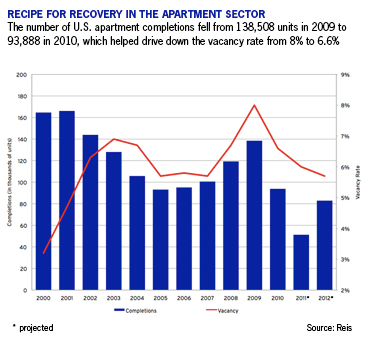
It is a bullish sentiment that gathered steam through 2010. With few projects initiated in 2009, there will be a shortage in the supply of rental apartments this year. Combined with a stabilizing economy, continuing uncertainty in single-family home prices, and echo boomers boosting demand, it will be heaven for multifamily in 2011.

Expect rents to grow at rates unseen since the early 1990s, when the sector experienced a similar pullback in construction. However, will these good times be sustainable? Or will heaven crash back down to earth as soon as 2012?

There is compelling evidence that effective rents will indeed post strong growth in 2011. Despite moribund economic growth in 2010, apartment vacancies fell sharply, ending the year at 6.6% after starting from a record-high base of 8%. Concessions that included subsidies for utilities and broker commissions as well as months of free rent were withdrawn swiftly.

This article is reprinted from National Real Estate Investor.  Their articles are insightful, timely and reliable. 

The time to buy is when the market is heading up.  All the signs are there suggesting the best multifamily climate in years.  To learn more about investing in Portland’s multifamily market, call Rick Bean at 503.577.1034 or contact him at rick@rosecitycre.com.

National effective rents grew by 2.3% in 2010, a healthy rebound given the record 2.9% decline in 2009. And this was when about 94,000 apartment units came on line and jobs were growing at a disappointing rate.

A rising tide …

Inventory growth will contract significantly in 2011. Reis projections add up to only about 51,000 units coming on line in 79 major metro markets. This is less than half of the

via Heaven for Multifamily in 2011, Closer to Earth in 2012.

--- END POST ---

Attractive Cap Rates Attract Investors to Multi-Family Properties in Portland | Landlord | Property Management | Multifamily

Rick M. Bean offers multifamily investment adviceHealthy demand drivers and a modest amount of new construction will support the Portland apartment market this year and into 2008. Buoyed by robust employment expansion across all job sectors, the metro is on pace to add more than 15,000 households annually over

Call Rick  Bean at 503.577.1034 or contact me at rick@rosecitycre.com to learn more about investing in Portland multifamily properties.

the next several years, a growth of 2 percent. While the housing market has cooled throughout much of the nation, Portland’s home prices continue to push higher, which, when combined with increased borrowing costs and tighter lending standards, will cause affordability to decline and support additional demand for rental properties. New construction is modest, and the metro’s residents tend to be resistant to unchecked development, suggesting that long-term overbuilding presents little concern. While areas in Northwest Portland and close to the city’s core will remain popular with renters, gentrification efforts such as the future University of Oregon campus in Old Town could offer some long-term upside potential. The investment market remains strong for Portland’s apartment properties, with current fundamentals healthy and forecasts calling for future growth. Over the past year, cap rates have averaged in the low-to mid-6 percent range, slightly lower than one year ago but still high enough to attract out-of-state investors, albeit in smaller numbers than in the recent past. While fewer out-of-state buyers are entering the market, local investors, many of which have built up large equity stakes in their properties due to rising prices, have increased buying activity and are expanding and/or upgrading their holdings. While investor demand for rental properties should remain elevated, condo conversion deals have essentially reached a standstill, and future deals could become less attractive going forward due to recent legislation that requires additional renter protections and notification requirements for conversion projects.

By the numbers, Portland’s employers are expected to add 18,400 new jobs this year, a 1.8 percent gain. Early forecasts call for more moderate expansion in 2008. Multi-family developers are on pace to bring 770 new apartment units to Portland this year, just below the metro’s long-term average of 1,000 units annually. With the market showing strength, builders are becoming more active, and more than 1,500 units are scheduled for completion in 2008. Vacancy is expected to inch higher in the fourth quarter as developers bring new units to the market; however, the overall trend is positive. Year-end vacancy is expected to improve 30 basis points to 4.9 percent, following a 70 basis point decline in 2006. Steady economic growth continues to fuel renter demand for apartment properties%

via Attractive Cap Rates Attract Investors to Multi-Family Properties in Portland | Landlord | Property Management | Multifamily.

--- END POST ---

Prospects for Multifamily Sector Improve Greatly

The outlook is improving for multifamily investments
Multifamily Trending Upward

Demand is up, additions to supply are down…debt for projects is cheap…sounds like  a good time to make Portland multifamily investments!  Contact us today:  503.577.1034 or rick@rosecitycre.com

A sharp increase in transaction activity for multifamily properties over the past year is indicative of strong investor interest in the sector, buoyed by improving fundamentals and demographic trends, which should support an increase in rental demand over the next few years.

The multifamily sector is showing signs of a firmly rooted recovery. According to Reis, net absorption in the third quarter surged by 94,000 units, dropping the national vacancy rate from 7.8% to 7.1%, one of the largest quarterly drops on record. Nearly 22,000 new apartment units were delivered to the market.

Rents increased for the second quarter in a row. Asking and effective rents increased by 0.5% and 0.6% respectively in the third quarter over the previous quarter, roughly matching the gains in the second quarter.

Strong demographics

A robust cohort of 70 million potential renters born between 1982 and 1995, the so-called echo boomers, is expected to lead the demand for apartment units over the next few years. It is estimated that population of renters ages 20 to 34 will expand by approximately 3.2 million between 2010 and 2012 [Exhibit 1].

Because of the Great Recession, record-high unemployment among workers under 35 years old has pushed many echo boomers to double up with friends or move back with their families. Household formation dropped to approximately 500,000 per year in 2008 and 2009, well below the long-term average of 1.2 million. This pent-up demand is returning to the market as the economy recovers.


Limited supply pipeline

Due to a combination of declining property values, falling rents and difficulty in obtaining financing, developers have been forced to scale back pipelines and postpone construction projects. As a result, apartment permits and construction starts have remained low over the past 18 months.

Industry experts project that approximately 99,000 new apartment units will be delivered in 2010, well below the long-term average of 146,000 units. However, as apartment capitalization rates compressed over the past six months, the development spread (development yield minus the cap rate) has once again become positive.

Combined with more readily available financing for the apartment sector relative to other property types, this cap-rate compression has led to increased interest in new development, especially in supply-constrained markets.

Favorable capital market conditions

Government-sponsored enterprises (GSEs) including Freddie Mac, Fannie Mae, and the U.S. Department of Housing and Urban Development (HUD), have dominated the multifamily financing market. They collectively financed over 80% of all multifamily financing in 2008 and 64% in 2009, according to Federal Housing Finance Agency.

Currently, the GSEs continue to provide attractive fixed-rate financing to the multifamily sector. Loan-to-values typically range from 70% to 80% for a term of seven to 10 years. Debt-service coverage ratios run from 1.25 to 1.35, and the interest rate ranges from 180 to 220 basis points over the 10-year Treasury yield. On average, apartment mortgages are approximately 120 to 150 basis points lower than those of other core property types.

Although GSEs remain the go-to sources for apartment financing, balance sheet lenders are becoming more aggressive and competitive to GSEs, particularly life insurers.

Housing crisis a lift for rentals

Consumer attitudes about homeownership have changed over the past few years. According to a recent survey conducted by Fannie Mae, although most Americans still prefer owning a home instead of renting, nearly 25% of renters say they will wait longer than they previously planned to buy a home.

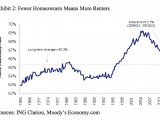
Furthermore, nearly 80% of renters surveyed believe that renting has been a positive experience for them and their families. Indeed, the homeownership rate steadily declined from 69% in the third quarter of 2006 to 66.9% in the third quarter of 2010, translating into approximately 2.3 million potential new household renters [Exhibit 2].

In our opinion, homeownership could continue to trend toward its long-term average of 65% over the next 12 to 18 months. Rental properties should continue to benefit from this trend.

--- END POST ---

Multifamily outlook is up!

From: National Multi Housing Counsel

WASHINGTON, DC – The apartment market’s rebound continues to gain momentum, according to NMHC’s latest Quarterly Survey of .

While the National Multi Housing Counsel focuses on the nationwide market for 50+ unit properties, the trends they have identified apply to the full spectrum of multifamily investments.  If you’re looking for Beaverton multifamily investments, or Vancouver Apartments…contact Rose City Commercial Real Estate:  rick@rosecitycre.com, or 503.577.1034.

Sales volume is up, debt and equity are more available and markets are tighter. Indexes for both sales volume and equity financing registered all-time highs.  The biggest improvement came in debt financing, which jumped from 58 to 81.

“Apartment market conditions continue to improve across the spectrum,” said NMHC Chief Economist Mark Obrinsky. “Indeed, the average for all four NMHC indexes set a new record for the second quarter in a row.”

“The strong responses in each of our last two surveys indicate widespread improvement over the last six months,” Obrinsky continued.  “Demand for apartment residences has substantially increased thanks to modest improvements in the jobs market and the continuing decline in home-ownership rates.  While the level of transactions remains subdued compared with the boom years of 2005-2007, activity is gradually growing from the low levels of late 2008-early 2009.”
“Going forward, the near-term outlook for the apartment industry is likely to be tied to the pace of job growth,” Obrinsky added.  “Over the longer term, positive demographic trends are likely to keep the demand for apartments growing.”
Key findings include (for all four indexes, figures above 50 indicate improving market conditions):
  • The Debt Financing Index increased dramatically, from 58 to 81, meaning borrowing conditions have improved. A full 64 percent of respondents said conditions for multifamily borrowing were better this quarter than last. This is the second-highest debt financing figure in the history of the series. Only three percent reported worse conditions.
  • The Market Tightness Index, which measures changes in occupancy rates and/or rents, rose from 81 to 83. Fully 69 percent of respondents said markets were tighter (meaning lower vacancies and/or higher rents). This was the sixth straight quarter in which this measure has risen, and is the highest figure since July 2006.
  • The Sales Volume Index increased from 72 to a record-setting 78. Sixty-one percent of respondents indicated sales volume was higher. This was the second consecutive record level in this index, and an indication of widespread improvement.
  • The Equity Financing Index increased again from a prior record 71 to a new
    record 73,
    indicating that equity financing is more available. Nearly half—48 percent—indicated that equity financing was more available; another record.  This is the seventh straight quarter of improvement for this index.

--- END POST ---

Apartments Stage Comeback-Renters Return in Surprising Numbers

Apartment Renters Return...In Surprising Numbers!by Ben Johnson from NREI

After two years of rising vacancies and slumping rents, apartment owners have reason to be cheerier these days.

According to the latest survey of 169 markets across the U.S. by researcher Reis, the national apartment vacancy rate peaked at a record 8% in the fourth quarter of 2009 and remained unchanged in the first quarter of 2010. Asking rents increased by a scant 0.1% in the first quarter, but that was the first gain since the third quarter of 2008.

When you hear that 1Q 2010 absorption rates were the best the nation has seen in a decade, Portland apartments, Vancouver multifamily…investment properties in the area are looking like better and better deals.

One economist has opined that he sees cap rates falling as more and more investors return to the market.

The best way to be a genius in five years is to make wise investments today.  Contact us:  503.577.1034.

Some 20,000 apartment units were absorbed in the first quarter of 2010, which is the strongest first-quarter showing in the past 10 years, according to Victor Calanog, director of research at Reis. “The multifamily market appears to be on the cusp of recovery. If so, pricing and transaction activity will rise and the window of opportunity for landing good deals may close soon,” says Calanog.

Rental demand drove the occupancy rate for downtown Chicago apartments higher in the first quarter, to 93.6% from 91.4% in the fourth quarter of 2009, according to consulting firm Appraisal Research Counselors.

The latest results surprised long-time industry watchers, including Robert Bach, senior vice president and chief economist at Grubb & Ellis. However, Bach is concerned about the abundant supply of empty condos and single-family homes that are entering the rental market in hard-hit areas like South Florida and Phoenix. He believes they are casting a shadow over traditional apartment communities, and siphoning off potential renters.

“I’m surprised the apartment fundamentals have bottomed out this quickly, but as long as there are these shadow units out there, then it’s going to be interesting to see if the apartment market can recover independent of that,” says Bach.

The rest of 2010 will be a telling barometer, notes Calanog. “The next two quarters will offer critical perspective as to whether positive rent growth is sustainable.” Calanog does expect the vacancy rate to improve over the next five years, dropping to 6.6% in 2014.

Unemployment stings young Americans

Certainly one of the most closely watched keys to the short-term apartment market turnaround is the jobs picture. According to the U.S. Bureau of Labor Statistics, the U.S. economy added 290,000 jobs in April, the largest gain since March 2006. That followed a revised 230,000 increase in March. Still, the overall unemployment rate rose from 9.7% in March to 9.9% in April, a sign that more Americans are starting to look for jobs.

According to some observers, danger lurks at the deep end of the renter pool. The primary renter market base, people aged 20-30, comprises 70% of the total U.S. apartment market, and that segment is recovering more slowly than others.

As an example, the unemployment rate among Americans aged 20-24 was 15.8% in March, but jumped to 17.2% in April. “The unemployment rate for young people has climbed faster than it has for the labor market in general,” says Sam Chandan, global chief economist and executive vice present at researcher Real Capital Analytics.

According to Chandan, the rental pool is not being supported by new entrants of young people graduating with jobs. “We need job growth among the younger age groups to drive apartment demand. There’s got to be some replacement there.”

Compounding the situation, one of the biggest challenges to recovery in this market is older, more skilled workers who are willing to take lower paying jobs just to find work. Typically this segment is more inclined to own rather than rent. “This is an issue that’s going to weigh on the performance of the apartment market,” says Chandan.

--- END POST ---

Apartment Sales Volume Up; More Money Available

Not only thawing, but heating up!

This is another great CoStar multifamily article by Mark Heschmeyer:

The apartment market continues to rebound from the “Great Recession” according to the National Multi Housing Council’s (NMHC) latest Quarterly Survey of Apartment Market Conditions.

Sales volume is up, debt and equity are more available and markets are tighter, according to respondents. For the first time since October 2005, all four survey indexes recorded better market conditions than three months ago. Indexes for both sales volume and equity financing registered all-time highs.

Contact Rose City Commercial Real Estate today to bring the recovery to Portland:  503.577.1034 or rick@rosecitycre.com

The biggest improvement came in market tightness, which jumped from 38 to 81.

“There is clear improvement in apartment market conditions on all fronts,” said Mark Obrinsky, NMHC chief economist. “We saw a sharp increase in the market tightness index, which fits with the surprisingly strong (for a seasonally weak period) effective rent growth. And the all-time highs recorded by the sales volume and equity financing indexes offer even more reason for optimism.”

“Even so, a sustained recovery in the apartment market needs a firm economic and demographic foundation,” Obrinsky added. “While the long-term prospects for the industry are bright, in the near-term the industry’s prospects still depend upon a stronger rebound in both the job market and household formation.”

Other key findings:

— The market tightness index, which measures changes in occupancy rates and/or rents, rose sharply from 38 to 81. This was the highest figure in nearly four years. Fully 64% of respondents said markets were tighter (meaning lower vacancies and/or higher rents). Only 2% reported looser markets. This is the sixth straight increase for this measure.

— The sales volume index increased to a record-setting 72 from 56. 48% of respondents indicated sales volume was higher. This is the highest ever reported and represents a nearly complete reversal from a year ago, when 43% said it was lower.

— The equity financing index increased further from 66 to a record 71, indicating that equity financing is more available. Nearly half indicated that equity financing was more available; another record. Only 3% thought equity financing was less available. This is the sixth consecutive quarter this index has improved.

— The debt financing index also increased, from 49 to 58, meaning borrowing conditions have improved. 18% said conditions for multifamily borrowing were better this quarter; nearly 80% indicated that borrowing conditions were unchanged. Only 2% said conditions were worse.

--- END POST ---

Scroll to Top