Multifamily

Portland Multifamily Shift Means Opportunity

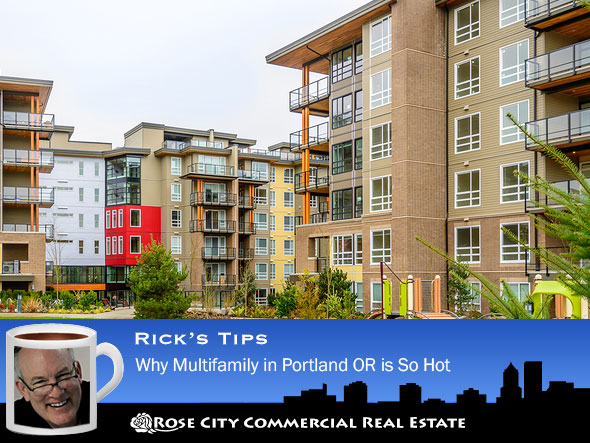
Brand new apartment building available for sale.

Improvement!

Rose City Commercial Real Estate is pleased to report that the Portland multifamily market is experiencing a significant increase in the availability of good multifamily properties for sale.  Just a year ago some of our multifamily Sellers elected high quality STNL (Single Tenant Net Lease) assets for their 1031 Exchange second legs…because there simply were no good multifamily assets available.  Rose City Commercial Real Estate’s marketing was focused exclusively on finding “off-market-but available” properties.  Now First Leg Sellers who become Second Leg Buyers have enough properties to choose from that they are much more likely to find an asset that meets suits their acquisition criteria closely.  I recently saw 7 multifamily properties listed in a single day!

The Change

One year ago there were only 15 or 20 multifamily properties available in the area. Contrast that with today:  within a 30 mile radius of our Lake Oswego office there were 67 multifamily properties for sale from $1,000,000 to $7,500,000:

57 existing properties

5 under construction

5 in the planning/pre-construction phase.

What It Means

With proper planning and assistance apartment owners can sell current assets and be in great shape to identify a Second Leg Property from the properties being marketed.  It also means if you want to expand your portfolio it makes sense to work with a knowledgeable Buyer Broker.

For more information, contact Sales@rosecitycre.com, or call Rick Bean at (503)577-1034.


--- END POST ---

ROSE CITY CRE IS GROWING


We are proud to announce that recently licensed Patrick J. Finney has placed his Real Estate license with Rose City Commercial Real Estate (RCCRE).

Patrick has a 25 year record of success in Marketing and Sales Management experience for Tektronix, Fairchild and other high tech manufacturers. He will work on marketing exclusively.

SUCCESS: When I tell you that working part-time he generated leads that turned into $17.3 Million of closed business for Rose City Commercial Real Estate…you’ll understand why we’re delighted to have him aboard!

FOCUS: Multifamily investors can relax. Patrick is very good at finding off market opportunities for 1031 Exchange Investors…in this market that is a real difference maker.

WELCOME PATRICK! Feel free to contact Patrick J. Finney about your real estate investment needs at PH: (503)577-8670, or EM: Sales@rosecitycre.com.

--- END POST ---

Why Portland Multifamily is So Hot


This is “Rick’s Tips” with Rick Bean, Principle Broker at Rose City Commercial Real Estate, rosecitycre.com. This episode we’ll learn why the Portland, Oregon multifamily commercial real estate market is a great investment right now.

The reason why Portland multifamily is so hot, is that Portland is enjoying a great reputation for returns from investors not just locally, but nationally. There’s a lot of money pouring into Portland and one of the reasons why is the last five years we’ve had extremely low vacancy rates. Even though there’s a lot of product being built now, anywhere you go you see it. Over the last ten years has been very little built, so even that is not destroying the vacancy rate.

Read or Click to Listen

Even with lots of new multifamily units being built in Portland, vacancy rates are staying low and demand is staying high?

Huge demand. As a matter of fact, millennials are loving Portland. It is a preferred destination. Also, our tech industry is booming here. Nike’s doing well, Oregon is doing well as a whole. Oregon has lead the beacon survey, that’s the ratio of people moving out versus the people moving in. Oregon’s lead the nation the last four years and I don’t think it’s any surprise that Portland has been the driver of that.
New construction in Portland has been slow. Is that changing now, and will that raise vacancy rates?

Over the last ten years there’s been very little built. Now certainly the last few months there’s been a huge increase. Even that is not enough to wipe out all the years that there was nothing built combined with the influx of population. Portland’s the new hip place to be. Young millennials are flocking here in droves. Even with all the product being built, vacancy rates have not soared. We would expect them to soar with the amount of product currently being built, but that’s not happening.

What’s happening next in Portland multifamily real estate?

I see for the near term for vacancy rates to stay relatively low. I don’t think we’re going to see as rapid an increase in lease rates, but I think it will be somewhat stable. I think it will continue to go up. There are some laws that are not entirely favorable to investors, and yet people are still moving here and it has not changed the availability at all. One of the hardest things to find right now in Portland, is an apartment complex for sale. One of the reasons for that is they’re so desirable to multifamily investors.

There you have it…in just about the time it takes to enjoy a cup of coffee you’ve expanded your knowledge of commercial real estate. To learn more about leasing, buying, selling or investing in commercial real estate, contact Rick Bean at 503.577.1034 or sales@rosecitycre.com.

--- END POST ---

Golden Age of Multifamily for Portland Investors?

Why do I think we may be entering a new “Golden Age of Multifamily” in Portland?  Maybe we aren’t there yet, but the fundamentals are changing to create it.

Nationally the peak of homeownership spiked at around 69.2% in 2004-2005…the balance was primarily renters.  Now the national rate for homeownership has dropped to about 65.4%.  With interest rates at all time lows, why isn’t there a flood of buyers?  Many don’t have high enough credit scores, but easing underwriting guidelines weaken that argument.  The truth is that more and more of the prime candidates for first time buyership are choosing to rent even though buying is within their means.  This is not merely anecdotal…the hard data shows the shift.  Remember, a 4.2% discount isn’t much of a sale. Being 4.2% older isn’t that big of deal.  But 4.2% of a 312,000,000 person country changing where they live is huge.  That’s over 10,000,000 people.

“The decline in homeownership rates is really a correction of the housing bubble,” said James W. Hughes, dean of the Bloustein School of Planning and Public Policy at Rutgers University, in reference to a new census report that found homeownership nationwide had fallen to a 15-year low of 65.4 percent, versus a high of 69.2 percent in 2004. “There were many people who shouldn’t have been homeowners, and now they’re not going to be.”


--- END POST ---

No Money Down Apartment Investing Deals = No Brains?

Multifamily Apartment BuildingThe Apartment Investing Market is heating up as a result of dropping vacancy rates, pent up demand entering the market, and the return of readily available low cost financing.  This is further enhanced by the low build rates over the last 5 years.  The bankers that wouldn’t return my calls 3-4 years ago think I’m a pretty cool guy again and even want to treat me to lunch.

As the current cycle goes on banks will see less and less risk and they’ll drop their DSCR’s (Debt Service Coverage Ratios) lower and lower. Debt service is paid after all operational revenues and expense have been accounted for.  In other words…its the ratio of NOI (Net Operating Income) divided by the Principle and Interest payment.  Before the crash there were some loans that were 1.15 DSCRs some were even lower.  This is risky, but it allows you to buy a lot more for your equity…in a rising market this is like having your own slot machine.  In the bad times of finance we saw some banks suspend lending at all DSCRs, while those that remained lending were at 1.4o.

The second effect of good times is that banks will increase the LTV (Loand to Value) ratios. That means for less money down you can buy more property.  Right now you can get 82% LTV debt.  That means you can buy a $1,000,000 with 180,000 equity down.  In the harder times of finance many banks were only going as high as 55% LTV.  That translates into a requirement of $450,000 of equity to get the same return as you can now get for $180,000.  The higher the LTV the more leverage you are employing.  When times are good, it is leverage that makes “Cash Cows” that produce amazing amounts of profit.  The downside?  If the market turns your “Cash Cow” can turn into a “Cash Alligator”, an animal with an appetite for cash reserves.

I am a fan of sound levarage. If there is one thing the wise ones learned from the last cycle is that what goes up will come down. An acquisition strategy with sufficient DSCR and low enough LTV financing to ward of the darker days is important.  One of the very best of the real estate investment gurus is John Wilhoit Jr.  The article that follows is from his blog…where he shares his concerns about buying without enough skin in the game:


The Dangerous Game of No Money Down Deals

by John Wilhoit Jr. on November 6, 2012

Attempting ye old standard “by the book” cookie cutter tactics lamely taught over and over again for single-family investing and applying this to a commercial multifamily deal is a recipe for disaster.  In fact, it is a very dangerous game as the end result is that you, the brand spanking new owner of that apartment property, probably have risk your entire net worth for the privilege.  Congratulations, cliff dweller.

When was the last time you were, figuratively speaking, thrown under a bus?  With respect to nothing down deals, too often people go willingly- under the bus.  Year in and year out we get emails seeking guidance on multifamily deals where the buyer has limited or no capital; the proverbial nothing down deal.  Lets me be succinct: DON’T DO IT!  There. I said it.

Few people seem to appreciate this response prior to gushing with deal specific particulars.  Doesn’t matter- don’t do it. I don’t care if your uncle is giving you the deal of a lifetime.  Sounds harsh, doesn’t it? Let me explain.

Maybe your uncle is a really nice guy, you took care of him when he broke his ankle and he’s doing a good deed in return.  With a three million dollar deal where the first mortgage is two million and Good Uncle is taking back a second for a million, you are toast (good intentions or not).

First of all, on the surface, Good Uncle has set the purchase price at three million.  Are you going to spend a few thousand on a commercial appraisal to validate that a reasonable price is three million?  At this level of leverage (100% financing) every available dollar will be going to debt service.  In reality, there will likely be a monthly deficit.  How will your relations be if the payment due on the second mortgage  is $5,000 monthly, but the asset is only kicking out $3,000 monthly?  Uncle wants his money.  After All, you bought the deal.

Second, what makes you so special?  Why are you being offered this deal? Is it your good looks, because you dress well?  What do you bring to the deal?  Consider the following:

If the answer is the ability to “fog a mirror” and “sign a paper” then these talents have nothing whatsoever to do with acquiring a quality multifamily asset AND having skills to run the deal- no matter the capital stack.  The capital stack is just one component of Multifamily ownership and asset management. Yet so many people get caught up in this segment of the deal that every other aspect becomes diminished.  This is tragic.  Why? Because while getting this right is imperative, it is just one leg of the table.  And a single strong leg does not a table make.

Most people selling a nothing down deal are looking to get out of Property Management.  They didn’t really know what they were getting into when they bought this asset and it’s kicking their butt- property management, vendors, dealing with tenants- this is not what they signed up for.  After trying to sell the deal and failing, they come up with the bright idea to sell the deal to someone they know for nothing down.  This is in the same category as living with you mother-in-law; it works sometimes, but is generally a bad idea.

So here you come, with limited input on Deal Structure, maybe some property management experience, and limited to No Working Capital.  You are… crispy toast just waiting to happen.

It really boils down to Capacity.  Yet, capacity by itself is not enough to make the deal work if every other aspect is out of whack with reality (including valuation).

So for those un-convinced, for the brave few that wish to proceed, please consider the following:

1. The transaction should be provided the same or more due diligence than any other deal- more actually because of the significant threat posed to your personal net worth.

2. The transaction should be arms length.  Meaning even if the sellers are known to you, there are no short cuts. Hire the same service providers you would for any other deal; appraisal, closing, attorneys, environmental, etc.

3. Listen to your attorney with respect to the assumption of existing debt.  Assuming a commercial loan has more thorns than any rose bush.  Getting it right requires quality counsel.

4. If DSC (Debt Service Coverage) is 1.0 or less ($1 of Net Operating Income  to pay for $1 of monthly debt  obligations) then you must have cash on hand to address any shortfall from day one.  And for the next month, and the next if necessary.  Otherwise you are dead in the water on the day of closing unless you have a source of funds for that unexpected, un-anticipated, yet immediate, $5,000 monthly negative).

5. Identify and price property management. If you have no experience in property management, this is not the time or place to learn the trade.  If you do have property management experience, great, cost out work and time required to address the asset. If the time required to manage is beyond your abilities, then you must hire a manager or PM company.  Factor these cost in.

Other articles you may like:

Multifamily real estate investment basics – part 1 of a series | Rose City Commercial Real Estate

Demystifying Selling Multifamily Assets | Rose City Commercial Real Estate

Insurance Costs Down for Apartments | Rose City Commercial Real Estate

REIT Multifamily Equity Index Surges | Rose City Commercial Real Estate

--- END POST ---

Michael Kapnick: The way investment real estate ought to be done!

Many investment real estate brokers view the market as having limited buyers and sellers, and they never compliment another broker or give ’em a break.  Those holding that viewpoint are sure to be disappointed by this post. I am grateful for the opportunity to work with a real estate professional like Michael Kapnick of Marcus & Millichap.  He’s one of the very best.  We  closed a multimillion dollar deal for a Medical Office Building recently.  He represented the Seller, I represented the Buyer.  It started out to be an all-cash, quick close deal.  We both had the luxury of great clients…no finance contingency…what could possibly go wrong? Everything! There was a litany of challenges, but the Preliminary Title Report problem stands out.   Five (5!!) lawyers, each representing a different viewpoint became involved.  Michael and I vigorously represented our clients and often disagreed with each other, but we were never disagreeable.  Despite weeks of negotiations and multiple creative proposals we canceled the deal and the Earnest Money was returned. Because Michael and I worked well together, we kept in touch, even when he found a new buyer.  When the new buyer faltered and went out of contract, Michael and I came up with a solution that created a win-win for both parties…and we closed. I’m proud to work in an industry whose elite pros demonstrate tenacity, creativity, and customer focus like Michael Kapnick.

For creative investment real estate solutions contact Rick M. Bean of Rose City Commercial Real Estate at 503.577.1034 or rick@rosecitycre.com.   August 2014 update:  I continue to work with Michael Kapnick on deals, and my respect for him continues to grow.  I have even referred business to him even though we work at competitive brokerages.


Other articles you may like:

No Money Down Apartment Investing Deals = No Brains? | Rose City Commercial Real Estate REIT Multifamily Equity Index Surges | Rose City Commercial Real Estate Commercial Investment 101| Rose City Commercial Real Estate

--- END POST ---

Recommended: John Wilhoit Jr.’s Multifamily Blog

Optimizing multifamily profitability is a bit art and a bit common sense.  Two areas where underperforming will impact cash flow are: 1. Failure to work renewals proactively, and 2. Poorly managed “Make Ready” costs.  Below is an article by John Wilhoit Jr. with some great pointers on both.  Click on the title to go to his site for additional great articles…he’s the real deal.


Multifamily Make-Ready’s Made Easy

by John Wilhoit Jr. on October 18, 2011

The best way to assure easy make-ready’s is to have as few as possible, right?  How to make that happen?  With an earnest focus on lease renewals.  Focusing on renewals reduces turnover.  Concessions at lease renewal are almost always less expensive than turnover expenditures.  Be it carpet cleaning, painting an accent wall or a few new light fixtures, any of these require less cash than a full make-ready.  Considering potential days vacant they are a bargain.

What else makes make-ready’s easy?  Preparation.  Preparation is having a handle on the resources required to perform make-readys thirty days prior to requiring those resources.  By resources we mean lining up labor, material and equipment. Simple, right?   But where to store that roll of carpet??   We’ll get back to that.   More importantly make-ready’s begin with the lease renewal process.

The backbone of being prepared for make-ready’s is in the leasing renewal process.  Lease renewals are your “leading indicator” to up-coming turnover, right?  Without  pro-active renewals it is impossible to prepare for pending turnover.  Renewals cannot be taken for granted.  Beginning the renewal process 90 days prior to the end of the lease term, anymore, is becoming standard operating procedure and represents the best tool in preparing for make ready’s.

Back to carpet.  Most major metro’s have a selection of vendors on carpet.  Inquire with yours about their ability to store rolls for you (whole or part) for free.  The caveat is that they will want you to use their installers.  Well, if you are doing this anyway this is a win/win.  You obtain free carpet storage and your vendor knows you think of them as your “one stop shop” for carpet and installation.  This is built-in work for the vendor going forward as the roll is used up.

Be fast, but do not be in a hurry – John Wooden (Legendary UCLA basketball coach)

Few property management companies keep much inventory on hand anymore.  Many of us consider Home Depot and Lowes as our inventory warehouse.   But when it comes to turnover a lack of inventory can add days to units being off-line.  So stock certain  items in advance because, as you know, most properties in your market area are in turnover mode at the very same time.   To remedy this, if there is no other on-site storage, consider utilizing a vacant unit for temporary storage.

Let me repeat; consider utilizing a vacant unit for temporary storage- only.  If there is any chance this “temporary” staging/processing area will become permanent just pass- don’t do it.  Now, assuming use as a temporary staging/processing area is available then only place boxed, non-liquid and light weight materials here.  No paint, no HVAC units.  Items include; blinds, air-filters, plumbing and light fixtures (boxed),

The positive outcome to having a systematic make-ready structure is minimizing unit down time, or off line days per unit.  Most professional management software will have a report option for tracking this.

Then there is the paperwork.  Any and all advanced documentation in hand will decrease days off line.  Performing a pre-exit walk-through when the tenant notifies of move out places your team in position for quick turnovers.

Electronic files, paper files, personnel- Oh My!  It is true, your best maintenance guy can fix anything. Even so, getting him to put down the paint brush and plumber’s putty to type a few words into an iPad is very unlikely.   For some processes paper is still our best friend.  Having a record paper record of turnovers is important, albeit a two-step process; converting paper records into electronic documentation.    It is a worthwhile step to avoid duplicity and track inventory.

Other articles you may like:


The Importance of Due Diligence in Multifamily Profits – Phase II – Books and Records | Rose City Commercial Real Estate

Demystifying multifamily cap rates, NOI, and investing basics | Rose City Commercial Real Estate

Multifamily real estate investment basics – part 1 of a series | Rose City Commercial Real Estate

Attractive cap rates attract investors to multifamily properties in Portland | Rose City Commercial Real Estate

Prospects for multifamily sector improve greatly | Rose City Commercial Real Estate


--- END POST ---

Strong Demand, Tight Supply Build Case for New Multifamily Development

Investors continue to prefer U.S. apartment buildings over most commercial properties, even commercial office space, as total multifamily sales volume jumped nearly 80% in the second quarter over the same perioud last year.

Although still just a fraction of its mid-2007 peak, the nearly $15 billion in sales in the quarter brought total investment for the first half of 2011 to $24.5 billion, according to CoStar Group data.

The average per-unit price of apartment properties reached $88,500 in the quarter — the highest since the third quarter of 2008, said CoStar Global Strategist Michael Cohen during CoStar’s Mid-Year 2011 Multifamily Review & Forecast.

FREE:  Rose City Commercial Real Estate will give you a no cost opportunity to develop a long term investment plan customized to your goals.  Portland multi-family investments are poised for solid gains.  Contact Rick Bean now at: 503.577.1034 or rick@rosecitycre.com

Meanwhile, strong renter demand continues to push down apartment vacancy rates and nudge up rents. With capitalization rates for existing properties seeing strong compression in some high-flying markets, larger multifamily developers have responded by starting to ramp up their development pipelines with new projects.

Top coastal markets continued to dominate sales volume in the first half of 2011, including Washington, D.C with $2.6 billion; Los Angeles, $2.3 billion and the San Francisco Bay Area, $2.1 billion. In Atlanta, where investors have sought a large number of distressed properties, sales totaled $1.3 billion in the first six months. In Phoenix, a housing bust market where fundamentals have picked up markedly, also logged $1.3 billion in sales.

For the second quarter, the top five transaction markets were New York City, with $1.35 billion; D.C., $1.3 billion, Los Angeles, $1.21 billion; Atlanta, $764 million and San Francisco, $689 million. Those markets accounted for about 36% of all sales volume nationwide during the quarter, with CBDs and well-located submarkets seeing the lion’s share of deals.

Institutional investors were by far the most active net apartment buyers, with net purchases of $1.6 billion on total acquisitions of $3.9 billion. REITs, private equity and owner/users were also net buyers, while REITs were also net sellers in a few markets such as Portland, Phoenix, the San Francisco Bay Area and Atlanta.

Average apartment capitalization rates continued to fall in the second quarter to slightly below 7%, while weighed average cap rates, driven by the large high-priced transactions in prime markets, declined to 5.7%. However, cap rates for mid-size value-add and opportunity deals are also declining. Cap rates on smaller transactions remain in a holding pattern.

Top deals in the second quarter included the acquisition of a 25% interest in a 20-property foreclosed portfolio by The Related Cos. from Fannie Mae for about $300 million; TIAA-CREF’s acquisition of The Corner at 200 West 72nd St. in New York from Gotham Organization and Phillip International for $209 million, or 1.07 million per unit; and Canada Pension Plan Investment Board’s $84 million acquisition of a 44% interest in a 654-unit property in Seattle from New Tower Trust Co.

Supply Tight Now, But Construction Starts Are Rising

Job growth has been the traditional source of apartment demand in the past. But in this cycle much of the demand is coming from many former homeowners who have become renters since the beginning of the housing crisis. That trend, combined with a growing number of young people forming households, is driving competition for a diminishing supply of apartments, powering the improvement in apartment fundamental since 2009.

CoStar forecasts total supply additions of just 30,000 units in the 54 largest markets in 2011, just one-third of the pre-recession average of apartment delivered between 2003 and 2008. However, multifamily construction starts are starting to tick up, with more than 70,000 starts in the first two quarters of 2011, suggesting a rise in completions in coming years, particularly in the 2013-2015 time period, Cohen said.

“It’s worth paying attention to the supply front,” Cohen said. “This is where I think the apartment market could be a victim of its own success. While we are forecasting below-average annual supply growth, we need to monitor the permitting data and the starts data.”

Vacancies, Rent Concessions Continue to Decline

Renter demand, while not at the outsized levels of 2010, remains very strong across the board, led by the fast-growing southern metros and the rebound in Detroit. Demand growth equaled about 66,000 units in the first half compared to the extraordinary increase of 105,000 units in the first six months of 2010, which was the strongest since 2005. However, the 45,000 units absorbed in the most recent quarter was more than the absorption of the two previous quarters combined, Cohen noted.

Other articles you may like:


The Importance of Due Diligence in Multifamily Profits – Phase II – Books and Records | Rose City Commercial Real Estate

Demystifying multifamily cap rates, NOI, and investing basics | Rose City Commercial Real Estate

Multifamily real estate investment basics – part 1 of a series | Rose City Commercial Real Estate

Attractive cap rates attract investors to multifamily properties in Portland | Rose City Commercial Real Estate

Prospects for multifamily sector improve greatly | Rose City Commercial Real Estate


--- END POST ---

Multifamily Real Estate Investment or “How Not To Lose $1T In A Day”

Here are some good reasons why multifamily real estate investment is a good strategy for those seeking conservative investment opportunities.

On May 6, 2010 NYSE stock values took a roughly $1,000,000,000,000 (trillion dollar) hit in about 20 minutes. Fortunately we discovered it was only a glitch in the automated trading programming and not a reflection of broader investor sentiment.  Stocks rebounded in short order.

Yesterday, August 8, 2011 it took much longer (all day) for the Dow Jones Industrial Average to drop 635 points, losing 5.6% of it’s value. Again that’s roughly $1,000,000,000,000…a trillion bucks.  Today investors bought back in and the market rebounded, regaining all but a few hundred billion dollars of the past day’s losses. Ouch!

It’s almost like we have our 401K’s and our stock portfolios being tended by a blindfolded drunk careening around.  Hang on, we might make or lose a ton of money.  Now on the more conservative side we have our bond holders.  Yesterday’s close at 2.182% for 10-year Treasuries is scarier in a way than the NYSE: At least with stocks you could make some money. Take a million dollars worth of bonds, pay taxes on the 2% profit and lose 2.7% due to inflation and you’re guaranteed a loss.  Nobody won the Warren Buffet Excellence in Investing Award by only losing .8% a year.

I am not trivializing the large losses of the one group, nor the guaranteed loses of the other.  It’s just that I believe investing in commercial real estate has an answer for each of them.  Over the next few posts I will detail varied multifamily acquisition strategies.  The next in the series is: Multifamily Acquisition Strategies for the Conservative Investor.


--- END POST ---

The Sky’s the Limit for Portland Multifamily Real Estate Investment

The Portland multifamily real estate investment community has had a lot  to smile about thus far this year:

  • Maximus Advisors, a multifamily research firm states that we are entering into four years of improving conditions for multifamily real estate investment.
  • Portland’s 4% occupancy rate was cited recently as being the second lowest in the nation’s 75 largest MSAs.
  • We were also cited as having the second highest rate of rent increase at 10.43% on an annualized basis.
  • Please note that is the average for the quad counties…Beaverton had an even higher average increase at 13% annualized.
  • Larger rent increases ahead?  As we get closer to 2% vacancy we will see even faster and larger rent increases.  Remember that it takes a week or two to turn a unit.

Much less reported, but much more important to net profitability is the virtual disappearance of

If you are ready to expand your real estate investment portfolio into real estate, contact Rick Bean of Rose City Commercial Real Estate at: 503.577.1034 or rick@rosecitycre.com.   Two things to remember: 1.  If you want to be a genius in 5 years, make smart real estate investments today. 2. Nobody is going to consider you an Einstein for almost taking action.  Call today.

leasing incentives.  I worked the Vegas market in property management during its decline from superstar status to cellar dweller.  On several institutional size properties we were giving away 2 months for a 12 month lease.  That’s 1/6 of the total gross revenue…16.66 almost 17%.  Other companies were giving away a flat screen TV as an incentive.

That’s a hell of a swing, moving from having to give away 17% of your gross rent to maintain 12% vacancy…into having 4% vacancy and adding 10% to your revenue.

Financing from traditional sources is returning to the market, as is conduit debt, GSE agency and insurance lending.  With rents rising, affordable financing becoming readily available and record low building levels, the national multifamily investment market looks solid for some time to come.  And Portland appears poised to be one of the nation’s leaders!


--- END POST ---

Scroll to Top