Looking for tax savings?

Study building costs to up cash flowBaltimore Business Journal – by Gary Anderson

Cost Seg Saves Money!
Optimizing your investment

Cost segregation, though known by many real estate owners, is sometimes overlooked.

It is a methodology used to reallocate certain building costs into separate identifiable components that can be depreciated over shorter lives. The primary purpose of a cost-segregation study is to reallocate as much building costs between land improvements and tangible property. The more costs allocated to tangible property, the greater the desired tax benefit. Tangible property creates tax benefits because it is depreciated over five or seven years while normal building costs are depreciated over 27.5 or 39 years.

A cost-segregation study may be performed for real estate already in service, for new construction and acquisitions. Generally, it is easier to analyze a building’s cost structure during initial construction or expansion since building plans are readily available and can be utilized to identify various components that may qualify as tangible property.

Costs that may be reallocated to land improvements consist of, but are not limited to, certain landscaping, sidewalks and fencing which are depreciated over a 15 year recovery period.

Costs that may be reallocated to tangible property include movable partitions, furniture, removable carpeting and wallpaper, certain fixtures and window treatments. Support systems that are needed to run certain equipment or machinery could be considered tangible property under certain circumstances.

There are several internal levels of cost-segregation studies ranging from a detailed engineering approach through a less formal rule-of-thumb appraisal. The Internal Revenue Service prefers the engineering approach since it will produce the most accurate results.

All businesses that acquire, construct or renovate real property would benefit from a cost-segregation study.

The real benefit of a properly documented cost-segregation study is the enhanced depreciation deductions it yields. A major advantage of the study is not necessarily that it produces more depreciation deductions, but that expenses accelerate more rapidly, producing a greater benefit due to the time value of money.

The ability to write off specific components identified as they are replaced is yet another advantage. For example, when a study is performed, the cost of the roof would be specifically identified. As the roof will eventually be replaced, the remaining cost could be written off.

One disadvantage of a cost-segregation study is the potential triggering of depreciation recapture and possible understatement penalties a taxpayer could incur for studies that are too aggressive in classifying costs. To avoid penalties and pass IRS scrutiny, the study must be objective and supported by contemporaneous records. Studies supported by an engineering study add credibility and produce the most accurate cost allocations.

Overall, cost-segregation studies can produce tremendous tax savings for those who build, acquire any business that builds, acquires or renovates property. The increased tax savings increase cash flow, which in turn, businesses can reinvest.

Gary Anderson, a certified public accountant and senior manager at Reznick Group P.C. in Baltimore, can be reached at gary.anderson@reznickgroup.com.

--- END POST ---

Distressed Commercial Real Estate Assets Jump 15%

FEATURED AUTHOR:   Mark Heschmeyer

The amount of distressed commercial real estate assets on the books of the nation’s banks and thrifts approached $60 billion as of year-end 2009. That is up from $52 billion just three months earlier, a 15% increase.

The $59.9 billion includes loans on multifamily and nonresidential income producing-properties that were 90 or more days past due, or in nonaccrual or foreclosure status.

The year-end numbers are contained in the Federal Insurance Deposit Corporation’s latest Quarterly Banking Profile, released this week. And they confirm that commercial real estate troubles are eroding the balance sheets of the nation’s banks.

As the CRE distress numbers went up, so did the number of troubled institutions on the FDIC’s “Problem List.” At the end of December, there were 702 insured institutions on the Problem List, up from 552 on Sept. 30. In addition, the total assets of “problem” institutions increased during the quarter from $345.9 billion to $402.8 billion. Forty-five institutions failed during the fourth quarter, bringing the total number of failures for the year to 140, the highest annual total since 1992.

The FDIC does not release the identity of the banks on its Problem List.

Loans on nonresidential income-producing properties that had been foreclosed on increased from $5.84 billion to $7.05 billion – a 21% increase.

Loans on multifamily properties that had been foreclosed on increased from $1.44 billion to $1.75 billion – a 22% increase.

Loans on nonresidential income-producing properties that were 90 days or more past due or were in nonaccrual status increased from $37.05 billion to $41.74 billion – a 13% increase.

Loans on multifamily properties that were 90 days or more past due or were in nonaccrual status increased from $7.75 billion to $9.39 billion – a 21% increase.

Reserves for loan and lease losses increased by only $7 billion (3.2%) in the fourth quarter, as institutions added $8.1 billion more in loss provisions to their reserves than they took out in net charge-offs.

Total net charge-offs totaled $53 billion, an increase of $14.4 billion (37.2%) over the same period in 2008. The annualized net charge-off rate rose to 2.89%, up from 1.95% a year earlier and 2.72% in the third quarter of 2009. This is the highest quarterly net charge-off rate reported by the industry in the 26 years for which quarterly data is available. Banks charged off 0.77% of their loans on nonresidential income-producing properties, up from 0.62% in the previous quarter. Banks charged off 1.11% of their multifamily loans, up from 0.92% in the previous quarter. This was the sixth increase in as many quarters in both categories.

For related CoStar coverage, see “http://www.costar.com/News/Article.aspx?id=6A579770FF5EC1CFD05D7036BE366D25

The average coverage ratio of reserves to noncurrent loans and leases fell from 60.1% to 58.1%, ending the year at the lowest level since midyear 1991. In contrast, the industry’s ratio of reserves to total loans and leases rose from 2.97% to 3.12% during the quarter, and is now at its highest level since the creation of the FDIC.

Not surprisingly, the total amount of commercial real estate loans on bank books was flat. Banks posted only $2 billion more in CRE loans at $1.092 trillion. The total amount of multifamily loans decreased slightly from $216 million to $211 million.

Despite the troubles in their CRE portfolios, commercial banks and savings institutions reported an aggregate profit of $914 million in the fourth quarter compared to $37.8 billion net loss a year earlier. More than half of all institutions (50.3%) reported year-over-year improvements in their quarterly net income.

Almost one-third of all institutions (32.7%) reported net losses for the quarter, compared to 34.6% a year earlier. For the full year, banks reported net income totaling $12.5 billion – up from $4.5 billion in 2008.

Do you want to increase your investment stake?  Whether your Want Vancouver, WA multifamily, or Lake Oswego Apartments, call Rose City Commercial Real Estate at 503.577.1034

--- END POST ---

Private Equity Investors To Boost Real Estate Allocations in 2010

Good news for real estate investors!


By Ben Johnson, NREI contributor


What did private equity investors, including huge institutional players such as pension funds, learn most from the recent collapse in commercial real estate values? They want more of the asset class.
A new study of 90 global private equity real estate investors by London-based researcher Preqin confirms that instead of fleeing to the hills, institutional investors intend to commit more capital to private equity real estate funds in 2010 than they did in 2009. And surprisingly, none of the participants in the survey conducted in the fourth quarter of 2009 has abandoned commercial real estate.
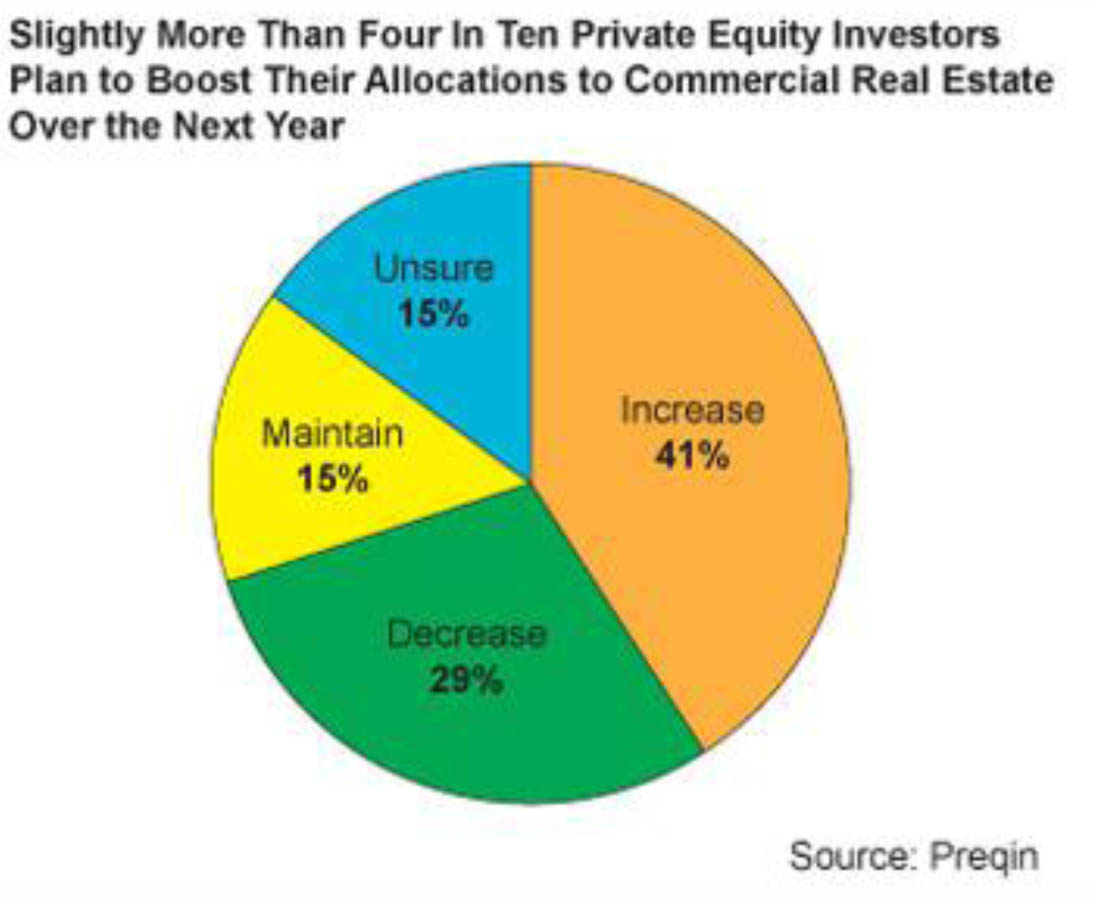
In fact, 41% of investors plan to increase their investment in the sector, while 29% expect to invest less than last year. Another 15% say that they will maintain their allocations, and the remaining 15% are unsure as they await the bottom of the market and recalibrate their strategies accordingly.   

Overall, the survey results suggest that “confidence is returning and investors are feeling more optimistic about the asset class,” says Forena Akthar, co-author of the Preqin study.

Hesitation lingers

Despite the apparent optimism, investors have not completely thrown caution to the wind when it comes to investing in real estate, whether making direct investments or committing capital to private equity funds. According to the survey, 55% of private equity real estate investors made no new fund commitments in 2009.
That helps explain the huge decline in private equity real estate fundraising activity. According to Preqin, the total capital raised in 2009 equaled just 31% of the levels reached in 2008. In all, 103 funds closed in 2009 with total commitments of $42 billion.   

Of those investors who plan to invest in commercial real estate in 2010, only 29% could estimate the number of funds they would invest in, and only 24% had an approximate figure in mind for the amount of capital they would commit.
These figures are much lower than in previous years, when most investors could more clearly predict both the number of funds and the amount of capital they would invest over the next 12 months.
When it comes to the long-term view, however, 75% of investors surveyed remain bullish on the real estate sector. “Despite the gloom, many investors did not lose confidence in the long-term benefits of investing in private equity real estate. They simply were not investing in 2009,” says Akthar, the survey’s co-author.
According to Preqin, returns from private equity real estate funds topped the S&P 500 Index by 35.8% over the past five years.
One long-time institutional advisor, Ted Leary, head of Los Angeles-based Crosswater Realty Advisors, thinks investors will cautiously re-enter the real estate game. He also notes that investors will be in a stronger position to dictate terms, including a reduction in fees, with their fund managers.
“The real estate investment manager community needs to regain the trust of their investor clients,” says Leary. “Some managers will, some managers won’t.”
When and where?
Nearly six in 10 investors (58%) plan to make their real estate investments in the first half of 2010. The remaining 42% are uncertain about when they will make a move in 2010.
And when they do pull the trigger, U.S. investors will likely stick close to home. That means potentially less capital for emerging property markets like China and India.
Not surprisingly, the vast majority of investors (73%) also are shifting their focus to target the two pillars of the commercial real estate industry — debt and distress.
“While investors are still attracted to value-added and opportunistic funds, a growing number of investors are looking to capitalize on opportunities presented by the dislocated real estate market,” says Stuart Taylor, a senior real estate analyst at Preqin.
The largest of these commercial real estate investors — targeting both mortgage notes and properties — include the Abu Dhabi Investment Authority with $62.5 billion in funding. Also in the mix is U.S.-based Allstate Investment Management with $20.7 billion, the California Public Employees’ Retirement System with $13.6 billion and TIAA-CREF with $13 billion.   

If you’re an investor wishing to re-enter the market, contact Rick Bean or Robert Poe at: 503.577.1034.  Whether you are looking for Portland distressed real estate or Hillsboro multifamily, we are ready to give you full service!

--- END POST ---

Get information on off market deals here!

The Deal Room

Why should you sign up for the Deal Room?

Simple:

  1. Bid on off market deals.  You know…the ones where you hear that someone closed on a great deal and you say:  “Heck…I’d have bought that if I knew it was available at that price!”
  2. The lowest proforma deal IRR currently is 20%.  Others are over 50%!
  3. Current opportunities:
    • Portland, OR deals
    • Phoenix, AZ deals
    • Dallas, TX deals

More cities and more deals are coming soon!

To be notified in advance of off market distressed properties becoming available, contact us to get your free pass to the Deal Room!

Rick M. Bean and Robert H. Poe

Rick@rosecitycre.com

503.577.1034

As with any investment there is an element of risk.  Purchaser should perform a complete Due Diligence Inspection before closing any deal.  Best of luck to you!

--- END POST ---

Mark Barry’s 2010 Apartment Forecast

2010 Apartment Projections

FOCUS ON MULTIFAMILY: Mr. Mark Barry will be the featured speaker at the Portland CCIM’s monthly luncheon on January 6, 2010 at the MAC Club. His focus will be current local apartment trends and 2010 projections. With over 4,000 appraisals completed, he is widely held as the leading apartment appraisal specialist in the area; Mark’s opinions carry great weight in the commercial real estate community. TIME: 12:15 to 1:30 PM on Wednesday, January 7, 2008.

LOCATION: The Multnomah Athletic Club is located at 1849 SW Salmon St. At over 550,000 Sq. Ft., The MAC is the worlds largest indoor athletic club. Phone: 503.223.6251 Web: www.TheMac.com CCIM: There are fewer than 9,000 professionals worldwide that have earned the designation; many industry insiders refer to CCIM as the “Doctorate of Real Estate.” The CCIM Institute provides cutting edge training on a broad range of Real Estate Investment topics, as well as signifcant networking opportunities. The Portland Chapter meets at the MAC on the first Wednesday of each month. Brokers network and share “Haves and Wants” from 10:00 am to noon; top tier industry specialists speak at the luncheon, 12:15 to 1:30 PM.

CONTACT RICK BEAN: PH-503.577.1034; EM- rick@rosecitycre.com If you would like:

  • A copy of Mr. Barry’s 2010 Apartment Trends Report.
  • Information on joining the CCIM Institute.
  • To list your multifamily property.
  • To discuss commercial property tax liability reductions.

--- END POST ---

Commercial Property Tax Relief Is Here!

Property tax, investment, great deal, apartment, commercial real estate
Taxes, Taxes, Taxes

The last couple of years have taken a toll on investment properties. With vacancy rates climbing and weakening Cap Rates, some properties have lost 30% or more of their value.  Regrettably, property taxes on commercial properties have not been adjusted to reflect this new value. As such, already strapped owners are paying an even higher percentage of their revenues to property taxes.

The rule I have always given my teams is don’t present me with a problem…unless you also have a solution.  Having identified a problem…here’s a great solution: Prime Property Tax Negotiation, LLC.  Prime PTN was formed to be an advocate for property owners that have been over-taxed. They will evaluate your taxes at no charge to you and fight for a lower assessment on your part.  There are no up-front fees.  Here’s the very best part: There’s no cost to you unless they are successful. 

Contesting assessments that overstate a property’s value is an extremely important component of wealth management.  I worked on a multifamily project in Phoenix, AZ that had an assessment that inflated the assessed value well over what it was really worth. By contesting the assessed value we reduced taxes and created over $150,000 in additional profits in one year.

How much will you benefit? To discuss potential savings call 503.336.6382 and ask for information about Prime Property Tax Negotiation, LLC.

--- END POST ---

Buyer Alert! Act now to close before New Years!

Multifamily, equity advantage, apartment, investmentRose City Commercial Real Estate has a buyer who is looking to purchase a multifamily investment in Vancouver, WA. The ideal size would be from 30 to 60 units. While he will not be using 1031 Exchange funds…he’s happy to cooperate with a seller who does. A to C- quality rating of improvements in A to C locations.

We are fully prepared to assist you in identifying a property to exchange into.

Financing is already handled…we can support a quick close before the end of the year. Stop reading and start dialing 503.336.6382 now!

--- END POST ---

Reducing Concessions

 investment, 401K,1031 Exchange, multifamily, apartment

One of the great ways to improve NOI is to minimize concessions. 

Remember that in a 8% Cap market that each dollar of NOI translates into $12.50 of imputed value.  $25K of concessions equals a $300K reduction in value.  This can make a material difference when selling the property or negotiating a new loan.  Of course if you are keeping the property, the $25K goes to the owner.

Gracehill has done it again:  they are offering free training on a subject that all multifamily management pros need to understand.

 PRESENTED BY: Mary Gwyn, Tiffany Yelverton & Kelly LaGuardia

DATE/TIME: Thursday, November 12, 2009 4pm ET, 3pm CT, 2pm MT, 1pm PT

SESSION DESCRIPTION: Don’t slash your rents until you take the time to participate in this chat forum aimed at selling value versus concessions.  If you’ve heard the old adage, “You get what you pay for,” then your customers have too!  Learn from the industry’s leaders how offering specials is rarely the best answer and how reducing them is quite often the way to go.

COST: Absolutely free, thanks to Spherexx.com.

RSVP: Visit us at www.gracehill.com and look for the details of this event on our home page.  Click the RSVP link to sign up and receive Chat Event Instructions.  Then, login to Grace Hill about 1015 minutes prior to the event and click on the Chat Room link, under the chat description, to be delivered to our Chat Room.  

--- END POST ---

Commercial Investment 101

I’ve talked to several potential investors recently that were not aware that there are multiple benefits of commercial real estate investing. 

Investment Basics
Investment Basics

When investors buy any commercial real estate they are acquiring a revenue stream.  Admittedly there are a few signature buildings that are so iconic that they are a “pride of ownership” acquisition, but most properties are valued solely for their future economic potential.  There are four primary ways in which investors benefit from their acquisitions:

1. Cash Flow

is the sum of:  Cash In – Cash Out.  The primary source of inflow cash is rent.  Pet rent, late fees, laundry and owner contributions are also part of the cash in stream.  Cash Outflows include taxes, expenses and distributions to owners.

Owner types vary widely on the importance they place on distributions:

  • Residential Multifamily properties (2 to 4 units) and smaller Commercial Multifamily properties cast off little cash.  Their owners tend to focus more on equity gained at the time of disposition. 
  • Investors of larger properties often use cash flows (distributions) as a primary source of spendable income.  They certainly expect gains at sale, but they often will use that gain to step up in basis to acquire a larger asset in the hope of increasing the monthly cash-flow. 
  • The bane of all investors is the much dreaded Cash Call.  When cash out ‹ cash in to the extent that operations are impacted, the property owner(s) are forced to add cash to keep expenses current.  Because of their focus on maintaining regular, dependable distributions, the owners of larger properties tend to have lower LTV loans.  This doesn’t eliminate cash calls, but it does make operations inherently more stable, reducing the likelihood of requiring additional cash.

2. Appreciation

is Future Disposition Price – Original Acquisition Price.   A 53 unit complex that is purchased for $3.2 million is 2007 appreciates $700,000 if it is sold for $3.9 million several years down the road. 

  • Appreciation gains can occur from (external) market forces such as a downward trend in Cap rates, or from increases in rent relative to expenses due to high demand. 
  • Gains can also be “forced” by internal forces.  This occurs when we reposition a property.  Renters will pay more for upscale amenities and newer looking accommodations.  Success requires having the amortized costs of improvements be exceeded by the increased rents.  In some cases we merely seek to raise the rents on the existing renters; other times we are using the upgrades to attract a new tenant profile.

3. Loan Paydown

is determined by subtracting the initial loan amount from the remaining loan balance at any given time.  Suppose a $3,200,000 property is acquired with a roughly 65% LTV loan at 6% with a 30-year amortization.  Day one the beginning loan balance would be $2,000,000.  42 months later (3-1/2 years) the loan balance would be $1,909,649.  The loan paydown amounts to $90,351 for that period.

4. Tax Shelters and Tax Avoidance Benefits

The final benfit to investors is the tax sheltering of income.  Cost Recovery (Depreciation) is the primary example.  Industrial and retail properties are depreciated on a 40-year basis; housing is depreciated using 27.5-years.   Note: Land is not depreciable.  Using our previous example of a $3,200,000 community, let’s assume that land was 25% of the value, leaving a deprecable amount of $2,400,000 to be depreciated over 27.5 years, or $87,27.73 per year.  That will act as a tax deduction to reduce profits by that amount for tax basis purposes. 

A more rapid depreciation methodology is provided by Cost Segmentation, or familiarly, Cost Seg.  This is performed based on findings of a cost engineer during their on-site inspection and review of the property. There is great acceptance of this approach by the IRS, but it is not fully understood by investors and many Tax Accountants.  Cost Seg. on Assets under $1 Million is not always cost effective due to the fixed costs of the on-site inspection.  Savings on multimillion dollar properties are substantial, and can change a 1.1 DSCR property into a 1.25.  That means that Cost Seg utilization can be the difference in some loans being approved!

Duties of Professional Investment Brokers

It is incumbent on the Real Estate Professional assisting a client with a multifamilty acquisition to have an understanding of that client’s risk profile, investment horizon plus target cash flow and appreciation rates.  It is also beneficial to have an awareness of how important their client deems tax shelter options.

--- END POST ---

FATCO To Hold CDPE Mastermind Training

Another great training session from FATCO!One of the things that distinguishes FATCO is the quality of it’s training…that’s exemplified here. 

Hats off to Mike Sampson and Pam Edwards, First American Title’s crack marketing group from the Portland Eastside Team.  They (and their counterparts from FATCO’s other area branches) are hosting a Certified Distressed Property Expert (CDPE) Mastermind Workshop Thursday, October 22nd.    In addition to examining the view from the Escrow Officer’s Desk, they have arranged for Roy Rogers, CPA to discuss the Seller’s Tax implications.   They are also providing introductions to Umpqua Bank’s Loss Mitigators who will be in attendance.  This is hard to beat: a high quality event you would gladly pay for…offered free by the good folks at First American.

Date: Thursday, October 22, 2009 from 9:30 – 11:30 am.

Location: FATCO; 222 SW Columbia, 4th Floor, Portland, OR 97201

Seating: Limited To 80.

RSVP: Linda@lindaeaton.com

To attend a great training, The Distressed Property Insider Report suggest you contact your FATCO marketing representative for prerequisites and details imediately!  For a great deal on a distressed property use that same urgency and contact us at rick@rosecitycre.com, or rpoe@rpoe.com.

--- END POST ---

Scroll to Top