Demystifying multifamily cap rates, NOI, and investing basics

Rick Bean demystifies multifamily investing

As there is a mix of investment sophistication  levels on this site I have opted to interject a review of the basics.  For you institutional investors…hang on we’ll have some information that we think you’ll find valuable in…later posts.

Below is a brief overview of basic investment evaluation techniques including: NOI, CAP Rate, and NOI, CAP, and NOI Multiplier.  Regular readers know I focus on multifamily investing heavily…but not exclusively.  But these basic concepts apply whether your are looking at apartments or single tenant triple net deals.  If you would like more information, please contact me:  rick@rosecitycre.com, or 503.577.1034.

What is NOI?: Net Operating income

What does it measure?: Measures the revenue generating capacity from operations.

When is it important?: Two times: When you is sellin’…and when you aint. On a more serious note, NOI is the source of payment for debt service, and cash flow distributions to the owners.

Why it’s important:  It provides a way to measure the revenue producing capabilities of an asset excluding debt service considerations.

What’s the formula?: Current Revenue – Current Expenses (Exclude debt service, capital expenses.)

Example: Current Revenue, June 2009: $100,000.
Current Expenses, June 2009: $ 35,000.
NOI, June 2009 $65,000.

What is a Cap Rate?

The capitalization rate is what the yield as a percentage of the initial investment would be in year one if you acquired the property all cash.

Why it is important: First “sniff test” investors use to check out an available commercial property.

What is the formula? NOI/Sale Price = Cap Rate
Example: $65,000/$812,500= 8%.

What is NOI Multiplier?

How much each dollar of NOI would contribute to value if property was for sale.

Why we care: Knowing how much each dollar on NOI is worth helps us evaluate the impact of incremental increases in revenue and expense. (Great for rehab/repositioning!)

What’s the formula? Sale Price/NOI = NOI Multiplier
Example: $812,500/$65,000= 12.50 (Each dollar of NOI creates $12.50 of value.)

NOI, CAP, and NOI Multiplier Problems

A Portland Multifamily investment Property X had the following revenues in 2008:
• Rent $122,500.
• Extraordinary gain: harvest lumber on property $25,000.
• Pet rent $300.

Property X had the paid the following in 2008:
• Utilities, taxes, management fees, etc. $48,000.
• Cap Ex: Completely rebuild lower parking lot $19,000.
• Re-stripe upper parking lot $125.

QUESTIONS 1 & 2 are based on the information above.

1. What was NOI?    ANSWER:  $74,675  Note: The lumber revenue and parking lot expense were not operating related and were thus excluded from NOI.

2. What is the asset worth if we assume a 6.9 Cap% ?   ANSWER: $74,675 / .069 =  $1,082,246

QUESTIONS 3 – 4 are based on repositioning an 18 unit property we are buying for $1,200,000 at an 8 cap with a 5.9 % loan. Current Annual NOI is $96,000:

3. How much is each dollar of NOI worth? ANSWER: $1,200,000/$96,000 = $12.50.

4. How much more would the property be worth if we could raise the rents in 10 of the units $10/month? (Assume that a year has 12 months, all the units are increased at the same time for the full year…and that we could do this without increasing expenses…without any change in turnover.)  Answer: 10 units X $10 X 12 months equals a $1,200 increase in Annual NOI. Multiply by $12.50 = $15,000 increase in value!

Whether you’re a seasoned pro or a newbie…feel free to contact us:  503.577.1034 or rick@rosecitycre.com.

These equations apply whether your looking at Portland OR investments…or anywhere else too!

--- END POST ---

Free Multifamily Investment Portfolio Valuator

Rick Bean's free multifamily portfolio valuator is available at 503.577.1034I was asked recently  by an investor to develop a tool for analyzing his multifamily portfolio.  He further challenged me to make it something simple that he could input the data into himself, that would be quick to use, show the values of the individual properties…or the aggregate portfolio and would have a Cap Sensitivity feature that would show values at a wide range of Cap rates.

For a FREE copy of Rose City Commercial Real Estate’s Multifamily Investment Portfolio Valuator call Rick Bean at: 503.577.1034 or e-mail me at: rick@rosecitycre.com.

I gave him the spreadsheet at no charge and now I’m offering to readers of this blog as well. One of the ways I give back to the community is to advocate for multifamily investorship…and by mentoring the next wave of investors.   Let me know if you would like a copy of my simple spreadsheet.  It works for 1-4 properties but is easily expandable to dozens of income properties.

Alternatively, consider us a primary resource if you would like to have a investment specialist provide a free valuation and analysis of your investment real estate.  Single assets or whole portfolios are reviewed for free.  Contact us at: 503.577.1034, or: rick@rosecitycre.com.

--- END POST ---

Attractive Cap Rates Attract Investors to Multi-Family Properties in Portland | Landlord | Property Management | Multifamily

Rick M. Bean offers multifamily investment adviceHealthy demand drivers and a modest amount of new construction will support the Portland apartment market this year and into 2008. Buoyed by robust employment expansion across all job sectors, the metro is on pace to add more than 15,000 households annually over

Call Rick  Bean at 503.577.1034 or contact me at rick@rosecitycre.com to learn more about investing in Portland multifamily properties.

the next several years, a growth of 2 percent. While the housing market has cooled throughout much of the nation, Portland’s home prices continue to push higher, which, when combined with increased borrowing costs and tighter lending standards, will cause affordability to decline and support additional demand for rental properties. New construction is modest, and the metro’s residents tend to be resistant to unchecked development, suggesting that long-term overbuilding presents little concern. While areas in Northwest Portland and close to the city’s core will remain popular with renters, gentrification efforts such as the future University of Oregon campus in Old Town could offer some long-term upside potential. The investment market remains strong for Portland’s apartment properties, with current fundamentals healthy and forecasts calling for future growth. Over the past year, cap rates have averaged in the low-to mid-6 percent range, slightly lower than one year ago but still high enough to attract out-of-state investors, albeit in smaller numbers than in the recent past. While fewer out-of-state buyers are entering the market, local investors, many of which have built up large equity stakes in their properties due to rising prices, have increased buying activity and are expanding and/or upgrading their holdings. While investor demand for rental properties should remain elevated, condo conversion deals have essentially reached a standstill, and future deals could become less attractive going forward due to recent legislation that requires additional renter protections and notification requirements for conversion projects.

By the numbers, Portland’s employers are expected to add 18,400 new jobs this year, a 1.8 percent gain. Early forecasts call for more moderate expansion in 2008. Multi-family developers are on pace to bring 770 new apartment units to Portland this year, just below the metro’s long-term average of 1,000 units annually. With the market showing strength, builders are becoming more active, and more than 1,500 units are scheduled for completion in 2008. Vacancy is expected to inch higher in the fourth quarter as developers bring new units to the market; however, the overall trend is positive. Year-end vacancy is expected to improve 30 basis points to 4.9 percent, following a 70 basis point decline in 2006. Steady economic growth continues to fuel renter demand for apartment properties%

via Attractive Cap Rates Attract Investors to Multi-Family Properties in Portland | Landlord | Property Management | Multifamily.

--- END POST ---

Apartment Groups Encouraged by Administration’s GSE Plan

Apartment Groups Encouraged by Administration’s GSE Plan;Contact: Michael Tucker, 202/974-2360, mtucker@nmhc.org

For Release: February 11, 2011

WASHINGTON, DC – National Multi Housing Council (NMHC) President Doug Bibby issued the following statement concerning today’s release of the Obama Administration’s proposal for reforming Fannie Mae and Freddie Mac. His statement is on behalf of NMHC and its joint legislative partner, the National Apartment Association.

There are some markets were all of the private lenders have simply withdrawn from making multifamily loans.  The GSE offerings are the only things keeping the multifamily market alive. Rose City Commercial Real Estate fully supports The National Apartment Association’s position on maintaining a robust GSE lending sector – Rick M. Bean 503.577.1034 or rick@rosecitycre.com.

“We commend the Administration for taking the first step in what will be a long process to overhaul the nation’s housing finance system, and we are encouraged that the Administration explicitly notes the need to support rental housing and to return to a housing framework that understands that not every American wants to or should own a house.

“We would encourage lawmakers to focus their attention—at least in terms of serving the rental housing industry—on the third option identified in the Obama plan, which would provide a federal guarantee at all times. We have serious doubts about the ability of an “emergency-only” federal guarantee to ramp up quickly enough to adequately respond to a capital crisis.

“Reform is absolutely necessary to address the serious flaws in the single-family sector. But as the Administration recognizes, policymakers need to understand that the GSEs’ multifamily programs were not part of the meltdown, and they are a vital capital source for the rental housing sector.

“We would urge policymakers to be very cautious in their reform efforts and not cause unintended consequences by trying to solve a problem that doesn’t exist in the GSEs’ multifamily business.

“Quite simply, the GSEs’ multifamily programs are not broken. They have default rates of less than one percent and they actually produce net revenue (profits) for the U.S. government. They pose no risk to the taxpayer. But they—and the nation’s supply of workforce rental housing—stand at risk of becoming a collateral victim of the single-family meltdown.

“We support a return to a marketplace dominated by private capital, but history has shown that even in healthy economic times, the private market simply cannot meet a majority of the rental housing industry’s capital needs.”

“Over the past 40 years, there have been numerous occasions when the private sector has been unable or unwilling to finance multifamily loans. A federally backed secondary market with an explicit federal government guarantee is absolutely critical to our industry’s continued health.

“Without the GSEs, from 2008 through 2010, there would have been widespread foreclosures of otherwise performing apartment properties.

via Apartment Groups Encouraged by Administration’s GSE Plan; Call for Continued Federal Guarantee for Rental Housing – NMHC.

--- END POST ---

Commercial Lending Bounces Back In 2010 – CoStar Group

More signs of increased multifamily investingPowered by improving conditions in the real estate and capital markets, CRE loan originations rose by 36% in 2010 over the previous year, according to preliminary data released at this week’s Mortgage Bankers Association (MBA) real estate finance convention in San Diego. In a separate report, the MBA also found that loan maturities continue to roll at a manageable level, with just 11% of the $1.4 trillion in outstanding commercial debt expected to mature this year, shrinking to 9% in 2012.

“All the fundamentals are ripe for a very positive, solid comeback, especially in the multifamily sector,” Faron Thompson, who attended the conference as the newest addition to Jones Lang LaSalle’s real estate investment finance team, tells CoStar.

Mortgage bankers originated $110 billion of commercial and multifamily mortgages during 2010, with a strong fourth quarter powering an increase of 36% from 2009, according to preliminary estimates based on the MBA Quarterly Survey of Commercial/Multifamily Mortgage Bankers Originations, released at the conference this week.

The results show that loan production by life insurance companies sprang back to life in 2010. Life companies were the leading source of lending, with origination volumes 155% higher than 2009 levels. Government-sponsored enterprises Fannie Mae, Freddie Mac and FHA/Ginnie Mae also saw strong volumes, with increases for FHA/Ginnie Mae offsetting declines in production for Fannie Mae/Freddie Mac. Total originations for commercial mortgage-based securities (CMBS) conduits increased more than 10-fold in 2010 while originations for commercial banks saw a year-over-year decline.

CB Richard Ellis Group Inc. posted an increase of 233% in its commercial mortgage brokerage business, driven by loan originations and strong GSE activity as well as improvements on the parts of traditional and conduit lenders, said CFO Gil Borok during the Los Angeles-based company’s fourth-quarter conference call.

Originations jumped 63% in the fourth quarter over the previous three months and 88% over fourth-quarter 2009, pushing totals above 2009 levels, said Jamie Woodwell, MBA’s vice president of commercial real estate research. The late rally was driven by increases in originations for office properties, which rose 170% over the same period a year earlier; and hotels, which rose 169%. Loans for industrial properties, retail and multifamily rose 98%, 94% and 81%, respectively. Health-care lending was flat at 4%.

Origination volumes typically grow over the course of the year and changes between the third and fourth quarters are likely driven at least in part by seasonal factors. However, among investor types, CMBS saw an increase in loan volume of 298% compared to the third quarter, by far the largest quarterly jump. The next-largest increase, origin

via Commercial Lending Bounces Back In 2010 – CoStar Group.

--- END POST ---

Rose City Commercial Real Estate Advocates For Lightrail Land Owners

Announcing PDX Lightrail Resources 503.577.1034 or rick@rosecitycre.com
Light rail service expanding to Milwaukie

Many of you know that a $1.5B  expansion is underway to extend the current lightrail system from Portland to Milwaukie.  You may not be aware that only 11% of the total funds are slated to compensate landowners for their losses. 61 businesses and 12 residences will be forced to relocate.  In all the government will be taking all or part of 129 parcels.  Many commercial brokers are licking their chops at the possibility of getting new clients…RCCRE is taking it a bit further.  We created PDX Lightrail Resources, a coalition of professionals focused on helping those impacted by the project.   Our group includes:

  • Real Estate Lawyers with condemnation experience to fight for your rights and full compensation of your loss
  • Commercial and Residential Brokers to assist with relocation and valuation
  • Commercial Appraisers
  • Residential Brokers
  • CPAs to explain potential gains and losses
  • Accommodators to assist with proper treatment of 1033 funds

Neither Rose City Commercial Real Estate nor PDX Lightrail Resources is fighting the creation of the Milwaukie leg of the system.  We think that Portland will benefit from the project near term through creation of much needed construction jobs and long term livability. But we are committed to making sure that those impacted recieve just compensation as required by Chapter 35 of the Oregon Revised Statues and the Federal Uniform Relocation Act.

Be aware that compensation is due not only for the whole and partial “takings”, but construction easements and other compensation items need to be considered as well!

To get a list of professionals that are part of PDX Lightrail Resources, please contact me at 503.577.1034, or send me an e-mail to: rick@rosecitycre.com.

--- END POST ---

Insurance Costs Down for Apartments

According to the National Multi Housing Council, apartment owners saw a 6 percent decline in insurance costs in 2010 compared with last year.  The finding came from the organization’s annual Apartment Cost of Risk Survey, which surveyed 45 owners who supplied cost data for insurance procurement for more than 750,000 apartment units.

The cost of borrowing is plummeting, as are insurance costs. This is happening at a time when few apartments are being built and demand is pent up.  This is the time to contact Rose City Commercial Real Estate to move from thinking about  multifamily investing to becoming an apartment owner.  PH: 503.577.1034 or rick@rosecitycre.com.

The decline represented a drop in the mean (nonweighted) average total cost of risk (TCR), which reflects the cost of the three principal components of insurance premiums: property, general liability and workers’ compensation. The weighted average cost of risk, which is less distorted by very large or very small respondents, dropped by a full 14 percent.

Rate decreases for two of the three TCR components—property and workers’ comp—drove premiums down. The mean average property cost of risk decreased by 11 percent from 2009 to 2010, driven largely by falling property rates. The mean average workers’ comp cost of risk declined by 3 percent, from $858 per employee to $833. By contrast, the third TCR component, general liability, saw a small increase of 3 percent in cost of risk.

Two-thirds of apartment firms, some 66 percent, now require residents to have renters’ insurance, according to the survey. That is a big jump from last year’s figure of 44 percent, and up dramatically from 2008’s total of 24 percent. The most common limit required is $100,000

The momentum of insurance rate decreases accelerated in 2010, notes the NMHC, following decreases in 2008 and 2009. The frequency and severity of losses have been on a decreasing path since 2004, so insurers are relatively flush with capital and thus rates are low. According to industry experts at survey partner Conning Research and Consulting, who analyzed the data for the survey for the NMHC, these conditions will continue until significant events push rates upward.


By Dees Stribling, Contributing Editor: Multi-Housing News Online

--- END POST ---

Prospects for Multifamily Sector Improve Greatly

The outlook is improving for multifamily investments
Multifamily Trending Upward

Demand is up, additions to supply are down…debt for projects is cheap…sounds like  a good time to make Portland multifamily investments!  Contact us today:  503.577.1034 or rick@rosecitycre.com

A sharp increase in transaction activity for multifamily properties over the past year is indicative of strong investor interest in the sector, buoyed by improving fundamentals and demographic trends, which should support an increase in rental demand over the next few years.

The multifamily sector is showing signs of a firmly rooted recovery. According to Reis, net absorption in the third quarter surged by 94,000 units, dropping the national vacancy rate from 7.8% to 7.1%, one of the largest quarterly drops on record. Nearly 22,000 new apartment units were delivered to the market.

Rents increased for the second quarter in a row. Asking and effective rents increased by 0.5% and 0.6% respectively in the third quarter over the previous quarter, roughly matching the gains in the second quarter.

Strong demographics

A robust cohort of 70 million potential renters born between 1982 and 1995, the so-called echo boomers, is expected to lead the demand for apartment units over the next few years. It is estimated that population of renters ages 20 to 34 will expand by approximately 3.2 million between 2010 and 2012 [Exhibit 1].

Because of the Great Recession, record-high unemployment among workers under 35 years old has pushed many echo boomers to double up with friends or move back with their families. Household formation dropped to approximately 500,000 per year in 2008 and 2009, well below the long-term average of 1.2 million. This pent-up demand is returning to the market as the economy recovers.


Limited supply pipeline

Due to a combination of declining property values, falling rents and difficulty in obtaining financing, developers have been forced to scale back pipelines and postpone construction projects. As a result, apartment permits and construction starts have remained low over the past 18 months.

Industry experts project that approximately 99,000 new apartment units will be delivered in 2010, well below the long-term average of 146,000 units. However, as apartment capitalization rates compressed over the past six months, the development spread (development yield minus the cap rate) has once again become positive.

Combined with more readily available financing for the apartment sector relative to other property types, this cap-rate compression has led to increased interest in new development, especially in supply-constrained markets.

Favorable capital market conditions

Government-sponsored enterprises (GSEs) including Freddie Mac, Fannie Mae, and the U.S. Department of Housing and Urban Development (HUD), have dominated the multifamily financing market. They collectively financed over 80% of all multifamily financing in 2008 and 64% in 2009, according to Federal Housing Finance Agency.

Currently, the GSEs continue to provide attractive fixed-rate financing to the multifamily sector. Loan-to-values typically range from 70% to 80% for a term of seven to 10 years. Debt-service coverage ratios run from 1.25 to 1.35, and the interest rate ranges from 180 to 220 basis points over the 10-year Treasury yield. On average, apartment mortgages are approximately 120 to 150 basis points lower than those of other core property types.

Although GSEs remain the go-to sources for apartment financing, balance sheet lenders are becoming more aggressive and competitive to GSEs, particularly life insurers.

Housing crisis a lift for rentals

Consumer attitudes about homeownership have changed over the past few years. According to a recent survey conducted by Fannie Mae, although most Americans still prefer owning a home instead of renting, nearly 25% of renters say they will wait longer than they previously planned to buy a home.

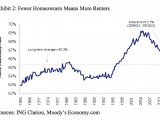
Furthermore, nearly 80% of renters surveyed believe that renting has been a positive experience for them and their families. Indeed, the homeownership rate steadily declined from 69% in the third quarter of 2006 to 66.9% in the third quarter of 2010, translating into approximately 2.3 million potential new household renters [Exhibit 2].

In our opinion, homeownership could continue to trend toward its long-term average of 65% over the next 12 to 18 months. Rental properties should continue to benefit from this trend.

--- END POST ---

Investment Real Estate Simplified

Demystifying real estate investing in 2011. When investors buy any commercial real estate they are acquiring a revenue stream. Admittedly there are a few signature buildings that are so iconic that they are a “pride of ownership” acquisition, but most properties are valued solely for their future economic potential. There are four primary ways in which investors benefit from their acquisitions:

1. Cash Flow

is the sum of: Cash In – Cash Out. The primary source of inflow cash is rent. Pet rent, late fees, laundry and owner contributions are also part of the cash in stream. Cash Outflows include taxes, expenses and distributions to owners.

GAME CHANGER: A recent change in the finance markets for apartments makes it possible to cash flow 12%, 15% or more per year off of multifamily investments. Contact us immediately for additional information at: 503.577.1034 or rick@rosecitycre.com

Owner types vary widely on the importance they place on distributions:

•Residential Multifamily properties (2 to 4 units) and smaller Commercial Multifamily properties cast off little cash. Their owners tend to focus more on equity gained at the time of disposition.
•Investors of larger properties often use cash flows (distributions) as a primary source of spendable income. They certainly expect gains at sale, but they often will use that gain to step up in basis to acquire a larger asset in the hope of increasing the monthly cash-flow. 

The bane of all investors is the much dreaded Cash Call. When cash out ‹ cash in to the extent that operations are impacted, the property owner(s) are forced to add cash to keep expenses current. Because of their focus on maintaining regular, dependable distributions, the owners of larger properties tend to have lower LTV loans. This doesn’t eliminate cash calls, but it does make operations inherently more stable, reducing the likelihood of requiring additional cash.

2. Appreciation

is Future Disposition Price – Original Acquisition Price. A 53 unit complex that is purchased for $3.2 million is 2007 appreciates $700,000 if it is sold for $3.9 million several years down the road.

•Appreciation gains can occur from (external) market forces such as a downward trend in Cap rates, or from increases in rent relative to expenses due to high demand.
•Gains can also be “forced” by internal forces. This occurs when we reposition a property. Renters will pay more for upscale amenities and newer looking accommodations. Success requires having the amortized costs of improvements be exceeded by the increased rents. In some cases we merely seek to raise the rents on the existing renters; other times we are using the upgrades to attract a new tenant profile.

3. Loan Pay-down

is determined by subtracting the initial loan amount from the remaining loan balance at any given time. Suppose a $3,200,000 property is acquired with a roughly 65% LTV loan at 6% with a 30-year amortization. Day one the beginning loan balance would be $2,000,000. 42 months later (3-1/2 years) the loan balance would be $1,909,649. The loan pay-down amounts to $90,351 for that period.

4. Tax Shelters and Tax Avoidance Benefits

The final benfit to investors is the tax sheltering of income. Cost Recovery (Depreciation) is the primary example. Industrial and retail properties are depreciated on a 40-year basis; housing is depreciated using 27.5-years. Note: Land is not depreciable. Using our previous example of a $3,200,000 community, let’s assume that land was 25% of the value, leaving a depreciable amount of $2,400,000 to be depreciated over 27.5 years, or $87,27.73 per year. That will act as a tax deduction to reduce profits by that amount for tax basis purposes.

A more rapid depreciation methodology is provided by Cost Segmentation, or familiarly, Cost Seg. This is performed based on findings of a cost engineer during their on-site inspection and review of the property. There is great acceptance of this approach by the IRS, but it is not fully understood by investors and many Tax Accountants. Cost Seg. on Assets under $1 Million is not always cost effective due to the fixed costs of the on-site inspection. Savings on multimillion dollar properties are substantial, and can change a 1.1 DSCR property into a 1.25. That means that Cost Seg utilization can be the difference in some loans being approved!  For additional information on Cost Segregation contact us at 503.577.1034, or Rick@rosecitycre.com

Duties of Professional Investment Brokers

It is incumbent on the Real Estate Professional assisting a client with a multifamilty acquisition to have an understanding of that client’s risk profile, investment horizon plus target cash flow and appreciation rates. It is also beneficial to have an awarenes of how important their client deems tax shelter options.

Contact us for more information at: 503.577.1034 or rick@rosecitycre.com

--- END POST ---

U.S. Multifamily Market Strengthens in Third Quarter On Rising Demand, Falling Vacancy

By Randyl Drummer

Almost every multifamily market saw strong leasing, rising demand and falling vacancies in the third quarter as the nation’s apartment market continued a solid 2010 rally. As of now, apartments should continue to surge over the next five years, with a growing supply of renters and very little new product in the planning pipeline.

Granted, vacancies remain above historical averages and the level of concessions to lure renters is still uncomfortably high for landlords in many markets. However, “of all the

Perhaps the most important factoid revealed in this article:  in 2009 the national aborption rate was -60,000 units.  To date in 2010 absorption is +140,000…and no signs of massive deliveries of new units.   Invest in a rising star by contacing us at 503.577.1034 or rick@rosecitycre.com.

property types, people are feeling the apartment market has clearly turned a corner,” said CoStar Global Strategist Michael Cohen, who presented the fourth and last in the company’s State of the Commercial Real Estate Industry series for the third quarter, along with Jay Spivey, director of analytics, and Kevin White, real estate strategist. “Improvements in the U.S. economy overall will favor the apartment market.”  Here are a few salient facts about national multifamily leasing fundamentals delivered by the CoStar team this week during the Third-Quarter 2010 Multifamily Review and Outlook:

* The national vacancy rate compiled from the 54 largest markets tracked by CoStar declined for the third straight quarter in 2010, falling 20 basis points to 7.7%. The national rate was a record 8.4% at the end of 2009, rising 130 basis points over the course of last year.

* The third quarter saw positive demand of around 47,000 additional units. Year to date, renters have absorbed about 140,000 units. In 2009, demand was a negative 60,000 units.

* So far in 2010, 20 metros have recouped their total demand for apartments lost due to overbuilding and other factors during the real estate downturn and recession. There’s a wide disparity across the country in demand growth. However, metros grew an average of 1.3% in the first nine months of 2010. Four of the five markets where demand is rising the fastest are Sun Belt metros, including Charlotte, NC, which saw the strongest growth at 3.5%, followed by Raleigh-Durham, NC; Phoenix and Dallas/Ft. Worth. Richmond, VA, also saw strong demand, mostly as a result of realignment of military personnel.

In terms of absolute growth, Dallas/Fort Worth blew away all other metros with fully 10% of the total positive year-to-date demand across the 54 largest markets. New York came in second place with 11,200 units of demand followed by Washington, D.C. with 8,300 units. The average metro saw vacancy fall about 76 basis points over the past six months, with Charlotte, Raleigh, Nashville and Dallas-Fort Worth seeing the sharpest drops.

So why such marked improvement in apartment fundamentals in light of less-than-stellar growth in the broader economy? A number of factors are likely contributing to this reversal of fortune in apartments, CoStar said.

New Supply: Slim to None. By the end of 2010, CoStar expects that apartment developers will have delivered about 54,000 new units — slightly less than half of 2009 levels. The miniscule increase of about 0.4% in inventory this year is just half the average annual pre-recession level of 2003-2008. Next year will be even slimmer pickings: CoStar forecasts a record-shattering low in deliveries totaling only about 0.2% of inventory.
Waning Homeownership. The percentage of Americans owning homes has dropped to an 11-year low — though it’s still well above historic rates, which ramped up in the mid- to late ‘ 90s in a strong economy and baby boomers occupying apartment space. Since 2004, declines in home ownership have moved a net total of more than 4 million people into the rental market.

Echo Boomers Are Finally Getting Their Own Crib. Many of these new renters are people ages 20 to 34, the prime demographic for apartments. About 3.6 million people have entered that age group since 2005.

Re-Employed Younger Folks. While echo boomers suffered disproportionate job losses during the Great Recession, Bureau of Labor Statistics household survey data shows they are now getting the lion’s share of net new jobs as the economy recovers.

The news is not all good. Many markets are still seeing high levels of free rent and other concessions, a challenge for landlords hoping to boost effective rents and NOIs. As of third quarter, average concessions as a percentage of face or asking rents was 5%. Phoenix ranked at the top with 12% of concessions as a percentage of asking rents, followed by Atlanta and Les Vegas at around 11%. In all, 15 metros among the top 54 are still above their long-term average for concessions.

On balance, however, landlords are starting to gain some pricing power in effective rents, with a few markets reporting gains in asking rents as well.

Over the next few years, the forecast is quite bright. CoStar forecasts supply additions through 2015 at a level less than half the rate of deliveries historically going back to 1982. Demand growth will trail the historical rate of growth by only 40 basis points.

“We have a favorable balance between demand growth and supply growth through 2015,” Cohen said. “By end of this year, vacancies in all but a couple of markets will be lower than they began the year.”

National vacancies are expected to fall by more than 2 percentage points from their historic 2009 high, ending at about 6% in 2015.

Multifamily sales are showing similar, but far from stellar improvement. While the overall investment market remains soft and weighted toward distressed properties, certain segments are performing and investor confidence and optimism are returning to the market, Spivey said. Sales in Phoenix, Long Island, Atlanta, Columbus, OH; Sacramento, Raleigh-Durham, South Florida and Orlando are above long-term averages.

But most markets are still below historical averages, with distressed transactions — REOs and foreclosures — making up a high percentage of total transaction volume.

An interesting exception is Phoenix, which has seen a better balance of distressed vs. non-distressed property trades. Despite being a housing-bust market, capital for non-distressed deals is flowing into Phoenix — in stark contrast with Atlanta, where most properties trading hands are distressed.

Investors appear most interested in newer properties less than 10 years old. Other positive signs for strengthening liquidity include a shorter average length of time on the market, fewer unsold properties withdrawn from the market, and a narrowing of the gap between asking and selling prices.

Real estate investment trusts are the most active buyers — in fact they’re the only net buyers in the market at present. Institutions, owner-users and private equity investors are all net sellers. REITs are buying the best large assets in attractive markets, and they’re generally willing to pay a decent price due to their low cost of capital and the diminishing supply of new apartment product.

In recognition of the latter, some apartment REITs, including AvalonBay Communities, are starting to restart their development programs, though most of this supply is probably a few years away from delivery.

“We’re beginning to hear a lot more noise about new supply, particularly from the REITs with their capital market access. They’re beginning to talk about moving ahead on projects,” Cohen said. “Other types of investors would like to move, given that fundamentals are beginning to make construction a little more palatable. However, development capital remains tough to access for most non-REITs, making it difficult sledding for early movers.

Some of the emerging development is legacy projects and land planned for and acquired in the last cycle and now being dusted off as demand metrics improve. That said, analysts will closely monitor apartment permits and starts, Cohen said.

In any case, REITs are definitely in the hunt for apartment product. Overall capitalization rates have declined for several quarters, with larger sales of over $20 million seeing the largest cap rate compression and distressed deals seeing higher cap rates in the bifurcated market.

“Many REIT buyers at sub-5% cap rates are banking on some real rent growth that will flow nicely into NOI,” Cohen said.

Apartments have seen the biggest increase in pricing in the CoStar Commercial Repeat Sales Index, which uses a methodology similar to the Case Shiller Index in the residential market. The U.S. multifamily index rose the highest within the four major CRE types in the CoStar Commercial Repeat Sales Index, with a positive 8.98% increase in the third quarter. The office index increased 6.08%, followed by the retail index at 5.56%.

The top 10 multifamily markets saw a larger run up in pricing during the boom and a smaller decline during the downturn. Of all the 30 sub-indices tracked by CoStar, the top 10 multifamily metros is the best performing, with the highest return over the last 10 years.

Though Some REITs Are Cautiously Re-Entering the Development Arena, Supply/Demand Balance Bodes Well for Apts. Through 2015
by Andy Drummer November 3, 2010

--- END POST ---

Scroll to Top