Portland Ranks Second In Nation For Jump In Rents

Portland Multifamily Rents Jump Second Most in the NationBy Ross Coulter of Axiometrics

DALLAS–(BUSINESS WIRE)–Effective rents (true rents net of concessions) have increased nationally by 4.65% for the year ending February 2011, further evidence of market strength that could lead this year to one of the largest pricing jumps in more than a decade, according to a report issued by Axiometrics Inc., a provider of data and analysis on the multi-family sector.

“The outlook for the remainder of the year looks strong, with job growth increasing and supply still at historical lows. In certain submarkets, growth far surpasses even these strong national averages.”

Rose City Commercial Real Estate has been predicting a huge upswing in Portland’s mulifamily investment market for some time.  We further predict that even without job growth we will see major rent increases continuing as a result of underbuilding of new multifamily units. The time is now to get into the Portland market before prices shoot up.  Stop reading and start dialing now:  503.577.1034…or contact us at rick@rosecitycre.com.

Axiometrics also reported that the national occupancy rate increased to an average rate of 93.24% in February.

“2010 was a strong year for rent growth, but the data in these first two months indicate 2011 could be the best year since we started reporting on the apartment market in 1996,” said Ron Johnsey, president of Axiometrics Inc. “The outlook for the remainder of the year looks strong, with job growth increasing and supply still at historical lows. In certain submarkets, growth far surpasses even these strong national averages.”

Axiometrics’ analysis indicated that effective rents increased 0.72% nationally between January and February. The growth in February was better than for every month of 2010, except one. In addition, the year-to-date increase in effective rents of 0.96% was also ahead of last year’s figure of 0.79%.

Top and Bottom Performing Markets – Annual Effective Rent Growth

Northern California remained the hottest region of the country in terms of annual effective rent growth. San Jose (10.51%), Oakland (7.75%), and San Francisco (7.36%) all ranked in the top 12 for annual rent growth. However, Southern California was at the other end of the spectrum, with San Diego (1.73%) and Los Angeles (1.47%) ranking among the bottom performing markets in the country.

Many submarkets demonstrated even stronger growth than the national averages, with more than 60 having annual effective rent growth of at least 10%. Some of the highest performing include south central Austin (19.2%), San Jose/Santa Clara (15.7%), and Portland/Beaverton (13.5%). Notable submarket performance was also recorded in Washington, D.C./Woodley Park/Cleveland Park/Van Ness (13.0%), Chicago/The Loop (13.7%), New York/Hudson Waterfront (12.4%), Nashville/Downtown/West End/Green Hills (11.7%), Phoenix/North Tempe (10.1%), and Denver/Lakewood-South (9.9%).

       
Effective Rent Growth: Top 10 Markets     Effective Rent Growth: Bottom 10 Markets
       
Market   Rate         Market   Rate    
    Monthly   Annual   Rank         Monthly   Annual   Rank
San Jose, CA   2.44%   10.51%   1     Augusta, GA   -0.40%   1.86%   79
Portland OR   1.58%   10.43%   2     Tucson, AZ   1.29%   1.85%   80
Savannah, GA   -0.40%   9.68%   3     San Diego, CA   0.46%   1.73%   81
Chattanooga, TN   0.67%   9.67%   4     Virginia Beach, VA   0.53%   1.61%   82
Greenville, SC   0.08%   9.35%   5     Reno, NV   0.93%   1.50%   83
Boulder, CO   -0.59%   8.46%   6     Los Angeles, CA   0.71%   1.47%   84
Oakland, CA   1.05%   7.75%   7     Little Rock, AR   0.59%   1.42%   85
Naples, FL   1.50%   7.73%   8     Cape Coral, FL   0.25%   1.35%   86
Greensboro, NC   0.51%   7.66%   9     Detroit, MI   -0.62%   1.04%   87
Washington, DC   0.93%   7.45%   10     Las Vegas, NV   -0.03%   -2.53%   88
National   0.72%   4.65%                  
                           

Occupancy Rate

In February, the national occupancy rate increased for the first time in five months. The rate improved 15 basis points from 93.09% in January to 93.24% in February. Occupancy had declined by a total of 55 basis points the previous four months.

In 13 of the top 88 markets, the occupancy rate increased by more than 50 basis points. Interestingly, some of the top markets for occupancy gains were bottom performing markets for rent increases. For example, Detroit and Reno showed strong monthly and annual occupancy increases, but for more than a year their rent growth has been particularly weak.

 
Occupancy Rate
Market   Rate   Basis Point Growth
        Monthly   Annually
Detroit, MI   90.39%   171   275
Oklahoma City, OK   94.35%   138   355
Cape Coral, FL   92.28%   112   239
Montgomery, AL   87.64%   70   -86
Tacoma, WA   94.18%   70   302
Fort Lauderdale, FL   94.26%   68   49
Reno, NV   95.94%   66   267
Albuquerque, NM   95.14%   65   170
Corpus Christi, TX   92.69%   63   11
Augusta, GA   93.28%   62   -44
West Palm Beach, FL   93.79%   55   -14
Phoenix, AZ   92.51%   54   275
Sacramento, CA   94.60%   53   51

National

  93.24%   15   125
             

About Axiometrics

Axiometrics Inc. measures the performance of the apartment sector every month. The company tracks individual properties or portfolios owned by both private and publicly traded apartment REITs (Real Estate Investment Trusts), as well as properties owned and managed by private investors, developers, and management companies in more than 300 markets, totaling over 16,500 properties and 4.4 million units. Axiometrics delivers its data and analysis through a set of affordable, sophisticated tools that enable clients to improve property and investment performance at a fraction of the cost of the additional revenue generated. Learn more at www.axiometrics.com or call 214-953-2242.


--- END POST ---

Miranda Homes Nominated For Sustainability Award

It makes good sense to build green for the sake of the environment, but building green is also a good business decision as well.  Green sells.  Rob Boydstun of Miranda homes has combined a number of existing methods and technologies into a truly remarkable home.  Imagine being able to build a price-competitive home…that is also LEED Platinum?  Or going from dry foundation to having exterior walls, interior walls, siding, and and rafters in place in 72 hours?  Or building the entire structure in 41 work days?

Never one to rest on his laurels, Mr. Boydstun has directed his engineering team to recreate the way multifamily projects are designed and built. 

Contact us if you’re an investor or green enthusiast interested in learning more about Miranda’s revolutionary  multifamily building techniques.  Their methods are going to be utilized in a 40+ unit technology demonstrator project that will be breaking ground on Portland’s East side later this year.  rick@rosecitycre.com or 503.577.1034.

There’s money out there for permanent financing on multifamily projects, but construction funding is harder to come by.  But if we could shave a third or even half off the construction time the bank’s risk would be significantly reduced.  If the final product was more comfortable and greener the bank’s risk would be reduced further.  The Miranda multifamily method advantage is obvious.

Being a fan of both green and multifamily, my nominee forThe Portland Business Journal’s Sustainability Award was easy.  I wrote a letter supporting Miranda Homes’ nomination and sent it to a few hundred Real Estate Brokers and multifamily pros.  Seasoned developer Gordon Jones, not only nominated Miranda Homes, he did it  so passionately and eloquently I have printed it below:

Gordon C. Jones’ Nomination of Miranda Homes for The Portland Business Journal’s Sustainability Award:

Your Name: Miranda Homes
Your Org.: NA
Your Phone: (503) 702-1555

Nominee Org.: Miranda Homes
Nominee Name: Rob Boydstun
Nominee Email: rboydstun@mirandahomes.com
Nominee Phone: (503) 849-7337

Nominee Organization Size: Small

Describe the nominated organization’s demonstrated innovation in overhauling internal operations to reach sustainability goals:
Miranda Homes has reinvented the construction process, bringing technology learned in manufacturing in partnership with Toyota to home building. Starting with the demolition process they recycle everything possible. They take lean construction to a new level, producing less than 1/2 lb. of waste per square foot of construction as compared to 6 to 8 lbs. per sq. ft. for typical construction in the Portland market. They build using steel studs and structurally insulated panels produced in their own plant with Revit(c) based software that results in no waste in manufacturing the components. The steel is from recycled automobiles. The sheeting and exterior foam insulation overlaps adjoining panels so that no seams allow air infiltration. After assembly and installation of MEP the structure is insulated with spray-in soy-based foam insulation. An air exchange system changes the air several times per hour. The sealed crawl space is conditioned to prevent mold and mildew.

What could other companies learn about sustainability from this organization’s operations?
Sustainability is not measured just in the performance of the end product or building, but must be inherent in the entire process. By definition sustainability means the wise and efficient use of resources and thus should result in not only less materials used in construction, but in a more efficient use of time, less waste on the job site and a resulting savings in producing the building. Miranda can build a conventional single family home in less than 2 months, as compared to at least seven months for even efficient builders using conventional methods. Their methods include revolutionary software that take design drawings in Revit(c) and convert them directly to the manufacturing equipment that literally make every structural component for the building, without waste. The panels are loaded on trucks on a first on last off order, clearly labeled, so that upon reaching the job site they are unloaded and assembled with utmost efficiency.

How has innovation in the company’s sustainable operations been incorporated as part of a thriving business?
The culture of Miranda Homes is one that demands innovation, creative thinking and using the skills and resources of every employee to brainstorm each job and model it completely before beginning the manufacturing process. Old methods and construction technologies are rethought and better more efficient methods are employed. By employing their own technology and engineering specialists, they are able to control the entire process from design, engineering, manufacturing, purchasing and assembly. Miranda even buys all building components for their subs, such as electrical, plumbing, mechanical, masonry etc. and then the subs work out of Miranda’s inventoried trucks, so that there is very little waste and no materials end up on other jobs or back at the subs warehouse. Miranda has spent the past three years investing in this technology and developing the software and manufacturing methods. They are now beginning to realize the benefits of that fully vertically integrated model.

-Gordon C. Jones

--- END POST ---

Demystifying Loan Assumptions by Dobens Law, LLC

While agency lending is a great source for multifamily loans, their programs aren’t for every one in every situation. Credit markets remain tight for all commercial subcategories.  They tend to ameliorate risk through shorter terms rather than higher interest rates.  Well qualified borrowers can find 6% interest money…but it often is based on 15 or 20 year amortization schedules and 3 to 5 year terms.  While loan paydown is accelerated, the borrower practically needs to leave the closing table to start looking for their next loan.  I feel that a broker has not fully supported their client’s best interest if they don’t at least caution them about short terms. 

It is important to use the proper financing tools to acquire investments for maximum profit.  Let Rose City Commercial Real Estate assist you. Contact us at 503.577.1034.

Loan assumptions provide an alternative to taking out new short term debt.  There are benefits and risks associated with this that are well detailed in the article below from multifamily legals specialists Dobens Law, LLC.  For more information, visit their website at: www.dobenslaw.com

By Charles Dobens of Dobens Law, LLC:

So many investors think that purchasing a multi-family property through an assumption process is quick and easy. The financing component, in their mind, has already been taken care of by the seller. Now all they need to do is step into their shoes and take over where the seller left off.

Not so fast.

It doesn’t work quite like that and an investor needs to understand the entire assumption process before jumping in with the sharks. This article is going to provide you with a “peeling-back-of-the-onion” view of buying property through an assumption. It is also going to provide you with contract wording that you should add to your offers and contracts to protect you every step of the way. Nevertheless, this is a guide. It is no replacement for sound legal advice. Make sure you get advice throughout the entire process.

What Is an Assumption?

The textbook definition of a mortgage assumption is the agreement between the buyer and the seller where the buyer takes over the payments on an existing mortgage from the seller. Sounds simple, doesn’t it? But let’s get more in to the details.

According to one set of loan documents, the provision allowing the transfer of ownership of the property through an assumption process is found in the section entitled “Transfers of the Mortgaged Property or Interests in Borrower”. After you get through all the discussions regarding Events of Default, you come upon a clause that states the following:

Lender shall consent, without adjustment to the rate at which Indebtedness secured by this instrument bears interest or to any other economic term of the Indebtedness, to a Transfer that would otherwise violate this Section 21 if, prior to the Transfer, Borrower has satisfied each of the following requirements: . . . . . .

And there you have it. Sounds simple, doesn’t it? Well, let’s go through how this all plays out when you buy a property.

Who Brought The Guy With The Gun?

When you enter into a purchase and sale contract for real estate, the parties involved are typically the buyer and the seller. Any changes or modifications to the deal are negotiated between these two parties. When you enter into a purchase and sale agreement using an assumption, you now have a third party involved in the contract that, in normal deals, is a sideline player, but in an assumption, they control EVERYTHING.

That new party is “the Bank.”

You are instantly at a competitive disadvantage in the negotiation process. You now no longer have the ability to negotiate terms for the loan based upon your abilities. You now have to take those terms that the seller negotiated (probably years ago) and make them your own.

My advice to you is to use this to your competitive advantage in the negotiation process. The Seller is not doing you any favors by requiring you to take over his note. On the contrary, you are doing him a huge favor and don’t you ever forget it.

Here’s why.

Why Can’t I Just Use My Own Money?

Why does a seller require the buyer assume the existing note and pick up where he left off? The answer is – because the Seller made a deal with the devil and now he wants his soul back.

If you go back to the documents referenced above and look at the loan documents (before we were strictly looking at the mortgage) there exists a provision that states, in part, the following:

Schedule A

Prepayment Premium

Any prepayment premium payable under Paragraph 10 of this Note shall be computed as follows:

What follows is a very complex formula that takes in to account the number of months left in the term of the loan and the Yield Rate. In other words, the seller has a huge pre-payment penalty if he sells the property outright and pays the bank back.

Enter you, stage left, the solution to his problem.

How Do I Know I am Getting Myself into an Assumption Deal?

First off, it will be plastered all over the broker’s material claiming that this is an assumption. If it isn’t, then I can usually tell within the first 30 seconds of looking at a broker’s package whether this is an assumption or not. Here’s how.

Most brokers run pro forma numbers based upon either a 20, 25 or 30 percent money down analysis; easy round numbers. When you are looking at a property package that does an analysis using a “funny” number, like 12% down, then you know that you are looking at an assumption. No one puts 12% down unless they can. (Now before all of you get excited and think “wow, I can buy a property with 12% down if I do an assumption?” Hold your horses. Keep reading. It’s not that easy.)

The note amount is already set for you. It is whatever exists at the time of the purchase. The purchase price, then, becomes the variable. Set the purchase price and subtract the note value and there is your down payment amount. Reduce the purchase price and you have reduced the amount of money that you have to put down.

So Why Is This Such a Challenge?

Because there is a new party at the table that nobody controls and he’s got a gun.

Seriously, though, let’s go back to the provisions in the mortgage detailed above that define how an assumption is conducted. I will take each pertinent provision step by step and explain what this means in “real life”:

1. “Lender shall consent, without adjustment to the rate at which Indebtedness secured by this instrument bears interest or to any other economic term of the Indebtedness.”

Sounds good, doesn’t it? You enter into a P&S with the seller and you already know what the terms of the note are going to be. Right? Wrong. Even though this is what the contract says, it doesn’t mean the bank will abide by that.

For those of you reading this now and thinking that I don’t know what I am talking about, believe me, this is experience speaking. Here’s what happened to me.

We were approved for the loan assumption under one condition; we had to put an additional $600,000 in reserve with the bank. Here’s how the conversation went:

                                Bank:    “Congratulations, you’ve been approved.”

                                Me:        “Great. When can we close?”

Bank:    “Once you sign all the documents and transfer $600,000 into the reserve account.”

Me:        “Huh? Who said anything about $600,000? That’s not part of the deal. That’s a new economic term”

                                Bank:    “Then you are not approved.”

                                Me:        “Huh. You just said I was approved.”

                                Bank:    “Yes and congratulations.

The circular conversation continued from there.

Do you see where I am going with this? It didn’t matter that the contract said that they could not change any economic term. It also didn’t say that the bank would agree to me buying the property with only 12% down. They own the gun. So if we wanted to get the deal done, we had to add $600,000 to the amount we needed to put down. Needless to say, the cash on cash returns changed drastically.

2. The transferee meets all of the eligibility, credit, management and other standards (including any standards with respect to previous relationships between Lender and the transferee and the organization of the transferee) customarily applied by Lender at the time of the proposed Transfer to the approval of borrower in connection with the origination or purchase of similar mortgages, deeds of trust or deeds to secure debt on multifamily properties

So what does this mean exactly? This means that you, the buyer, have to look as good on paper as the seller in the eyes of the bank. That begs the question, what does the seller look like?

No one knows.

Some sellers anticipate this issue when they apply for a loan so they only tell the bank exactly what it wants to hear in order to get the loan. The problem is that you don’t know what that is. I know some investors who have put together a fantastic team and would have had no problem getting a new money loan but were turned down by the bank because they did not look as strong on paper as the existing borrower. So the bank “dinged” them. Had it been a new money purchase, they would have sailed right through underwriting.

See what I mean about there being another party at the table.

3. In addition, Borrower shall be required to reimburse Lender for all of Lender’s out-of-pocket costs (including reasonable attorney’s fees) incurred in reviewing the Transfer request, to the extent such expenses exceed $3,000.

This one absolutely sent me through the roof one time. Two days before the close, the bank provides us with a source and use of funds statement documenting how much we will need to close. Hidden amongst all the bank fees was a $15,000 legal bill for the lender’s attorney. The lawyers representing the buyers and the sellers were shocked that they could get away with that type of charge, but guess what? We had no choice and had to pay it.

The bank showed up to the negotiating table with a gun.

Here’s What You Need to Do To Be Successful in an Assumption

So, still want to do an assumption?

If the answer is yes, and it should be, provided you follow my rules for success that I am about to detail here, then here are the things you need to do to be successful:

Remember what was discussed in the chapter on negotiations. Never lose control of the process. Always remember that you are in control. Do not give up the driver’s seat to anyone. ONCE YOU DO, YOU LOSE. 

Make sure that the following provision is in either your Letter of Intent or your Purchase and Sale contract:


In the event written approval of the Lender to the Loan Assumption is not obtained in writing on or before sixty (60) days after the Effective Date, or if Lender notifies Seller or Purchaser of its disapproval of the Loan Assumption, and so long as Purchaser has supplied all requested information to Lender and used best efforts to obtain Lender Approval, Purchaser may terminate this Contract by written notice to Seller and the Earnest Money shall be returned to Purchaser, and neither party shall thereafter have any obligations one to the other except for obligations which expressly survive termination of this Contract.  If Lender approves the Loan Assumption, but imposes economic requirements as an additional financial obligation of Purchaser, then Purchaser shall advise Seller of such requirement and Seller and Purchaser shall attempt in good faith to allocate the responsibility for such obligation between them, failing which, Purchaser may terminate this Contract by written notice to Seller as set forth above.  If Lender approves the Loan Assumption, but imposes no additional economic requirements, then Purchaser has no termination right, this condition shall be deemed satisfied and the Earnest Money shall be released to Seller immediately after the expiration of the sixty (60) day period or on the date Lender Approval is obtained, whichever is earlier.

Why do you need this provision? Because the bank does not care one bit about the schedule that you and the seller have agreed to in the P&S. They are going to get around to your deal on their time frame. That means that there is the possibility, and it is a strong one, that your money will go hard before the lender has made a final determination. If they end up approving you but it is conditional upon some new economic term, you can’t walk without losing your earnest money. You lose.


Put a stipulation in the P&S that you will only pay closing costs up to a certain amount. Anything above that amount is the responsibility of the Seller. Hey, it’s his bank. Let him pay the fees above the normal closing costs.

Put a provision in the P&S that states the Seller has to disclose the financial package that he provided to the bank so that you know what you are dealing with when comparing yourself to the seller. If he is not willing to provide it then I can assure you, you are wasting yours and your investor’s time and money.

Finally, Who Loves ‘Ya Baby?

When you apply for a mortgage, your mortgage broker loves you. He has to because he doesn’t get paid unless he has success. Therefore, he will do everything in his power to close that deal.

With an assumption, you are standing out there all by yourself and you are going to be pulled and pushed in every direction that the Lender decides to go in. No one is looking out for your best interests. No one really benefits by you closing this deal or not.

FULL DISCLOSURE: I have never worked with the company I am about to recommend but I spoke with the owner and she explained to me how they operate. Boy, I wish I had known about them before ever trying an assumption.

1st Service Solutions (www.1stservicesolutions.com) of Grapevine, TX is a company made up of former CMBS lenders who are now specializing in the representation of buyers and sellers through the assumption process. This is a well needed service.

I recommend that you contact Ann Hembly to discuss how they operate and how you should include her fees in the P&S so that you do not bear the brunt of them yourself. Remember, when you do an assumption, you are doing a huge favor to the Seller. Let him pick up the costs of the process.

Charles Dobens of Dobens Law, LLC represents new and intermediate investors through the entire process of acquiring and managing multi-family property. From analyzing deals, negotiating contracts, putting the financing in place and closing the escrow, Dobens Law is with their clients every step of the way. In addition to providing legal representation, Charles Dobens owns and operates over $20,000,000 of multi-family property around the country. He can be reached at 781-987-4765.

 Here’s What You Need to Know About Assumptions-Dobens Law, LLC | Dobens Law, LLC.

--- END POST ---

Double Digit Rent Increases Ahead

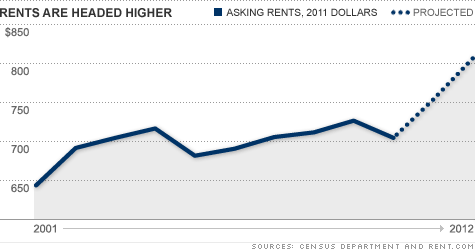
 (CNNMoney) — Renters beware: Double-digit rent hikes may be coming soon.

“The demand for rental housing has already started to increase,” said Peggy Alford, president of Rent.com. “Young people are starting to get rid of their roommates and move out of their parent’s basements.”

By 2012, she predicts the vacancy rate will hover at a mere 5%. And with fewer units on the market, prices will explode.

The conditions that Alford cites as spurring rent increases are more pronounced in the Portland multifamily market:  4% vacancy rates, high barriers to entry, and years of under building apartments in Oregon are setting the table for large rent increases for several years.  Add to that scenario the availability of ultra cheap financing and you have an investment niche that is set up to wildly outperform other segments.  For additional information contact Rose City Commercial Real Estate at: 503.577.1034 or rick@rosecitycre.com.

Rent hikes have averaged less than 1% a year over the past decade, according to Commerce Department statistics, adjusted for inflation. Now, Alford expects rents to spike 7% or so in each of the next two years — to a national average that will top $800 per month.

In the hottest rental markets, the increases will likely top the 10% mark annually for the next couple of years. In San Diego, Alford anticipates rents will rise more than 31% by 2015. In Seattle rents will climb 29% over that period; and in Boston, they may jump between 25% and 30%.

This is a sharp change from the recession, when many Americans couldn’t afford to live on their own. More than 1.2 million young adults moved back in with their parentsfrom 2005 to 2010, said Lesley Deutch of John Burns Real Estate Consulting. Many others doubled up together.

As a result, landlords had to reduce prices and offer big incentives to snag renters.

Now that the recession is easing, many of these young people are ready to find new digs, mostly as renters, not owners. Plus, the foreclosure crisis continues unabated, and the millions losing their homes are looking for new places to live.

Apartment developers many not be able to keep up with this heightened demand, which will force prices upwards, according to Chris Macke, a real estate analyst with CoStar, which tracks multi-family housing trends.

“There will be an envelope of two or three years,” said Macke, “when the rise in demand for rentals will exceed the industry’s ability to meet it.”

Plus, Alford added, “there’s been a shift in the American Dream. We’re learning from our surveys that a huge proportion of people are choosing to rent.”

They’ve experienced the downsides of homeownership — or seen friends and family suffer — and don’t want to take the risks or pay the higher costs of homeownership.

Where homeownership costs are particularly high, there are many more renters than owners. In Manhattan, for example, only about 20% own their homes; in San Francisco, about of third of the population does; in Los Angeles, less than 40%; and in Chicago, about 44%.

There’s one factor that could rein in rent increases: the huge number of foreclosed homes that could hit the market over the next few years.

In many markets, like Phoenix and Las Vegas, there are neighborhoods filled with recently built, single-family homes going for fire-sale prices. When the cost of owning homes falls well below the costs of renting them, more people will buy.

“That’s always been the biggest competition for rentals,” said Deutch.

--- END POST ---

Demystifying the Four Engines of Real Estate Wealth Building

Swimming pool and Apartment housess

This is an article I wrote at the request of a small investor who asked that I lay out a simple framework of the four engines of real estate wealth building and how residential and commercial investment strategies vary.  

When investors buy any commercial real estate they are acquiring a revenue stream.  Admittedly there are a few signature buildings that are so iconic that they are a ”pride of ownership” acquisition, but most properties are valued solely for their future economic potential.  I tell investors that its better to admire the revenue generated more than the asset itself.

There are four primary ways in which wealth building occurs

1. Cash Flow

is the sum of:  Cash In – Cash Out.  The primary source of inflow cash is rent.  Pet rent, late fees, laundry and owner contributions are also part of the cash in stream.  Cash Outflows include taxes, expenses and distributions to owners.

Rose City Commercial Real Estate is a resource for investors ready to move into this hot market…or those that just want to learn more about real estate investing.  Contact us at 503.577.1034 or rick@rosecitycre.com.

Owner types vary widely on the importance they place on distributions:

  • Residential Multifamily properties (2 to 4 units) and smaller Commercial Multifamily properties cast off little cash.  Their owners tend to focus more on equity gained at the time of disposition.
  • Investors of larger properties often use cash flows (distributions) as a primary source of spendable income.  They certainly expect gains at sale, but they often will use that gain to step up in basis to acquire a larger asset in the hope of increasing the monthly cash-flow.
  • The bane of all investors is the much dreaded Cash Call.  When cash out ‹ cash in to the extent that operations are impacted, the property owner(s) are forced to add cash to keep expenses current.  Because of their focus on maintaining regular, dependable distributions, the owners of larger properties tend to have lower LTV loans.  Instead of holding assets with 20% as equity and 80% debt…they put down 30% or even more. This doesn’t eliminate cash calls, but it does make operations inherently more stable, reducing the likelihood of requiring additional cash.

2. Appreciation

is Future Disposition Price – Original Acquisition Price.   A 53 unit complex that is purchased for $3.2 million is 2007 appreciates $700,000 if it is sold for $3.9 million several years down the road.

  • Appreciation gains can occur from (external) market forces such as a downward trend in Cap rates, or from increases in rent relative to expenses due to high demand.
  • Gains can also be “forced” by internal forces.  This occurs when we reposition a property.  Renters will pay more for upscale amenities and newer looking accommodations.  Success requires having the amortized costs of improvements be exceeded by the increased rents.  In some cases we merely seek to raise the rents on the existing renters; other times we are using the upgrades to attract a new tenant profile.  The strategy of turning a C+ asset into a B or B- is pone of the most lucrative plays in real estate.

3. Loan Paydown

is determined by subtracting the initial loan amount from the remaining loan balance at any given time.  Suppose a $3,200,000 property is acquired with a roughly 65% LTV loan at 6% with a 30-year amortization.  Day one the beginning loan balance would be $2,000,000.  42 months later (3-1/2 years) the loan balance would be $1,909,649.  The loan paydown amounts to $90,351 for that period.

4. Tax Shelters and Tax Avoidance Benefits

The final benefit to investors is the tax sheltering of income.  Cost Recovery (Depreciation) is the primary example.  Industrial and retail properties are depreciated on a 40-year basis; housing is depreciated using 27.5-years.   Note: Land is not depreciable.  Using our previous example of a $3,200,000 community, let’s assume that land was 25% of the value, leaving a deprecable amount of $2,400,000 to be depreciated over 27.5 years, or $87,27.73 per year.  That will act as a tax deduction to reduce profits by that amount for tax basis purposes.

A more rapid depreciation methodology is provided by Cost Segmentation, or familiarly, Cost Seg.  This is performed based on findings of a cost engineer during their on-site inspection and review of the property. There is great acceptance of this approach by the IRS, but it is not fully understood by investors and many Tax Accountants.  Cost Seg. on Assets under $1 Million is not always cost effective due to the fixed costs of the on-site inspection.  Savings on multimillion dollar properties are substantial, and can change a 1.1 DSCR property into a 1.25. That means that Cost Seg utilization can be the difference in some loans being approved!

Duties of Professional Investment Brokers

It is incumbent on the Real Estate Professional assisting a client with a multifamilty acquisition to have an understanding of that client’s risk profile, investment horizon plus target cash flow and appreciation rates.  It is also beneficial to have an awareness of how important their client deems tax shelter options.

--- END POST ---

Billionaire Carl Icahn returns $1.76B to investors – Yahoo! News


NEW YORK – On the eve of the bull market’s second anniversary, billionaire investor Carl Icahn had an unsettling message for his investors: Take your money back. Icahn told investors in his hedge funds that he didn’t want to be responsible to them for “another possible market crisis,” especially given the rapid increases over the past two years. Stocks have nearly doubled since hitting 12-year lows on March 9, 2009.

While Carl Icahn is worried about the legs of the current bull stock market tiring, Rose City CRE is forecasting the start of a multifamily bull market.  We are not sending capital back to investors…our mesage is clear: “Bring it on!” 

 The overall commercial real estate market is unhealthy, but Portland multifamily, Beaverton apartment investing…they make real sense.  (The best time to buy is when prices are down, there’s a limited supply and prices are getting ready to go up.  What’s not to like?!) Express your inner bull by calling 503.577.1034 or emailing me at rick@rosecitycre.com.

Icahn, who has built a fortune from taking stakes in well-known companies and then pressing for changes, also said he was concerned about the economic outlook and political tensions in the Middle East. Icahn’s targets over the years have included Yahoo Inc., RJR Nabisco and Revlon.

“While we are not forecasting renewed market dislocation, this possibility cannot be dismissed,” Icahn said in a letter to his limited partners. The letter was dated Monday and disclosed in a regulatory filing Tuesday.

Outside investors make up just 25 percent, or $1.76 billion, of the $7 billion in assets Icahn oversees. Despite losses in 2008, the funds have had returns of 106.9 percent since their inception in 2004. In the first two months of the year the funds have returned 8.7 percent.

Not everyone believes Icahn is returning his investors’ money because he’s bearish about the markets.

Jack Ablin, chief investment officer at Harris Private

via Billionaire Carl Icahn returns $1.76B to investors – Yahoo! News.

--- END POST ---

Heaven for Multifamily in 2011, Closer to Earth in 2012


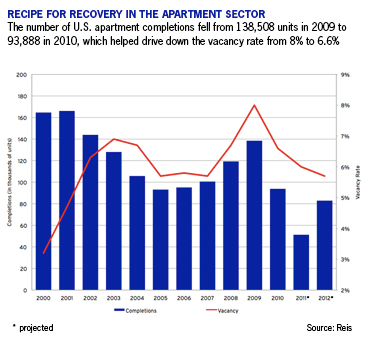
It is a bullish sentiment that gathered steam through 2010. With few projects initiated in 2009, there will be a shortage in the supply of rental apartments this year. Combined with a stabilizing economy, continuing uncertainty in single-family home prices, and echo boomers boosting demand, it will be heaven for multifamily in 2011.

Expect rents to grow at rates unseen since the early 1990s, when the sector experienced a similar pullback in construction. However, will these good times be sustainable? Or will heaven crash back down to earth as soon as 2012?

There is compelling evidence that effective rents will indeed post strong growth in 2011. Despite moribund economic growth in 2010, apartment vacancies fell sharply, ending the year at 6.6% after starting from a record-high base of 8%. Concessions that included subsidies for utilities and broker commissions as well as months of free rent were withdrawn swiftly.

This article is reprinted from National Real Estate Investor.  Their articles are insightful, timely and reliable. 

The time to buy is when the market is heading up.  All the signs are there suggesting the best multifamily climate in years.  To learn more about investing in Portland’s multifamily market, call Rick Bean at 503.577.1034 or contact him at rick@rosecitycre.com.

National effective rents grew by 2.3% in 2010, a healthy rebound given the record 2.9% decline in 2009. And this was when about 94,000 apartment units came on line and jobs were growing at a disappointing rate.

A rising tide …

Inventory growth will contract significantly in 2011. Reis projections add up to only about 51,000 units coming on line in 79 major metro markets. This is less than half of the

via Heaven for Multifamily in 2011, Closer to Earth in 2012.

--- END POST ---

Time to invest again!


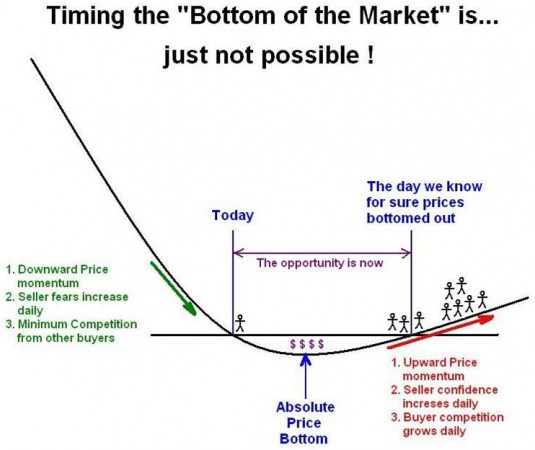
It seems as though we are continually getting asked whether we are at the bottom of the Real Estate market and our reply is “we may not be at the bottom but we must be close”.

What we can tell you though is what we see happening with the deals that are being done and reasons to consider doing deals sooner rather than later.

THE BOTTOM

Unlike the stock market, the actual cost of real estate is a combination of price paid and the interest rate of any loan. The lowest price paid often is not actually the “bottom” and it is with this thought in mind and current interest rate trends that many believe the actual bottom may have already passed…

TIMING

The diagram above clearly exhibits another reason to work your deal sooner rather than later. The exchanges we are completing today are the tightest we have seen in twenty years. What I mean by tight is we have very little time in the exchange, sales and purchases often happening within days of one another. One’s ability to time a deal is better today than we have ever seen, and as you know time is the #1 headache in any exchange.

CONCESSIONS

Whether discussing one’s ability to time the deal, get terms on a deal, or working to get something built we are seeing people work to make things happen. Even municipalities are encouraging development in hope of fees enabling projects that in the past were not possible.

Stop trying to time the market…the time is now to move into multifamily investing.  We ask for the opportunity to respresent you:  Rick M.  Bean at 503.577.1034 or rick@rosecitycre.com

CAPITAL GAINS TAX RATES

Although we have been granted an extension of the Bush Era capital gains tax rates it is temporary with proposals that could increase those rates dramatically in the near future. Additionally, individual States with income taxes continue to increase their State rates. For those intending to exit real estate realizing a gain it is critical to understand what lies on the horizon.

JUST WRITE THE OFFER

Our advice is to write the offer that makes sense to you. The offer might get accepted or you may get the call 6 months from now asking whether you are still interested. We have had several deals recently where initial offers were promptly discarded yet the deal ultimately got done!

via Post 1031 800.735.1031 capital gains self directed IRAs 1031 investment sec 1031 exchange.

--- END POST ---

Five Reasons You Should Strongly Consider Green Multi-family Investing

Although green real estate (as a strategy) continues to grow in popularity among real estate investors, it is largely concentrated in the single family residential market. However, the single greatest ‘green’ opportunity for investors right now is the multi-family (MFU) market. If you’re interested in growing your real estate portfolio you should strongly consider green multi-family.

Five reasons why you should strongly consider green multi-family

1. Demand is greatly outpacing supply. More prospective apartment renters are demanding green features. Many will pay more for them. However there is a serious lack of supply of green apartment developments in almost all markets in the US. If you green an existing apartment building in 99% of the markets in the US, chances are you’ll have no competition.

We are currently exploring some green multifamily building options for projects in Portland.  Cutting edge LEED Platinum design.  Learn more by contacting us at 503.577.1034 or rick@rosecitycre.com.

2. Green Multi-family is largely unaffected by economic conditions. When times are tough, people scale down and move into apartments. When times are good, there are still tons of renters who live in apartments (Students, seniors, Echo-Boomers, single professionals, etc). Green multi-family is like your neighborhood bar. In a bad economy people drink to forget/escape; it a good economy they drink to celebrate. Either way, green multi-family are like bars without the drink umbrellas- bullet proof to economic conditions.%0

via Five Reasons You Should Strongly Consider Green Multi-family Investing.

--- END POST ---

Equity Residential Buys the Most in 2010 – Dispositions And Transactions, Reits – Multifamily Executive Magazine

 I’ve attached an article about the great year that multifamily giant Equity Residential had in 2010.  For those more focused on the Portland scene, Equity closed on half a billion dollars of Class A assets in Jamuary 2101.  Some of the deal were market transactions not bottom fishing expedititions.  This was the first sign that in some markets fundamentals were starting to improve.  When you see Sam Zell spending money…and I mean big money…it makes you start to think that someday soon the sun may shine again. 

Multifamily prices are down from the heady 4 and 5 Cap days of just a few years ago…and some cities have fundamentals that support jumping back in. One of the largest brokerage houses also has an extensive market research dibvision.  They are predicting a 4.3% jump in Economic Rents in Portland for 2011.  Another key player, Integra Realty Resources predicts a double digit rise in multifamily values in Portland of the the next two years. 

Brandishing deep pockets, a well-known mogul, and a penchant for high-barrier markets, Equity Residential made buying units in 2010 look like child’s play. And if the REIT has its way, the industry should expect more of the same in 2011.

By:Les ShaverRelated ArticlesSave / Share

Credit: Tim Klein/AuroraIt is possible to step inside the offices at Two North Riverside Plaza in Chicago, listen to Equity Residential president and CEO David Neithercut and vice president of acquisitions and dispositions Alan George talk about their 2010 deal flow, and never once hear the name Sam Zell. Indeed, Neithercut and his team have gained the confidence of Wall Street over the past five years. Despite this, Zell’s shadow still looms large.

Take Equity’s $475 million acquisition of three of New York developer Harry

Macklowe’s assets last January. While the deal had been shopped to a number of people in a number of different forms, one call from Macklowe to Zell is what really got the ball rolling. “By working with Sam Zell, our presence is everywhere,” Neithercut says. “If we wanted to buy deals in Ecuador right now, we could.”

Equity, the third-largest owner on the 2010 Multifamily Executive Top 50 list with 137,007 units, didn’t need to go to Ecuador in 2010 to close 16 apartment deals (plus six land deals), making it the largest apartment buyer in the industry last year. Indeed, Equity scooped up more than $1.4 billion of assets from San Diego to New York in 2010. [See “Trophy Assets”]

Of course, helpful to that achievement is the presence of Zell, who, along with Neithercut, George (called a “tireless buyer” who “knows his markets cold” by one competitor), and two board members, sits on an investment committee that signs off on all deals. But the real story behind Equity’s dealmaking success in 2010 is deeply ingrained, highly experienced teams in acquisitions, finance, and even operations, all of which allow the company to recognize market improvements before others in the industry do—and then capitalize on it.

via Equity Residential Buys the Most in 2010 – Dispositions And Transactions, Reits – Multifamily Executive Magazine.

--- END POST ---

Scroll to Top